Posted August 13, 2026

By Sean Ring
War Money Moved Early
Yesterday, I taught you how to read Wall Street's forced confessions.
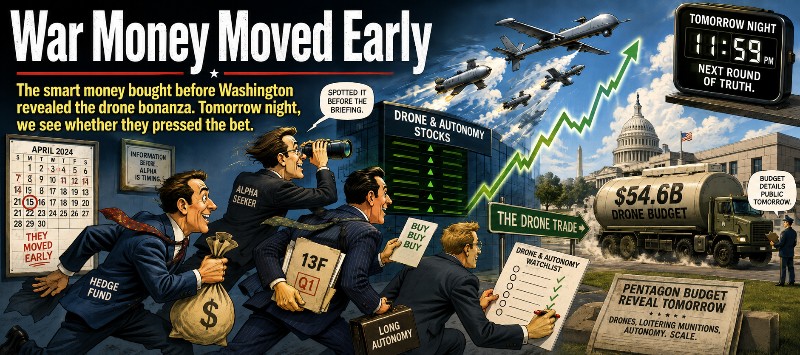
Today, let's read some together. Because here's what most people don't realize about the drone trade: the smart money didn't wait for the Pentagon's $54.6 billion request in April.
The Stampede You Missed
Back in January, The Donald announced a proposed $1.5 trillion defense budget, the biggest topline in American history. No DAWG details yet, no $54.6 billion line item. Just a request, which happened to be the size of a telephone number.
The drone sector didn't wait for the specifics. Pure play autonomy names ripped off their lows in weeks, some of them up 50% or more before the detailed request ever landed. By the time April's budget documents spelled out the DAWG money, the first move had already happened.
Then the first-quarter filings arrived in May and confirmed it. Across the sector, institutions adding drone and autonomy names outnumbered those cutting them. The hedge fund positions in the space climbed quarter over quarter. Specialist funds, the ones that live and breathe defense procurement, opened fresh positions worth 9 figures.
That's the cluster pattern I described yesterday: independent professionals reaching the same conclusion at the same time, before the headline told the tourists what to think.
One Confession, Read Properly
Let's read a single name closely, because it teaches both lessons at once. Take AeroVironment (AVAV), the granddaddy of American small drones.
The bull case is real. Quarterly revenue recently hit $408 million, up 143% from a year ago. The funded backlog sits around $1.1 billion. Institutions own more than 85% of the stock and have been buying at roughly a two-to-one pace over sellers. In July, Wedbush initiated coverage with a $250 target, calling its battlefield-tested product line a moat new entrants can't copy in time.
That's what the whale-watchers will report this weekend. Here's what a lazy 13F reader would miss.
The company also disclosed a financial restatement, a material weakness in its internal controls, a canceled Space Force contract, and a $151 million write-down in its space segment.
Every fund showing up as a "holder" in tomorrow night's filings bought or held through that news. Some did the work and concluded the drone business outruns the accounting mess. Others are tourists who saw "drone stock" and clicked buy. The filing won't tell you which is which. Only position changes over time will, which is why we compare quarters.
One ticker, both lessons. The cluster is the signal. The fine print is the test.
The Giants Are Confessing, Too
Don't sleep on the primes, either.
Lockheed Martin spent its second quarter announcing new missile defense facilities, $1.4 billion in hypersonics work, and fresh counter-drone investments. When the biggest contractor on Earth starts redirecting capital toward stopping cheap drones, that's the fly swatter economics from Monday showing up in a boardroom.
The primes won't give you the violent upside of the small names. But their filings and contract announcements tell you which way the river is flowing.
Two Tailwinds the Budget Headlines Skip
While we're here, two structural facts that make this more than a budget trade.
First, starting January 1, 2027, new Pentagon sourcing rules ban Chinese-made drone parts. In short, DC mandated replacing the supply chain that starts and ends in Shenzhen. That supply shortfall must be made up whether DAWG gets $54 billion or $5.
Second, the Pentagon has started taking direct equity stakes in drone suppliers. Some small names have jumped 50% when the news hit the wires. That’s the USG’s new playbook: Declare a sector vital, fund it with public money, and let private shareholders keep the upside.
We walked through that script in a May Rude edition on the Trump boys and tungsten. As they say in Asia, “Same, same, but different.” As we know, the system rewards those closest to the spigot, and it can turn on in an instant.
Own the Field
Last month, in The Case for Baskets, I mentioned owning sectors instead of headlines. It applies here with force. The drone buildout will mint winners and decimate pretenders.
Sector vehicles now exist for this theme, including a dedicated drone ETF (DRNZ) and the defense sector SPDR (XLI, which holds the big industrials and primes).
Yes, you give up the moonshot. But you also give up the “Lordstown risk” we flagged on Tuesday. For you, that may be a fair trade.
Tomorrow Night's Confessions
The setup for the midnight deadline is clear. The first quarter filings showed the professionals frontrunning the topline announcement. Tomorrow night's filings, covering April through June, answer the question that matters:
After the $54.6 billion made the headlines, did the funds press, trim, or hedge?
Watch for 3 behaviors.
- Did the Q1 clusters add or reduce?
- Did new specialist funds initiate positions in the second tier, the counter-drone and components names, after the request was published?
- Is anyone hedging with puts, the way our young AI manager hedged his semiconductor longs?
Wrap Up
Tomorrow morning, before the deadline, you'll already understand the patterns worth watching.
In fact, why not watch Aaron Gentzler interview Jim Rickards about them if you haven’t already?
Then, as the confessions will pour in before midnight, you'll be able to read those patterns like a professional.

A Crude Awakening
Posted October 23, 2026
By Sean Ring

All That Glitters Is Diesel
Posted October 22, 2026
By Sean Ring

Treason’s Greetings!
Posted October 21, 2026
By Sean Ring

Zach’s Second Opinion
Posted October 20, 2026
By Zach Scheidt

A COLA, But No Smile
Posted October 20, 2026
By Zach Scheidt