Posted May 05, 2026

By Sean Ring
Trumps, Tungsten, and Tax Dollars
Let's talk about tungsten.
It's not glamorous. You won't find it on CNBC. But it has the highest melting point of any metal on earth. Tungsten is critical for armor-piercing rounds, hypersonic weapons, semiconductors, and high-temperature components.
Right now, China controls over 80% of the global supply.
When Beijing restricted tungsten exports earlier this year, the Pentagon got nervous. Prices jumped. Everyone scrambled.
Enter the Trump family.
How the Play Works
Start with a small New York holding company called Skyline Builders Group. Until recently, it had no connection to mining. No one was writing feature stories about it.
Then Donald Trump Jr. and Eric Trump showed up.
The Trump brothers bought into Skyline through an entity linked to Dominari Securities. (They serve on Dominari’s advisory board.) This quiet buying of shares allowed them to build a stake without drawing public scrutiny.
Then the US government became obsessed with tungsten, for entirely legitimate reasons.
The Kazakh Connection
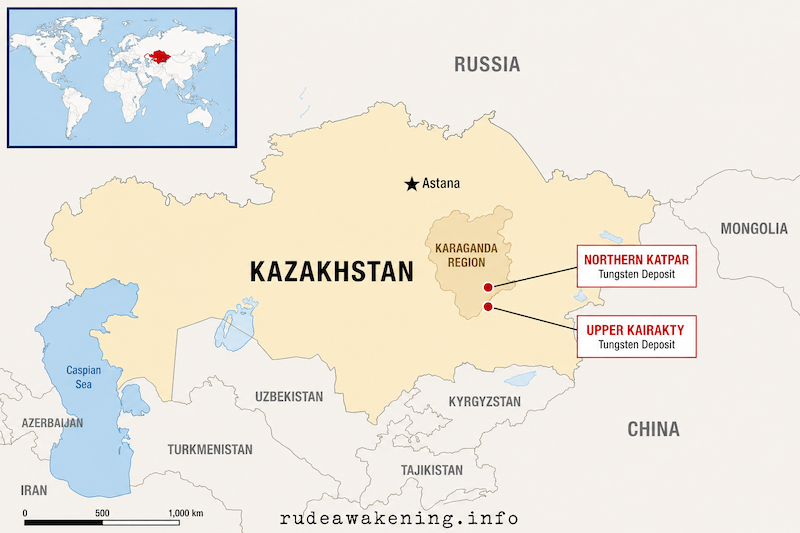
A private firm called Cove Capital, run by Pini Althaus, won the rights to develop what's described as one of the world's largest undeveloped tungsten deposits. The project is located in Kazakhstan, at the deposits known as Northern Katpar and Upper Kairakty. The total development cost is around $1.1 billion. Cove's vehicle gets 70%. Kazakhstan's state miner keeps 30%.
Althaus knows this world well. He previously founded USA Rare Earths, a company that secured over $1.5 billion in US government support for rare-earth projects. The man knows how to talk to defense planners… which means he knows how to unlock government money.
For the Kazakhstan deal, he got more than just financing signals.
He got the full force of the USG behind him.
Pick Me A Winner!
Althaus told the Financial Times that President Trump, Secretary of State Marco Rubio, and Commerce Secretary Howard Lutnick all gave Cove "direct support" to win this deal.
Lutnick, better known as the chief of Cantor Fitzgerald, reportedly sent a personal letter to Kazakhstan's president backing the project.
Once again, DC is picking winners.
Socialized Investment, Private Profit
Once the deal closed, the public financing followed.
The US Export-Import Bank (EXIM) signaled it could provide up to $900 million in project financing. The US International Development Finance Corporation (DFC) indicated it could add up to $700 million more.
Total: up to $1.6 billion in taxpayer-backed loans and guarantees, into a single overseas mining project.
EXIM and DFC aren't charities. They charge fees and expect repayment. But the risk sits with the US government. If the project fails, losses are socialized. If it succeeds, the upside goes to the private shareholders.
Now ask yourself: who are those shareholders?
Skyline Buys In
Shortly after the Kazakhstan deal became public, Skyline Builders, the same small company where the Trump sons had built a position, raised tens of millions of dollars and bought a 20% stake in Kaz Resources, the Cove-controlled entity holding the tungsten assets.
In April 2026, Skyline and Cove Kaz announced a merger to create Kaz Resources Inc., which will seek a Nasdaq listing under the ticker KAZR.
The merged entity will own the 70% project stake and the right to tap that $1.6 billion in US government-supported financing.
The press releases talk about Kazakhstan, critical minerals, and Pini Althaus.
They don't mention Donald Trump Jr. or Eric Trump.
We’ve Seen This Before
Last year, 1789 Capital, where Trump Jr. is a partner, took a stake in Vulcan Elements, a rare-earth magnet startup. Months later, the Pentagon's Office of Strategic Capital handed Vulcan a $620 million loan plus a $50 million equity-style injection. It’s the largest package the office has ever granted.
The drone manufacturer Powerus reportedly received backing from the Trump family before the launch of an $1.1 billion federal drone program.
The script is the same every time. The sons take equity in a small or obscure company. The administration declares the sector "strategic." Government financing pours in. The stock re-rates. The family wins.
Wrap Up
None of this requires a smoking gun. No one needs to prove a back-room quid pro quo. The mechanics are hiding in plain sight.
The US is genuinely vulnerable to a tungsten shortage. China dominates the market. Kazakhstan has the deposits. The Pentagon needs the supply.
But "America needs tungsten" and "the president's sons should profit from it" are two very different propositions.
DC has always blended policy and profit. That's nothing new. What's different here is the speed, the scale, and the directness of the connection between White House decisions and family portfolios.
You're being told this is industrial policy.

A Crude Awakening
Posted October 23, 2026
By Sean Ring

All That Glitters Is Diesel
Posted October 22, 2026
By Sean Ring

Treason’s Greetings!
Posted October 21, 2026
By Sean Ring

Zach’s Second Opinion
Posted October 20, 2026
By Zach Scheidt

A COLA, But No Smile
Posted October 20, 2026
By Zach Scheidt