Posted August 04, 2026

By Sean Ring
The Hidden Diesel Tax
Last week, I asked my grads to build a spreadsheet.
It was simple. Three barrels of crude go in. Two barrels of gasoline and one barrel of diesel come out. We plugged in real EIA prices: $84 oil, $4.10 gas, $5.30 diesel.
The math nearly knocked them out of their chairs.
That barrel of crude costs a refiner $252. Turn it into fuel, and you get $567 worth of gasoline and diesel. Gross profit: $315 per three barrels, or $105 per barrel of crude processed.
I built that spreadsheet to teach a lesson about refining economics. I didn't expect Goldman Sachs to confirm it 3 days later.
The Trade Nobody's Hiding
My colleague Matt Badiali wrote about this same math in the Rude last week. He tracks something called the oil-to-gas ratio: how many gallons of gasoline it takes to buy one barrel of crude. Since 1990, that number averages 34. On July 6, it hit 23.
That's the fifth-lowest reading since 1984. In plain English, gasoline is expensive relative to oil. And when that gap widens, refiners don't lose. They win. Big.
You can see it in the charts. Valero, PBF Energy, and HF Sinclair all broke out of months of sideways trading in the last few months, right as crack spreads blew out. The VanEck Oil Refiners ETF (CRAK) is telling the same story. Wall Street already expects a blowout earnings season.
Then Goldman put out a note that made the same point from a completely different angle: supply.
Goldman Finds the Choke Point
Goldman's commodity team built a new model tracking global refinery output. Their finding: global refinery runs fell 6.5 million barrels a day from a year ago, driven by outages in Russia, chaos in the Gulf, and weak Chinese processing. U.S. refiners are running flat out, above 97% of capacity, the highest since 2018. But it's not nearly enough to cover the shortfall.
Goldman’s conclusion, in their own words: diesel is “at the epicenter of the supply squeeze.” Global diesel exports have dropped 35% year over year. European diesel futures just hit a three-month high.
Two separate research shops, using two separate methods, landed on the same target: diesel and gasoline are scarce, refiners are the toll collectors, and this isn't ending soon.
My students flagged something similar in a research note their bank published that I couldn’t access.
Why This Isn't Just a Trade Idea
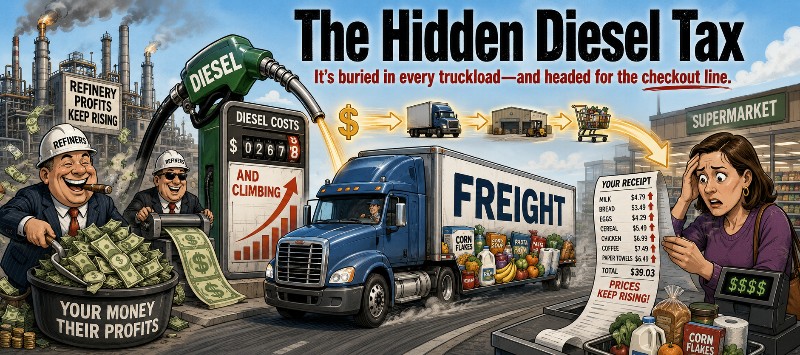
Diesel is the fuel that moves almost everything you own from a warehouse to a shelf. Trucks haul roughly 70% of America's freight, and diesel is their only option. When the price of diesel goes up, freight costs go up, whatever material the shipper is hauling.
That’s the Diesel Floor. No matter what happens with rent, wages, or used cars, if the truck that hauled your groceries paid a fortune for fuel, that cost shows up somewhere on the shelf. It's baked in before the product ever reaches the register.
And right now, it's real. Truckload spot rates hit an all-time high this summer near $3.83 a mile, with fuel surcharges running well above last year's levels. Some carriers with cost-plus fuel contracts are pocketing an estimated 11 cents a mile in extra margin, a nice windfall for whoever sits closest to the pump. Everyone downstream just pays the bill.
This is the Cantillon Effect again, the same mechanism I've written about before. New scarcity, like new money, doesn't hit everyone evenly. It rewards whoever's closest to the source and taxes everyone standing in line behind them.
Why the Fed Can't Cut
We already know the USG wants lower rates. We already know Kevin Warsh, the new Fed chairman, has held the line anyway. This is a big reason why.
Diesel-driven freight costs move through the economy slowly. They show up in trucking invoices before they show up in official inflation data. If crack spreads and freight rates stay this hot into the fall shipping season, the Fed gets handed a stubborn, physical, hard-to-ignore reason to keep rates right where they are.
A central bank can print money, but it can’t print diesel.
An Honest Caveat
Matt B’s warning is worth repeating.
The trade is crowded. If demand falls hard enough, gas and diesel prices will follow, and refiner margins will shrink.
But that's a story about the trade, not about inflation itself. Even if refiner stocks roll over next quarter, the diesel cost under everyday prices won’t go away until supply genuinely loosens.
Wrap Up
The price of moving a box in a truck says diesel price inflation is a problem, and physics and geopolitics set the price.

A Crude Awakening
Posted October 23, 2026
By Sean Ring

All That Glitters Is Diesel
Posted October 22, 2026
By Sean Ring

Treason’s Greetings!
Posted October 21, 2026
By Sean Ring

Zach’s Second Opinion
Posted October 20, 2026
By Zach Scheidt

A COLA, But No Smile
Posted October 20, 2026
By Zach Scheidt