Posted July 28, 2026

By Matt Badiali
The Last Great Crack
Refiners are quietly raking in the cash. That may seem counterintuitive, with oil prices up due to the wars. But one of the best times to pad their margins happens when consumers expect to pay more.
That’s where we are right now.
The wars in Iran and Ukraine have oil prices in the headlines every day. The main shipping lane in the Middle East is a war zone. And Yemeni soldiers shot up two Saudi Arabian oil tankers in the Red Sea.
All that points to higher prices at the pump. But what if I told you that we are at an all-time extreme for refining profits…
Let me show you what I mean.
Cracking the Barrel
A barrel of oil contains 42 gallons of liquid. If we divide the price of a barrel of oil by the price of a gallon of gasoline, we get a simple Oil to Gas ratio. It’s not perfect, because it doesn’t account for the prices of the other distillates. But for rough data, it’s great.
Another way to think of this is how many gallons of gasoline it takes to buy one barrel of oil. The average oil-to-gas ratio since 1990 is 34 gallons of gasoline to buy 1 barrel of oil.
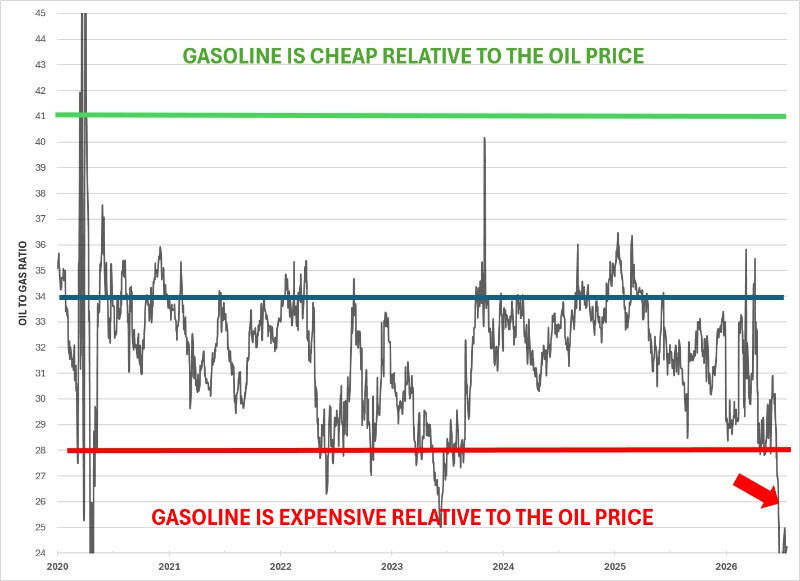
Statistically, 95% of the data falls between 28 on the low side and 41 on the high side.
Above 41, gasoline is cheap compared to the oil price. Below 28, gasoline is expensive. Since 2005, gasoline has been expensive more often than it was cheap. Those are periods when refiners are making more money than usual.
You can see the period in 2020, when refiners clawed back profits after the COVID lockdown. And then the refiners claimed “constrained global refining capacity” to put the spurs to us again from 2022 to 2023. Now, the refiners have the Iran war as an excuse.
On July 6, 2026, the Oil to Gas ratio hit 23. That’s tied for the 5th lowest level since 1984. In other words, refiners are gouging the heck out of us today. And that will show up in their earnings.
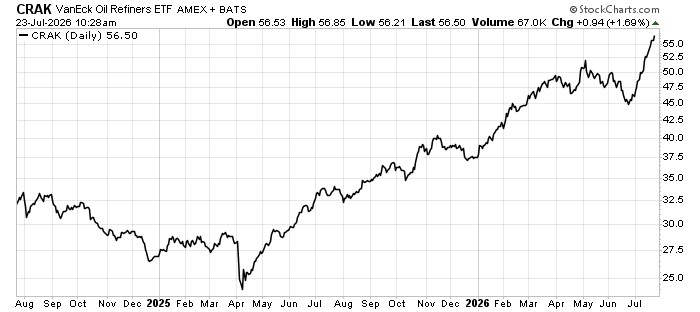
The major refiners begin reporting at the end of July. Investors think this will be a good quarter for the group, as you can see from the chart of the VanEck Oil Refiners ETF (NYSE: CRAK):
A Crowded Trade
Everyone is on the long side of this trade. It’s all over the headlines. Bloomberg, Forbes, and Reuters all post about it weekly (if not daily). It’s super popular right now.
I agree with them, but (and it’s a major BUT), I don’t think it will last.
The saying in commodities is that the cure for high prices is high prices. When stuff gets expensive, we buy less of it. And gasoline has a long history of high prices killing demand.
The U.S. consumes about 35% to 40% of the world’s gasoline production. And most of that consumption (over 90%) is average joes driving our cars.
But here’s the thing. The average joes feel pinched right now. Everything costs more, particularly the stuff we buy every day. I cruised through my local grocery store (Publix) the other day, checking prices. An 8-pack of Bounty paper towels costs $30.
Paper towels! And a box of cereal topped $6. Holy food inflation! Those prices began to hit the market. Two major retailers announced revised earnings recently.
Giant grocery store chain Albertsons and ag supply store Tractor Supply both cut guidance for the rest of the year. According to Bloomberg:
Tractor Supply Co. cut its guidance for the remainder of its fiscal year and withdrew its longer-term outlook as shoppers continue to pull back from bigger-ticket purchases and discretionary spending on goods like seasonal items and pet toys and treats.
The Albertsons executives said,
…the company expects to see additional cost pressure from suppliers in the second half of the year and that other grocers are investing more in prices. Low-income households continue to experience the most pronounced pressure.
Wrap Up
Those two bits of information are like tremors in a major fault zone. You better believe that this chart of Albertsons foreshadows a lot of retailers:
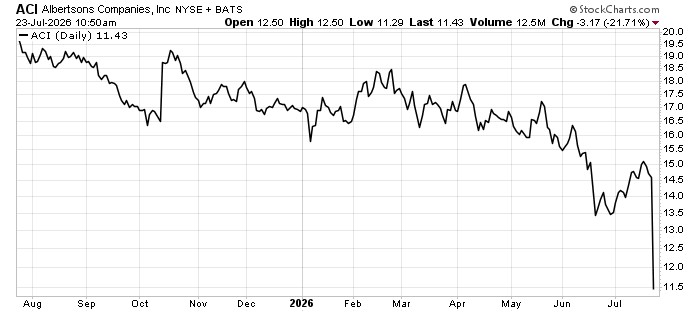
And I fully expect refiners to get here too. So, if you are long refiners, it may be time to look for an exit. And if you are so inclined, it may be time to look for short positions among the group.

A Crude Awakening
Posted October 23, 2026
By Sean Ring

All That Glitters Is Diesel
Posted October 22, 2026
By Sean Ring

Treason’s Greetings!
Posted October 21, 2026
By Sean Ring

Zach’s Second Opinion
Posted October 20, 2026
By Zach Scheidt
A COLA, But No Smile
Posted October 20, 2026
By Zach Scheidt