Posted October 12, 2026

By Sean Ring
The Crusade That Never Paid
I know, I know. The last thing you wanted to see this morning was yet another Columbus article.
And I swear, I wasn’t going to write one. (Trump buying Russian oil is a bigger story I’ll delve into tomorrow.)
But last week, I finished reading a book that blew my mind… and I’ve just got to tell you about it.
That book is Raymond Ibrahim’s Sword and Scimitar, and I can’t recommend it enough. It chronicles the 8 decisive battles between Christendom and the Islamic world.
I had long known that the conquest of North Africa, Spain, Portugal, and the Balkans was a blood-drenched invasion of an amazing world. And there’s much to talk about on that front.
But I’m going to skip that for today and talk about an episode Ibrahim brings up that I certainly wasn’t taught in school and didn't know anything about.
A Business Plan For a Holy War
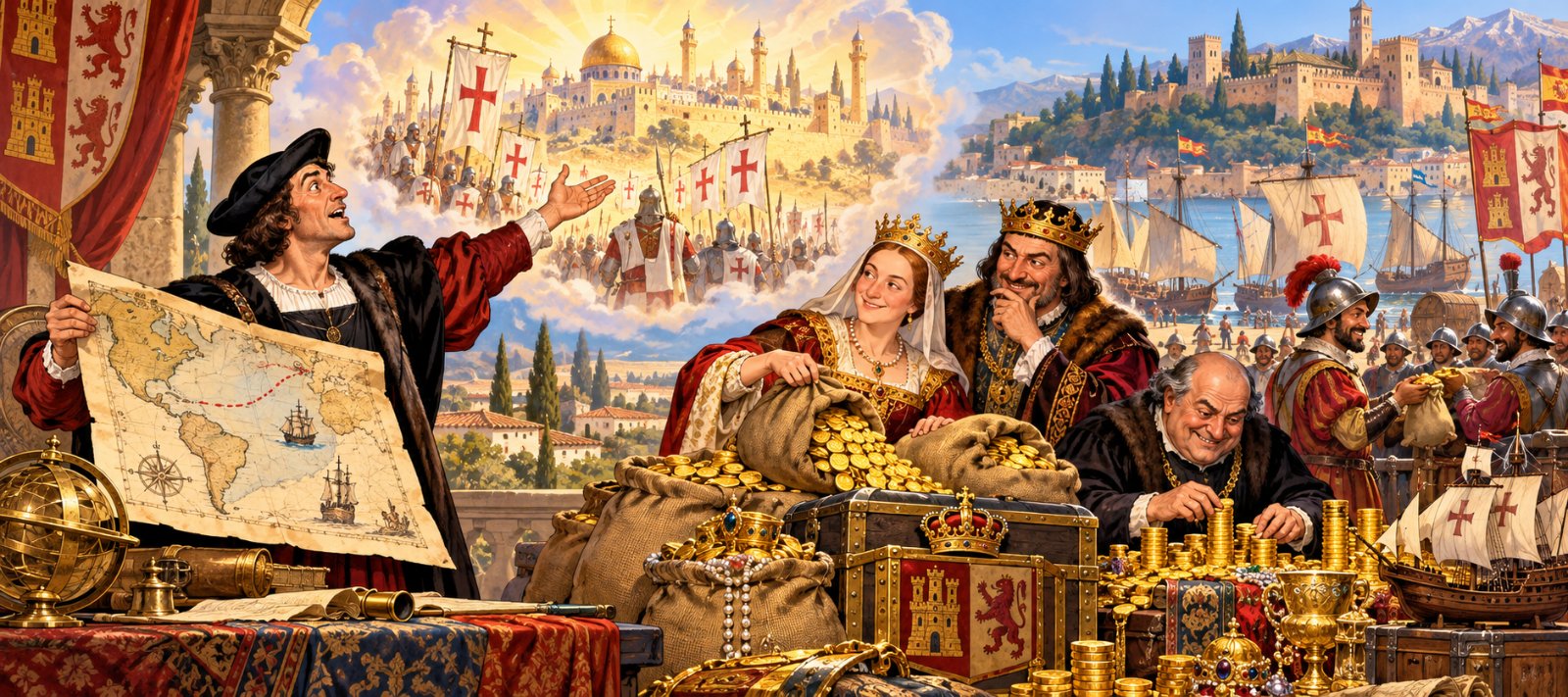
Columbus wrote that Spain’s Queen Isabella and King Ferdinand laughed and said they liked his idea, an idea my history teachers never told me.
How’s this for a shock: Columbus’s idea was that every penny of profit from his voyage would go to… the conquest of Jerusalem.
In his book, Ibrahim writes that many Europeans believed that if they could reach the peoples east of Islam (in Asia), “together they could crush Islam between them.” Quoting another historian, he calls the voyage an effort to launch “a final and definite Crusade against Islam by way of the Indies.”
Surely that would’ve been history’s greatest squeeze play.
The Squeeze Play
Constantinople (present-day Istanbul) fell to the Ottoman Turks in 1453. Ferdinand and Isabella took Granada (in Andalusia) 39 years later.
Columbus was there when it happened. He opened his log of the first voyage with the scene. On January 2, 1492, he watched the royal banners rise over the Alhambra. The last Muslim king in Spain came out to kiss the monarchs’ hands.
Then Columbus turned to his mission. He called the monarchs “enemies to the sect of Mahoma and to all idolatries and heresies.” He wrote of a prince in the East called the “Gran Can,” meaning “King of Kings.” This ruler and his forefathers had asked Rome many times to send teachers of the faith. Rome never did.
So the Crown sent Columbus, with letters for the Great Khan.
The squeeze play behind that mission was centuries old. Europe had long dreamed of a Christian king beyond Islam, the fabled Prester John, who would march west and strike Islam from behind.
In 1289, Argun, the Mongol ruler of Persia, wrote to the King of France. He offered to take Jerusalem together.
Portugal ran the same play down the coast of Africa. Prince Henry the Navigator’s chronicler wrote that Henry sent ships to learn whether Christian princes in those parts would aid him against the enemies of the faith.
Columbus sought the same ally by sailing the other way.
A Caveat…
Ibrahim writes that the monarchs sent Columbus to see how the people of the Indies “can help in the war effort.” Those words are his summary. Columbus’s log says he was sent to see the princes, their cities, and their lands, and how they might be converted to the faith.
The conversion had to come first. An ally might come later. It’s a technicality, but an important one.
And Columbus’s view of China was outdated. The Mongol khans had lost it in 1368, 124 years before he sailed. Marco Polo’s China no longer existed.
The Use of Proceeds
On Christmas Day, 1492, the Santa Maria ran aground off Hispaniola. The next day, Columbus wrote in his log that he hoped the men he’d leave behind would find enough gold that the Crown could prepare to take the Holy Sepulchre within 3 years.
Then he reminded his backers of his pledge. “I protest to your Highnesses that all the profits of this my enterprise may be spent in the conquest of Jerusalem.” That’s when they laughed and said it pleased them. They added that they’d wanted it anyway.
In March 1493, Columbus reached Lisbon on the way home. He wrote to the monarchs again. A copy of that letter turned up in the 1980s, and Ibrahim cites it, too. Columbus offered to raise an army “for the war and conquest of Jerusalem.” He said that within 7 years, he could pay for 5,000 cavalry and 50,000 infantry.
He never let it go. In 1503, sick, broke, and shipwrecked on Jamaica, Columbus wrote that Christian hands would rebuild Jerusalem and Mount Zion.
So did Columbus write to Ferdinand and Isabella about a war on Islam? Yes, more than once.
But Columbus didn’t ask the Khan to raise an army. Columbus offered to fund one from the West, with Indies gold. The squeeze play was the dream, but the money was the plan.
But the Gold Went Elsewhere…
Columbus thought his use-of-proceeds pledge would bind the people who held the money.
Ferdinand laughed and said yes. But a king doesn’t spend on a sailor’s dream. A king spends on the people who keep him on the throne. Ferdinand had nobles to reward, wars in Italy to win, and North African coasts to guard. A crusade 2,000 miles away didn’t pay any of those bills.
So in 1501, Ferdinand did the practical thing. He sent the scholar Peter Martyr d'Anghiera to Cairo to bargain with the Sultan to protect pilgrims and the holy sites. In return, the Spanish would help protect the Egyptian Mamluks against the threat of the Ottoman Turks. Ferdinand had chosen diplomacy over a crusade.
Meanwhile, the New World’s gold and silver poured into Seville. Those nearest the spigot, the Crown and its bankers, got the wealth first. Everyone else got the higher prices that followed. That’s the venerable Cantillon effect in action again: new money enriches whoever grabs it first.
Eventually, some of that silver did fight the Ottomans. It helped pay for the fleet that won at Lepanto in 1571. But most of it went to Spain’s wars in Europe and to the Genoese bankers who lent against it. Columbus’s hometown got its cut after all.
Still sure he’d reached Asia, still waiting for his crusade, Columbus died in 1506.
Wrap Up
Ibrahim was right about the squeeze play.
It was Europe’s oldest strategic dream. He’s right that Columbus wrote to his monarchs about a war for Jerusalem. He leans a little far in making the Indies a war ally. The log speaks of converts. With Columbus’s own math, gold would pay for the crusade.
The gold went where gold always goes. A founder can promise anything about where the money will go. The one who holds the capital decides. It was true in Seville in 1493, and it’s true in The Swamp today.
Still, if they taught this story about Columbus, rather than the boring old Nina, Pinta, and Santa Maria stuff, many more students would be interested in their history classes.
Have a lovely day!
No Farewell to Arms
Posted October 09, 2026
By Sean Ring

Just Blew It.
Posted October 08, 2026
By Sean Ring

Fission Accomplished?
Posted October 07, 2026
By Sean Ring

The Lease of Their Worries
Posted October 06, 2026
By Sean Ring

You Can’t Print a Smelter
Posted October 05, 2026
By Sean Ring
