Posted October 09, 2026

By Sean Ring
No Farewell to Arms
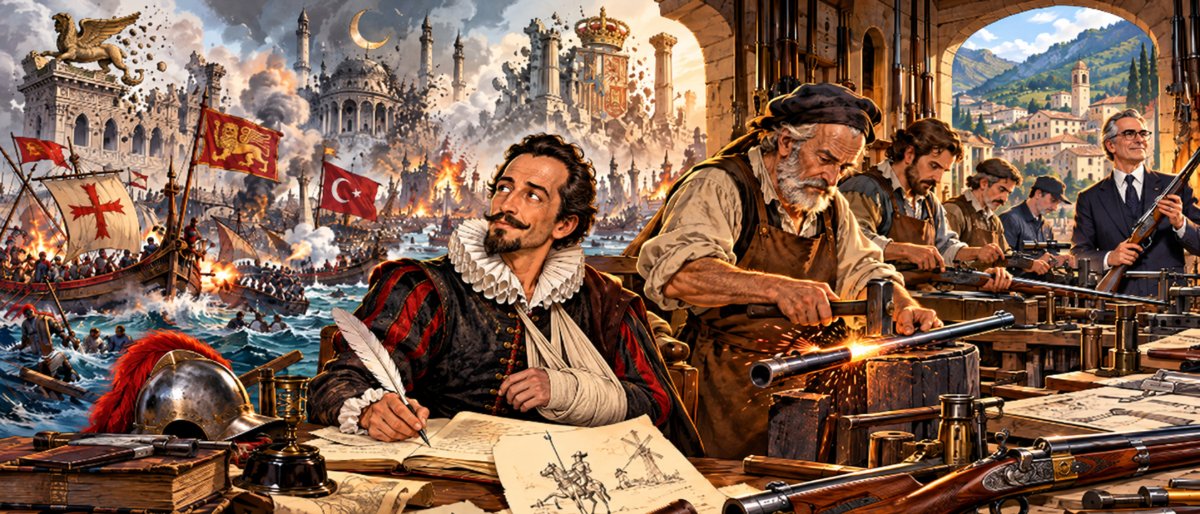
On the morning of October 7, 1571, a 24-year-old Spanish soldier lay below his ship’s deck with a fever.
His captain told him to stay put. But Miguel de Cervantes, who would one day write Don Quixote, refused. By his own account, he said he’d rather die for God and his king than hide from the fight. So he took a skiff and 12 men and sailed into battle.
By nightfall, 2 bullets were buried in his chest. A third bullet forever cost him the use of his left hand.
But, by God, he had just fought in the greatest sea battle of his age and would live to tell the tale. Luckily for us, his side - or I should say, our side - won that battle.
The people who came out ahead after the Battle of Lepanto, fought 455 years and 2 days ago, weren’t the admirals or the emperors. They were a future author and a family of gunsmiths from a valley near Brescia. Last week, that family’s company turned 500.
The Biggest Win in a Century
In 1570, the Ottoman Turks invaded Cyprus and besieged Famagusta, Venice’s richest colony. Pope Pius V answered by creating the Holy League. Spain, Venice, the Papal States, Genoa, the Knights of Malta, and a few others signed on.
Don John of Austria, the half-brother of Spain’s King Philip II, took command of the fleet. He was 24, the same age as Cervantes. Venice sent Sebastiano Venier, a tough-as-leather patrician in his seventies. The Ottoman fleet sailed under Ali Pasha.
They met in battle just off the coast of Lepanto (called Nafpaktos in Greece), near where the Gulf of Patras meets the Gulf of Corinth. More than 400 galleys crashed together in battle.
Venice brought a secret weapon: 6 galleasses. These floating gun platforms tore holes in the Turkish line before the boarding started. After that, it was hand-to-hand fighting, from deck to deck, through impenetrable smoke.
When the Muslim sailors saw Ali Pasha’s severed head lofted upon a spike on his own flagship, they knew the battle was lost. The Ottomans lowered their sacred standard for the first time in history.
As many as 30,000 Ottoman sailors and soldiers died with him. About 12,000 Christian galley slaves walked free.
Rome rang its bells, with Pius V crediting the Rosary. The Church still keeps October 7 as the feast of Our Lady of the Rosary.
The Ottoman navy had looked unbeatable, but all you need is one loss to dispel a myth.
Then the Bill Came Due
Unfortunately, the League didn’t retake Cyprus, and it didn’t sail on Constantinople. It argued. Spain wanted to strike North Africa. Venice wanted Cyprus back. Pius V died in May 1572, and the glue holding the alliance died with him.
Meanwhile, the Turks got back to work. By some counts, Istanbul’s shipyards had launched about 150 new galleys by the spring of 1573.
Grand Vizier Sokollu Mehmed Pasha spelled it out for Venice’s envoy. As the story goes, he said Venice had only shaved the Sultan’s beard. But by taking Cyprus, the Turks had cut off Venice’s arm.
As it turns out, Venice signed a separate peace in March 1573. It gave up Cyprus and paid the Sultan 300,000 ducats for his trouble.
Why did the “winners” pay the “losers”?
Venice was a merchant republic. Its ruling families lived on trade with the East. Every month of war meant empty warehouses. They did what they had to do.
Spain wasn’t in great shape either. Even its South American silver mines couldn’t save its fiscal situation. Philip II defaulted on his debts in 1575, for the third time in his reign.
To be fair, even though the Ottomans rebuilt their ships, they lost so much at Lepanto that their navy was never the same again.
So who came out ahead?
Winner #1: The Gunmaker
On October 3, 1526, the Venice Arsenal paid 296 ducats to a master barrel maker from Gardone Val Trompia named Bartolomeo Beretta. He delivered 185 arquebus barrels (for the long guns). The record of that payment still sits in the State Archives of Venice.
Gardone was Venetian land back then. Beretta tradition holds that the family’s barrels armed the Venetian fleet at Lepanto 45 years later. No receipt proves it. But the Republic bought its barrels from Gardone, and the Berettas made them.
Napoleon ended the Republic of Venice in 1797. Thankfully, the Ottoman Empire is also gone. Philip II’s Spain went broke again and again.
And yet, Beretta is still in Gardone. The family still runs it, now in its 15th and 16th generations. This month, it marks 500 years in business.
How? By planning in generations, instead of quarters. Today’s CEOs should take note.
Economists call this low time preference. You value tomorrow more than today, so you build instead of splurge. The Berettas have done this since the 16th century.
The Lindy Effect is defined as “the longer something has lasted, the longer it’s likely to last.” This 500-year-old business has outlived everything that tried to kill it. Long may it continue… and it probably will.
Winner #2: The One-Handed Writer
Cervantes didn’t get rich from Lepanto. In fact, it was only the start of his troubles.
In 1575, Barbary pirates seized his ship on the way home to Spain. He spent 5 years as a slave in Algiers and tried to escape 4 times. In 1580, the Trinitarians, a Catholic order that ransomed captives, paid 500 gold escudos and brought him home.
Later, the Crown made him a tax collector. In 1597, he left the king’s tax money with a banker. The banker went bust, and Cervantes paid for it by going to jail in Seville.
History has a sense of humor.
In the prologue to Don Quixote, Cervantes hints that the book was born in a prison. Tradition says it was that one. What many call the first modern novel came out in 1605.
Once, a man mocked the aged Cervantes as old and maimed. Cervantes replied:
What I cannot help resenting is that he calls me old and one-handed, as if it had been in my power to stop time from passing over me, or as if my maiming had been born in some tavern brawl, and not in the highest occasion the past and present ages have seen, or future ones hope to see.
History’s greatest writers aren’t born, but made from events that steel their characters.
Wrap Up
Every age has its Lepantos: a victory, happy headlines, and celebrations in the streets. But out of the public eye, the scorecard tells a different tale.
Sure, the admirals got the paintings and the Sultan got Cyprus.
But the real returns went to the ones who played the long game. One was a family that built something its descendants still run. The other was a broken soldier who turned his worst years into one of literature's greatest works.
This week, the Church marked the feast of Our Lady of the Rosary, as it has for more than 4 centuries.
But now, Venice is a tourist-infested open-air museum and the sultans have been consigned to history’s dustbin.
And yet, Beretta still forges barrels in the same valley, and Don Quixote is still in print.
Now that’s legacy.

Just Blew It.
Posted October 08, 2026
By Sean Ring

Fission Accomplished?
Posted October 07, 2026
By Sean Ring

The Lease of Their Worries
Posted October 06, 2026
By Sean Ring

You Can’t Print a Smelter
Posted October 05, 2026
By Sean Ring

Pardon My Financial French
Posted October 02, 2026
By Sean Ring