Posted October 05, 2026

By Sean Ring
You Can’t Print a Smelter
In 1575, the most powerful man on earth stopped paying his bankers.
Even for a king, that’s never a good idea.
Philip II of Spain ruled an empire that stretched around the globe. He possessed Europe’s finest infantry. His silver mines in Potosí (present-day Bolivia) delivered unimaginable treasure across the Atlantic. On paper, no prince alive was richer.
And yet, he defaulted on his debts, not once, but 4 times: in 1557, 1560, 1575, and 1596.
Many of his lenders were Genovese. Genoa is just over an hour’s drive from my farmhouse in the Piedmont, and the grand palaces of its old banking families still line Via Garibaldi. Those families got rich lending to a king who couldn’t balance his country’s books.
The situation posed one of history’s greatest questions.
How does an empire up to its ears in silver go broke?
The answer has two parts. Historian, author, and professor Niall Ferguson gave us the first. Last week, macro analyst Luke Gromen pointed at the second. Together, they paint a picture of America that eludes network news.
The Money Ledger
A senior fellow at the Hoover Institution, Ferguson studied the great powers from the 1500s to the present. He boiled it down to one rule. Any great power that spends more on debt service than on defense risks its great power status.
He calls it Ferguson’s Law.
His logic is simple. Interest is the one expense you can’t skip. However, defense is one you can. When money gets scarce, the bondholders still get paid while the generals tap their fingers waiting.
Bourbon France is the classic case. In 1788, debt service was eating more than half the royal budget. By 1789, the horrendous French Revolution was in full swing.
Sadly, the United States crossed that line in 2024. In fiscal 2025, the Congressional Budget Office (CBO) pegged net interest at $970 billion and defense at $893 billion. For fiscal 2026, which ended last week, the CBO projected about $1.04 trillion in interest against $885 billion for defense.
Interest now trails only Social Security in the federal budget. (And we know Social Security isn’t going anywhere, either.)
That’s the first ledger. It’s ugly enough, but it’s not the whole story.
The Metal Ledger
Gromen’s argument runs like this. The dollar’s role as the world’s reserve currency hollowed out American industry. Shortsighted neoliberals handed the title of “the world’s workshop” to China. It seems like common sense, but they didn’t see that a hegemon that can’t build its own weaponry doesn’t stay a hegemon for long.
He made the point by sharing a chart on aluminum. Between 2005 and 2024, China's primary aluminum output grew more than 5x(!), to over 40 million tons a year. American output fell by about 73%. The U.S. Geological Survey puts our 2025 production at roughly 660,000 tons. China makes that much in under a week.
In 1980, America ran 33 primary smelters. Today, only a few still pour aluminum.
Why should we care?
Because aluminum is a war metal used in fighter jets, missiles, armored vehicles, and ships. The same story shows up in the shipyards. A 2023 Navy intelligence slide put China’s shipbuilding capacity at about 232x America’s. That figure counts commercial yards, so it overstates the naval gap. But even a fraction of that number would keep admirals awake at night.
Ferguson’s Law reads the money. This part, the metal ledger, reads what a nation can actually produce when the shooting starts.
Spain’s Silver and America’s Dollar
Let’s return to Spain for a second.
Spain had the world’s money. Silver poured in from the Americas. With so much silver, it was cheaper to buy cloth, tools, and goods from abroad than to make them at home. So Spain bought. The silver flowed out to Genoa, Antwerp, and beyond. Spanish workshops closed down.
Spain may have held the money, but others held the production.
The dollar is our Potosí. Because the whole world needs dollars, we can print them and trade them for goods. It’s so much easier than mining metals, aye!
Of course, that feels like real wealth. And in many ways, it is. But every year we do it, the trade makes it a little cheaper to import a smelter’s output than to run a smelter ourselves. Our plants closed one by one, and the skills went with them. We don’t call it a “Rust Belt” for nothing.
Our problem is that capital consumption doesn’t announce itself. It just shows up one day as an empty factory, a desolate city, and, worst of all, a hollowed-out region.
Nobody Saw This Coming (But Should’ve)...
Every choice along the way made sense to the people making it.
Cheap imports kept prices low for voters. Foreign buyers of Treasuries kept borrowing costs down. A closed smelter in Kentucky cost a few hundred jobs. No politician ever won an election by saving an aluminum potline.
The bill for those choices landed later, on both ledgers at once.
Wrap Up
Thankfully, Ferguson says crossing the line isn’t destiny.
The UK proves it. After Wellington and Blücher ended Napoleon’s reign in 1815 at the Battle of Waterloo, British debt topped 200% of GDP. But London didn’t default, nor did it inflate the debt away.
The UK grew out of the hole.
How? Britain was the workshop of the world. Its factories and productivity paid off the debt.
So history proves that a country can survive a bad money ledger if its metal ledger is strong. Spain had the silver and lost. The Brits had the factories and won.
Luckily for us, the metal ledger is starting to turn.
Century Aluminum restarted idled potlines at its Mount Holly smelter in South Carolina this year. DC now treats metals, ships, and shells as matters of national security.
In this case, it’s certainly “better late than never.”

Pardon My Financial French
Posted October 02, 2026
By Sean Ring

For Whom the Debt Tolls
Posted October 01, 2026
By Sean Ring

Spend It Like You Stole It
Posted September 30, 2026
By Sean Ring
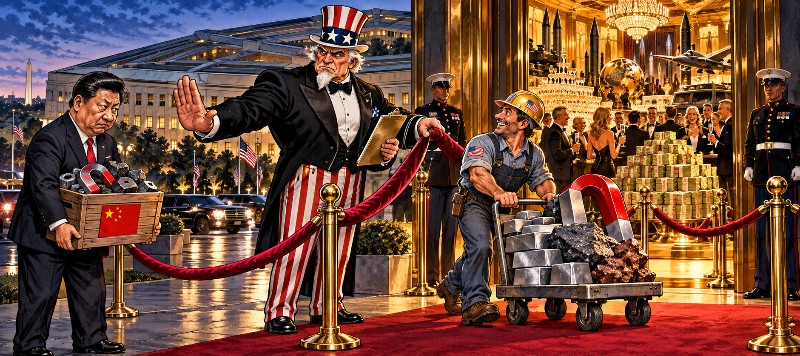
The Pentagon’s Velvet Rope
Posted September 29, 2026
By Sean Ring

From Athens with Contempt
Posted September 28, 2026
By Sean Ring