Posted April 29, 2026

By Sean Ring
Five Cent Bull
Most people see nickel and think of two things: the coin in their pocket and the stainless-steel sink in their kitchen.
But that’s just a small part of what nickel does for us.
It’s one of the most strategic metals on Earth. It builds skyscrapers, powers fighter jets, and runs through the guts of every premium electric vehicle. Right now, it's quietly ripping higher while everyone stares at gold and silver, hoping they’ll get back to their old highs.
Nickel futures just hit a near two-year high, trading above $19,200 per tonne. That's up over 11% in a month and 23% in a year.
Let me tell you why this run has legs.
What Nickel Does
Nickel is a hard, silvery transition metal. On its own, it's as dull as dishwater. But mix it into steel or other alloys and magic happens.
It resists rust. It handles brutal heat. It bends without breaking.
About 2/3rds of all nickel ends up in stainless steel. Think buildings, bridges, kitchen appliances, hospital equipment, and food-processing plants. If it needs to last decades without corroding, it has nickel in it.
Another big chunk goes into superalloys. These are the exotic metals that line jet engines, gas turbines, and chemical reactors. Without nickel, modern aviation doesn't fly, and modern power plants don't generate.
Then there's the new kid on the block: batteries.
High-nickel cathodes power the long-range EVs that command a premium. Tesla, BMW, and Mercedes want this nickel-rich chemistry. As EV penetration and grid storage scale, battery-grade nickel demand grows with them.
The Bull Case Gets Louder
Nickel has been a frustrating trade recently. Indonesia flooded the market with cheap supply. Prices crashed. Western mines shut down. The last time I wrote about nickel was in 2024 when political unrest gripped New Caladonia.
But the tide is turning. Here's what's changed.
Indonesia is tightening the screws. The country dominates global supply, and it just raised its ore pricing framework. Mining quotas are getting cut. Production costs are rising. The cheap-supply story is breaking down.
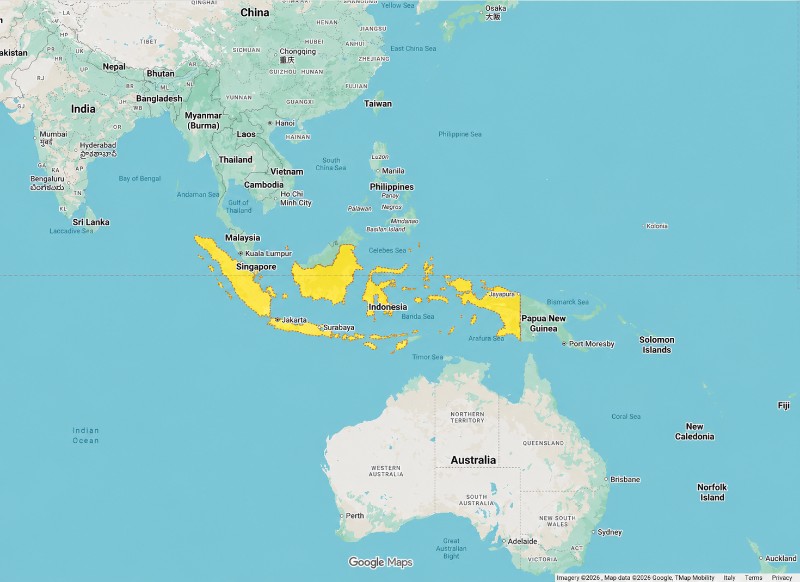 Map of Indonesia (highlighted in yellow); Source: Google Maps
The Strait of Hormuz is back in the headlines. Sulfur shortages tied to shipping disruptions in the Strait have raised processing costs for nickel intermediates. Every barrel of trouble in the Persian Gulf adds another dollar to nickel's price floor.
The market is flipping into deficit. The International Nickel Study Group now projects a small global deficit in 2026, reversing this year's surplus. That's a major pivot.
Western supply is broken. New sulfide deposits are scarce and sit in tough jurisdictions. The Indonesian HPAL projects that replaced them are capital-intensive and technically risky. Analysts say nickel needs to hit $20,000–22,000 per tonne to bring curtailed Western mines back online.
Guess what the price is doing now?
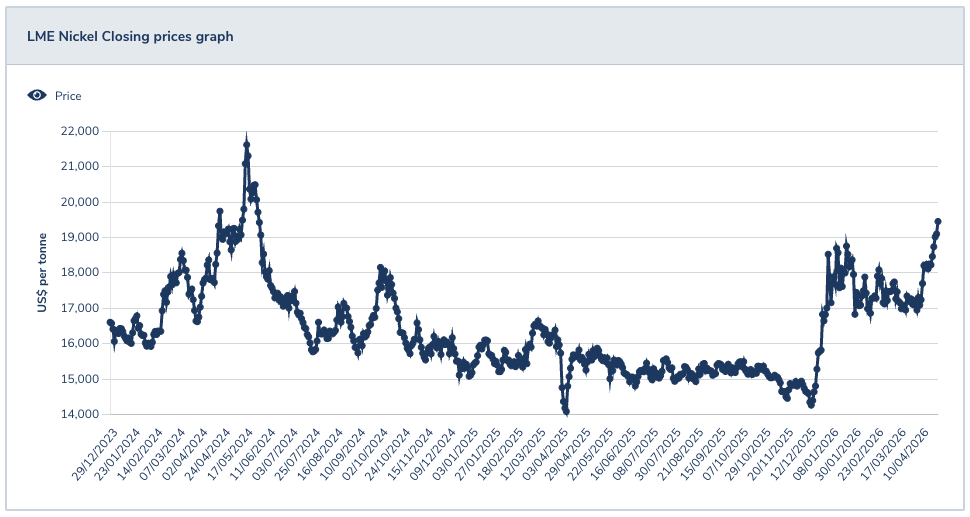 Credit: LME
From a chart perspective, nickel just broke through the previous high level of 18,700. The next significant stop is the previous high of 22,000. Once we get through there, 30,000 is no longer a pipe dream.
The Quality Split
Here's the wrinkle that makes nickel interesting.
Not all nickel is equal. The Indonesian flood is mostly low-grade, high-emission material. Battery-grade Class 1 nickel — the clean, pure stuff — is a different beast.
The U.S., the EU, and allies are tightening rules on traceable, low-carbon supply chains. Carbon border taxes. Sourcing mandates. Defense procurement rules.
This effectively splits the market into two. Cheap "dirty" nickel for stainless steel. Premium clean nickel for batteries, defense, and Western supply chains.
That second bucket is structurally tight. And politically protected.
The Risk Premium
Look at where nickel comes from: Indonesia, the Philippines, Russia, and New Caledonia.
That's not exactly a list of friendly democracies.
Russia is sanctioned. Indonesia bans ore exports and demands local processing. The Philippines flirts with environmental shutdowns. China finances most of the new Indonesian capacity.
Now layer in nickel's role in defense. Naval vessels. Aircraft. Missile systems. Nuclear infrastructure. Hydrogen plants. Carbon capture. Every modern security and energy project needs nickel.
Governments are waking up. They're classifying nickel as a critical mineral. They're stockpiling. They're subsidizing domestic projects.
When Washington and Brussels start writing checks for "strategic supply," prices don't go down.
A few opportunities for nickel investing include NIKL, the Sprott Nickel Miners ETF. If you don’t like ETFs, three of NIKL’s biggest holdings are the Australian-listed Nickel Industries Ltd. (ASX: NIC), which just broke out to new highs, Talon Metals (TSX: TLO), and Canada Nickel Company (TSXV: CNC).
Disclosure: I’m not invested in these companies, and this is not a formal recommendation. I won’t be tracking them in the unofficial Rude portfolio.
Wrap Up
Nickel is the workhorse of the industrial economy and the secret ingredient in the energy transition.
The long-term setup is hard to ignore: rising costs, tightening supply, growing battery demand, segmented markets, and geopolitical risk premiums that keep climbing.
Smart money sees a strategic asset trading well below its incentive price.
For investors, the playbook isn't complicated. Nickel won't make you rich overnight. But it's the kind of trade that pays off when everyone else is chasing the latest meme stock.
The 5-cent metal is about to earn its respect.

Pardon My Financial French
Posted October 02, 2026
By Sean Ring

For Whom the Debt Tolls
Posted October 01, 2026
By Sean Ring

Spend It Like You Stole It
Posted September 30, 2026
By Sean Ring
The Pentagon’s Velvet Rope
Posted September 29, 2026
By Sean Ring

From Athens with Contempt
Posted September 28, 2026
By Sean Ring