Posted December 05, 2024

By Sean Ring
Assassination in Broad Daylight
In May 2022, I wrote a Rude piece called “It Ain’t Over ‘Til The Plutocrat Goes Splat.”
Here’s the upshot of the article:
The Fed will not have done its job of quelling inflation and the accompanying malinvestment until we have some plutocratic bankruptcies.
That is, we need to get the plutocrats to feel financial pain.
When that finally happens, the Fed can take pride in a job well done!
I didn’t want CEOs or other rich folk jumping out of buildings, a myth John Kenneth Galbraith debunked in his book The Great Crash, 1929. But I thought they needed to feel definitive financial pain if the system was ever to reform itself.
Since they didn’t feel any pain, financial or otherwise, it looks like some members of the public have taken matters into their own hands.
Yesterday at 7 am in New York City, a still at-large and unknown assassin shot dead UnitedHealthcare CEO Brian Thompson in front of a hotel.

Credit: Zero Hedge
Before you read on, know that as a God-fearing Catholic, I know murder is morally wrong and don’t condone in any way what happened on the streets of Manhattan yesterday morning.
But as an economist, my job is to take the world as it is, rather than as it should be. That means I’ve got to look at these situations without any tint on my spectacles, including rosy moral ones.
The most disturbing revelation I’ve had about this murder is that I can’t believe something like this didn’t happen sooner.
Please let me explain my reasoning before you throw your phone in anger or disgust.
Dependable Dan
Dan Amoss, the hardest working man in the newsletter business and one of the most admirable men alive, wrote this on our editorial chat board:
…"Medical Loss Ratio" is the portion of insurance premiums paid to providers. I know well the grief providers like doctors have to run through their hoops and take whatever their bureaucrats decide is a "just" price for services rendered. The distance between consumer and producer leaves tons of room for mischief. A more mature society would have started a RICO case against the health insurance oligopoly long ago... Health insurers may say they're "free market businesses" but only by using a veneer of market principles. At the core, they are rent seekers. I could see their stocks one day having a "Taleb's turkey" chart pattern. That said, what a tragic story. If the murderer's intent was being upset over non-coverage, that's the evil way of lashing out. Far better to join a reform movement.
If you’re unfamiliar with the term “Taleb’s turkey,” you can read about it here. In short, turkeys love getting fed until Thanksgiving; things are great until they’re suddenly not.
I chimed in, “You’re too good, Dan. I don’t think the problem goes away in any of the “Big” white collar businesses like finance, pharma, or healthcare until executives start making decisions like their lives depended on [them].”
Now that this awful cat is out of the bag, it will become a feature of the system, which means more risk. Specifically, that’s key man risk.
Key man risk occurs when a business relies heavily on one or a few people whose skills, knowledge, or leadership are integral to its success. Now that “premeditated but unanticipated murder” has happened once, we could see a bunch of copycats.
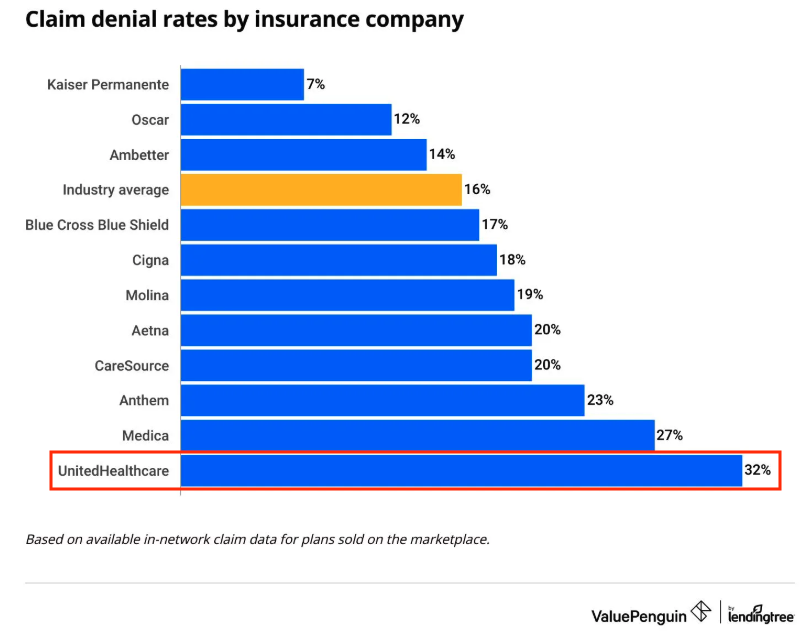
Later in the day, good friend and colleague Ray Blanco provided this chart:
Credit: Value Penguin
The above is not justification for what happened. Nor can we definitively say unpaid claims are the reason Thompson was assassinated. For all we or the inept NYPD know, a jilted lover, humiliated tailor, or cuckolded husband could’ve hired the shooter. As of 6 am ET this morning, the NYPD still doesn’t have a clue.
Let’s zoom out to see why this awfulness could become the norm.
Public Safety in Big Western Cities is Defunded
I noticed one of the first things New York City Mayor Eric Adams said was, “We want to be clear to New Yorkers that this does not appear to be a random act of violence.”
He had to say this to calm New Yorkers, who know better than anyone how out-of-hand New York has become without its Giuliani-era police force.
Cities thrive when they provide order, safety, and low-risk opportunities in exchange for the density, diversity, and complexity that define urban living. Yet, in many cities, this tacit agreement has been ripped up.
The Left likes its brand-new voters without police records. Over the past decade, urban governments have defunded or neglected law enforcement in response to these political pressures, with catastrophic results.
Rising crime rates, rampant homelessness, open-air drug markets, and a general sense of chaos have replaced the once-bustling vibrancy of Big Western city life. (You don’t see these problems in Tokyo or Hong Kong.)
In the absence of law enforcement, opportunists, organized crime syndicates, and even lone wolves are stepping in, leaving ordinary citizens and high-profile individuals at the mercy of unrestrained violence.
Why CEOs Are Targets
This murder wasn’t random—it was obviously calculated. Let’s assume it had something to do with unpaid claims, a high probability.
Like many corporate giants, UnitedHealthcare has faced criticism for its role in the healthcare system. The stark divide between billionaires and those struggling to make ends meet becomes even more visible in cities where poverty is high. Sticking out like sore thumbs, CEOs are easy targets.
Urbanites who feel they have nothing to lose are more likely to employ violence, whether through random crimes of opportunity or premeditated acts like this assassination.
And the aforementioned absence of strong public safety leaves even the wealthiest and most influential individuals exposed.
A Dangerous Precedent
If this incident signals anything, it may be the normalization of violence against corporate and public figures.
When cities fail to enforce laws, they send a dangerous signal: consequences for criminality are minimal to none. Over time, this encourages not just petty criminals but also those willing and able to commit crimes like assassinations.
Many cities have seen an increase in organized crime as politicians prevent law enforcement from addressing everyday street-level offenses. Targeting high-profile individuals will become a tactic for these groups.
Of course, high-profile crimes inspire copycats. Thompson’s assassination sets a precedent where others will follow suit in cities where police forces are already neutered.
Wrap Up
Whether for gaining leverage or making a statement, everyone from lone assassinations to organized crime syndicates will feel a rush of dopamine weighing the dark possibilities.
The long and the short of it is this: CEOs need to make big calls with more in mind than the bottom line. Cities need to get back to being places where police have the power to enforce the law and make people feel safe.
If not, private citizens will sleep with one eye open before inevitably packing their bags and leaving for greener and safer pastures.

Crude and Unusual Profits
Posted October 15, 2026
By Dan Amoss
The Half-Life of a Bargain
Posted October 14, 2026
By Matt Badiali
Pump and Circumstance
Posted October 13, 2026
By Sean Ring
The Crusade That Never Paid
Posted October 12, 2026
By Sean Ring
No Farewell to Arms
Posted October 09, 2026
By Sean Ring