Posted August 21, 2026

By Sean Ring
You Don't Own Your Stocks
Do me a favor. Open your brokerage app. Look at your shares. Your Apple. Your silver miners. Your index funds.
Now here's the fun part: you don't own them. Not the way you think you do.
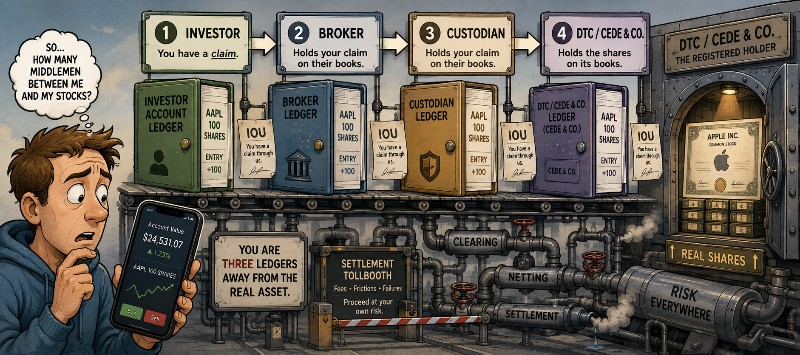
The legal owner of nearly every share listed in America is a partnership you've never heard of. It's called Cede & Co. It sits inside the Depository Trust Company in Lower Manhattan. On paper, and paper is what counts, Cede & Co. holds almost the entire US stock market.
You own an IOU. The lawyers call it a "security entitlement." Your broker owes you shares. Your broker's custodian owes your broker. The Depository Trust Company (DTC) owes the custodian. You sit at the end of a long line of promises, 3 ledgers away from the actual asset.
It seems strange. Or is it?
Let me tell you how we got here, who runs the machine, and why the firms that hold everything are the most powerful banks you never think about.
The Day Wall Street Drowned in Paper
Until the late 1960s, stocks were paper certificates. Sell your shares and a courier physically hauled the certificate across Manhattan. Then trading volume exploded. Back offices buried themselves alive. Failed trades piled up. It got so bad the NYSE closed every Wednesday just to catch up on paperwork. Brokerages died of clerical error. They called it the Paperwork Crunch.
The fix was elegant. All they did was lock the certificates in a single vault and register them under a single nominee, Cede & Co. Then ownership changes hands via bookkeeping entries. The Depository Trust Company opened in 1973. From that day on, the stock market stopped being a paper market and became a database.
And somebody has to run the database.
Enter the Custodian
That's what a custodian bank does. It runs the database, or, more clearly, holds assets for investors. Safekeeping, settlement, dividend collection, recordkeeping, all the plumbing. It doesn't lend your assets to condo developers. Client assets sit off the bank's balance sheet, segregated, out of reach of the bank's own creditors. The custodian isn't betting your money. It's charging tolls on it.
The tolls are staggering. Alexander Hamilton's bank, BNY, was founded in 1784 and is the oldest in America. It’s the custodian of about $62 trillion in assets. That's roughly 20% of every investable asset on Earth. State Street, JPMorgan, and Citi, along with BNY, control the books for most of the world's wealth.
It gets better. BNY is the sole clearing bank for US Treasuries. Every day it runs the "tri-party repo" machine. That's the overnight lending market where money funds lend cash to dealers against Treasury collateral, with BNY in the middle holding and valuing the collateral for both sides. That market is measured in trillions… every single day.
If BNY's systems went dark one morning, Wall Street's short-term funding would seize up. We got a preview in 2023, when hackers hit the US arm of China's biggest bank. Its operations staff had to settle Treasury trades the old school way, allegedly walking a USB stick full of trades across town. The financial system runs on a handful of pipes, and the custodians own the pipes.
Custody Is Power
If your ownership is an entry on someone else's ledger, then your ownership is, at the limit, a permission slip. Just ask old Vlad Putin. After his tanks rolled in 2022, some $300 billion of Russia's reserves were frozen with Western custodians, the largest share held by Euroclear in Brussels. Russia still "owns" those assets the way you "own" your shares.
Gold investors have known this forever. Allocated gold means specific bars with your name on them. Unallocated means a claim on the bank's pool.
The crypto kids rediscovered it and made a bumper sticker: not your keys, not your coins. (They think they invented it, like everything else.) But it’s the oldest rule in finance, and the entire modern market is built on the other side of it.
Finally, notice who sits closest to the ledger. The ledger's keepers never lose. Custodians get paid per asset, trade, or corporate action, whether in a bull or bear market. They're the tollbooths on the highway of capital. The market can crash 40%, and the tollbooth keeps ka-chinging along.
Now that’s using The Cantillon Effect to great effect!
Wrap Up
I'm not telling you the vault is about to fail. The dull truth is that custody exists because it works. Segregation is why customers of a failed brokerage generally get their assets back. The machine settles trillions daily with boring reliability. Boring is the product.
One more thing. If custodians are tollbooths that collect in every market weather, that's worth remembering when you look at the banks everyone ignores because they don't do anything exciting.

A Crude Awakening
Posted October 23, 2026
By Sean Ring

All That Glitters Is Diesel
Posted October 22, 2026
By Sean Ring

Treason’s Greetings!
Posted October 21, 2026
By Sean Ring

Zach’s Second Opinion
Posted October 20, 2026
By Zach Scheidt

A COLA, But No Smile
Posted October 20, 2026
By Zach Scheidt