Posted April 22, 2026

By Matt Badiali
You Can’t Print Copper!
If you don’t own any mining companies under $100 billion in market value, you’re going to miss the bull market of the decade.
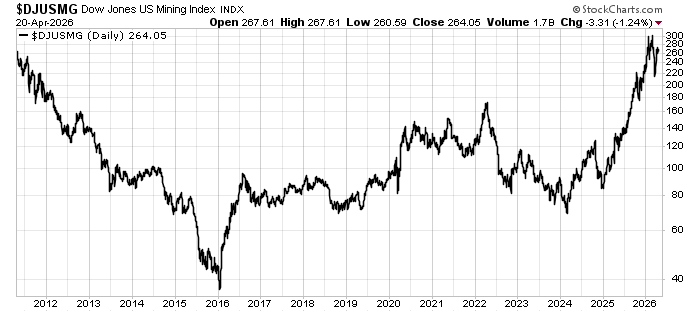
It’s not your fault. The mining industry didn’t set the world on fire over the past 15 years. As you can see in this chart of the Dow Jones U.S. Mining Index, it was a difficult investment environment:
Over the past fifteen years, the S&P 500 outperformed mining companies by 500% (!), as you can see in this chart below:
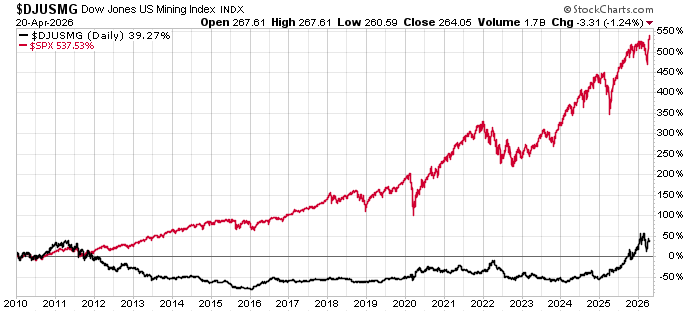
This is the chart of a neglected industry. Capital went away. And mining is capital-intensive. To attract investors, some miners, such as Barrick Gold (NYSE: GOLD), Newmont Mining (NYSE: NEM), and Coeur Mining (NYSE: CDE), used capital to buy back shares and pay dividends.
Every dollar they spent on their own shares was money taken from exploration and development.
Mines Don’t Refill Themselves
Here’s the thing about mines…they’re finite. A mine is like a glass of water. When you drink all the water, the glass is empty. It doesn’t refill itself. Mines are like that. They have a lifespan, and then you have to find a new mine.
Across the industry, almost regardless of commodity, we saw a massive underinvestment in new mines. Professional Engineer Kenny MacEwen of mining consultancy TMG described it well:
The capital starvation in mining did not happen overnight. Following the commodity supercycle of the early 2000s, oversupply, and plummeting prices in many sectors led to significant cost-cutting measures. Exploration budgets were slashed, projects were shelved, and companies focused on short-term profitability over long-term resource development.
Investor sentiment further exacerbated the issue. In recent years, funds have pivoted toward technology and renewable energy sectors, favoring growth stories over the cyclical and capital-intensive nature of mining. Environmental, social, and governance (ESG) considerations have also made some investors wary of mining projects, especially those with high carbon footprints or contentious social impacts.
This lack of investment has left the industry with aging infrastructure, declining ore grades, and an insufficient pipeline of new projects to meet rising demand. As economies rebound post-pandemic and the energy transition accelerates, the gap between supply and demand becomes apparent.
And the rocks have something to do with this as well. The easy material is gone. All the big, glossy, high-grade deposits that once stuck up out of the ground are gone. Now, we are looking more deeply, using advanced tools and longer exploration times. It’s high-risk and has long timelines. In addition, there’s no guarantee that you’ll find anything. It’s hard to convince investors to write that check when they can make great returns in the market.
And then there’s development. Imagine going to investors or lenders to raise a billion dollars to build a mine. They will want assurances that the mine will go in on time and on budget. But the data doesn’t support that.
According to a McKinsey analysis of 35 large mining projects (from 2002 to 2015), thirty went over budget, and 27 suffered significant delays. And a recent S&P Global survey found that the average lead time for mines jumped from 12.7 years (2005-2009) to 17.9 years (2020-2023).
That’s not an incentive to invest.
This is how low prices cure low prices. If you can’t raise money to build new mines, then you risk supply shortages. And when you have more demand than supply… prices go up.
Here’s a brief list of the mined commodities facing shortages in the next few years:
- Copper
- Graphite
- Lithium
- Nickel
- Rare Earths like neodymium, samarium, dysprosium, terbium, and praseodymium
- Cobalt
Wrap Up
If you don’t have exposure to these metals in your portfolio, you’re going to miss a massive bull market. If you rely on the investment strategies of the last decade, you’ll be too late and too light in your investments in this sector.
There is no way we can deploy enough capital to prevent metal prices from rising much higher over the next couple of years. Mining analysts at McKinsey estimate that the world must invest $4.7 trillion to meet projected demand. The main mining bottleneck isn’t the rocks, it’s the money. And it will take much higher prices than we see today to open wallets and increase investment.

Pardon My Financial French
Posted October 02, 2026
By Sean Ring

For Whom the Debt Tolls
Posted October 01, 2026
By Sean Ring

Spend It Like You Stole It
Posted September 30, 2026
By Sean Ring

The Pentagon’s Velvet Rope
Posted September 29, 2026
By Sean Ring

From Athens with Contempt
Posted September 28, 2026
By Sean Ring