Posted January 21, 2026

By Sean Ring
Yen and the Art of Market Maintenance
For years, global markets have been floating on something they barely talk about.
No, not earnings. Or productivity.
Try this: Cheap yen.
Now that practically interest-free yen is disappearing. And when it goes, it has this nasty habit of taking stock markets with it.
What’s happening in Japan right now — rising bond yields and a weak currency — is one of those combinations that looks boring until it suddenly isn’t. Then it becomes a wrecking ball.
One of the things fixed income traders hate about equity traders is that equity traders think their returns only come from earnings. The truth is that the underlying macroeconomics has so much to do with how equities are funded, and therefore their returns, it isn’t funny.
But many equity traders grew up listening to fund managers like Peter Lynch say things like, “If you spend more than 13 minutes analyzing economic and market forecasts, you've wasted 10 minutes.”
Perhaps that was true in the 1980s, when the world’s stock markets weren’t interconnected like they are today.
What’s more, since the Nikkei cratered in 1989, and the Bank of Japan embarked on the dumbest Keynesian experiment of all time by putting interest rates on the floor, the Japanese yen became the funding currency in the “carry trade.”
Put simply, investors would borrow yen, convert the yen into dollars, say, and buy U.S. equities. For the most part, this way of funding equities worked for most of this century.
Now, it may be coming to an end. Allow me to elaborate.
From Tokyo, With Leverage
Let’s start with the uncomfortable truth.
Japan has indirectly financed a meaningful chunk of global risk assets over the past decade. I’m not talking about Japanese savers buying Apple stock, or their pension funds picking stock.
But by leveraged traders borrowing yen at near-zero cost and spraying that money across the world.
U.S. equities. Emerging markets. High-yield credit. Tech stocks. Crypto. Anything that went up faster than cash.
This is the yen carry trade. It’s neither new nor exotic. And it’s certainly not small.
For most of the last 20 years, Japan was the cheapest place on Earth to borrow money. The Bank of Japan pinned short rates at zero and controlled the yield curve, crushing bond yields. The BoJ was a central bank openly committed to making sure borrowing never became painful.
So global traders did what they always do: they exploited it.
Borrow yen. Convert it into dollars, euros, pesos, whatever. Buy higher-return assets elsewhere. Pocket the spread. Repeat.
If you do this enough times, with enough leverage, and earn carry, you get the bonus of pushing asset prices up. The trade becomes a self-reinforcing loop. Rising prices justify more borrowing… and more borrowing pushes prices higher.
Everyone, especially equities traders, pretends it’s “fundamentals.”
Bondzilla Awakens
That game only works under one condition: funding must stay cheap and stable.
That condition is now breaking.
Japan’s 10-year government bond yield has surged to 2.34%, the highest level in roughly 27 years. That might not sound dramatic to Americans used to 4–5% Treasuries, but in Japan it’s seismic, Fukushima style.
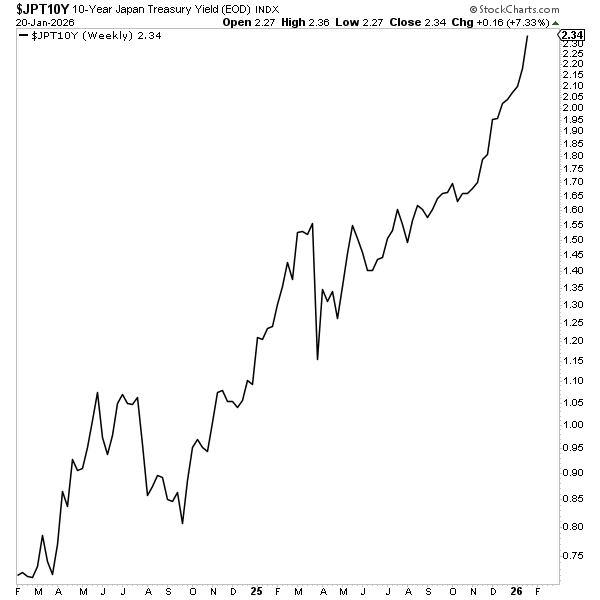
The above is not the gold chart. It’s the Japanese 10-year yield.
Japan is a country built on debt. Its public debt is north of 250% of GDP. (The reason that isn’t more of a global debacle is because you have to be Japanese to own JGBs.) Its government survives only because interest costs are artificially suppressed. Its bond market has long been treated more like a museum exhibit rather than a market.
But when yields rise there, it’s not just “rates are going up.” It’s a signal that something structural is shifting.
Borrowing in yen is no longer free. What’s worse is that it’s no longer predictable.
That uncertainty is weedkiller for leveraged trades.
The Silence of the Yen
Now add the second ingredient: a weak yen.
Normally, rising yields should support a currency. Higher returns attract capital. With stronger yields, you get a stronger currency. That’s Economics 101.
But not this time, for Japan, at least.
Despite rising yields, the yen remains historically weak. Japan’s government is implementing fiscal expansion plans amid increased political pressure for greater spending. Markets are questioning whether Japan’s debt trajectory is still sustainable… or containable.
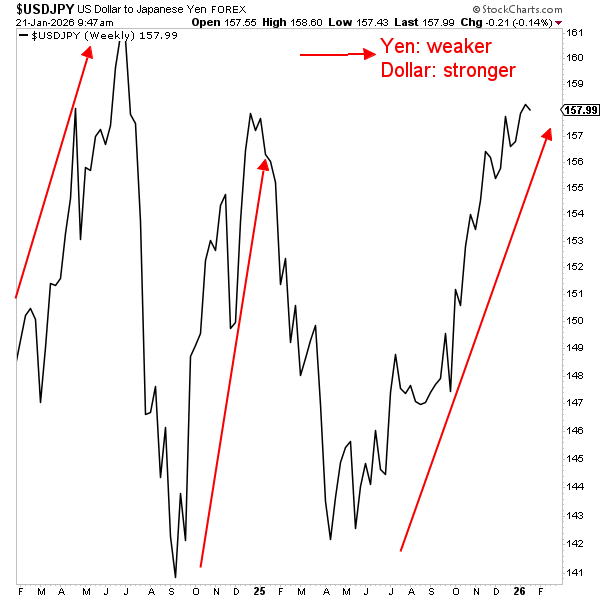
Since May 2025, USDJPY has risen from roughly 142 to 158, up 11%.
For exporters, a weak yen is a good thing. For leveraged traders, it’s dangerous.
Why?
Because, unlike old football players, carry trades don’t fade away. They die. Violently.
If the yen suddenly gets stronger, whether from intervention, a policy shift, or simple positioning stress, anyone who borrowed yen is instantly underwater.
When that happens, traders panic. They sell not what they want to, but whatever they can sell.
The Land of the Rising Unwind
Most investors miss this part.
A yen carry unwind doesn’t start in Japan. It shows up in your market.
Here’s the sequence:
- Japanese yields rise or volatility spikes.
- The yen strengthens suddenly, even briefly. (Usually, but not so far this time.)
- Leveraged traders face margin pressure.
- They dump risk assets, regardless of market, to raise cash.
- They buy yen to close funding positions.
- Selling feeds more selling.
The assets getting hit first are the most liquid, globally owned risk assets.
U.S. equities. Nasdaq darlings. Emerging-market ETFs. Crypto. High-beta junk.
Nothing is fundamentally “wrong” with those assets. They just happen to be the piggy bank.
And because estimates of the yen carry trade run to over a trillion dollars, even a partial unwind can move markets quickly.
You’ll see a few percentage points down in the S&P, at least, and much worse elsewhere.
The Sun Sets on Free Money
This isn't a hypothetical problem; the bond market is already showing clear signs of stress.
A recent jump of almost 20 basis points in Japan's 10-year yield in just a few days highlights the shift. Bond investors are now raising difficult questions regarding fiscal discipline, the viability of current debt levels, and the political will to accept higher interest rates. Once this psychological shift takes hold, a quiet return to the status quo is rare.
Compounding this risk is the current state of global markets: they are "priced for perfection." This is characterized by high asset multiples, minimal risk premiums, and concentrated positioning in momentum and growth-oriented trades.
In short, the financial ecosystem is at its most vulnerable. This is precisely the kind of environment where a funding shock will inflict maximum pain.
The Illusion
When carry trades unwind, commentators scramble for explanations. Earnings didn’t collapse. Productivity didn’t vanish. Consumers didn’t suddenly stop spending.
The hidden subsidy that had quietly made risk assets levitate turned off.
This is why yen shocks feel random. They aren’t driven by the headlines equity investors are watching. A constraint investors forgot about was reimposed.
The Trigger
This isn’t about Japan “crashing the world.”
Japan is the match, not the gasoline.
The gasoline is global leverage built on cheap funding assumptions. Japan just happens to be the biggest remaining source of ultra-cheap capital in a world that’s otherwise tightening.
When that source becomes unstable, the effects ripple outward.
Think of it like this: Japan has been underwriting risk appetite for years without getting credit. Now that underwriting is in jeopardy.
Watch This Space
If you’re trying to gauge whether this risk is growing or fading, ignore the headlines and watch three things:
First, Japanese bond volatility, not just yields. Calm rises are manageable. Spikes aren’t.
Second, USDJPY behavior. A sudden reversal (yen strength) puts massive pressure on investors.
Third, correlation spikes in global markets. When everything sells off together, funding stress is usually involved.
If those three line up, the unwind has accelerated.
Wrap Up
In 2008, it was mortgage funding. In 2020, dollar liquidity. In 2022, rate volatility. It wasn’t the fundamentals that broke. It was the financial plumbing.
This time, it could be the yen.
That doesn’t mean markets collapse tomorrow. I’m not telling you to sell everything, or worse, get short. I’m merely telling you a hidden support is cracking, and once markets notice, they tend to test it.
The yen carry trade has been one of the great unspoken enablers of the post-2008 bull market.
When the quiet engines fail, the ride gets rough fast.
Wall Street never prices this stuff in until it has to.

Handing China the Future of Transportation
Posted April 03, 2026
By Matt Badiali

Two More Weeks to Flatten the… Iranians
Posted April 02, 2026
By Sean Ring

No Quarter in March
Posted April 01, 2026
By Sean Ring

Bessent Misses the Mark
Posted March 31, 2026
By Sean Ring

The Iran War Will Drive Costs Higher for Longer
Posted March 30, 2026
By Matt Badiali