
Posted March 18, 2026

By Sean Ring
Why $5 Diesel Matters
Most people watch the price on the gas pump sign. But the number that should be keeping you up at night is the one nobody talks about on the evening news.
Diesel just crossed $5 a gallon.
And if you’ve never thought much about diesel, now’s a good time to start.
What Is Diesel, Exactly?
Diesel comes from the same barrel of crude oil as regular gas. But it’s thicker and heavier, and it packs more energy per gallon. It doesn’t use a spark plug. Instead, a diesel engine squeezes air until it’s scorching hot, then injects fuel. The heat does the work.
That design makes diesel engines slow but brutally strong. They pull massive loads mile after mile without burning through fuel. We build them for real work, not the commute.
Gasoline is the fuel for your car. Diesel is the fuel that runs the entire economy.
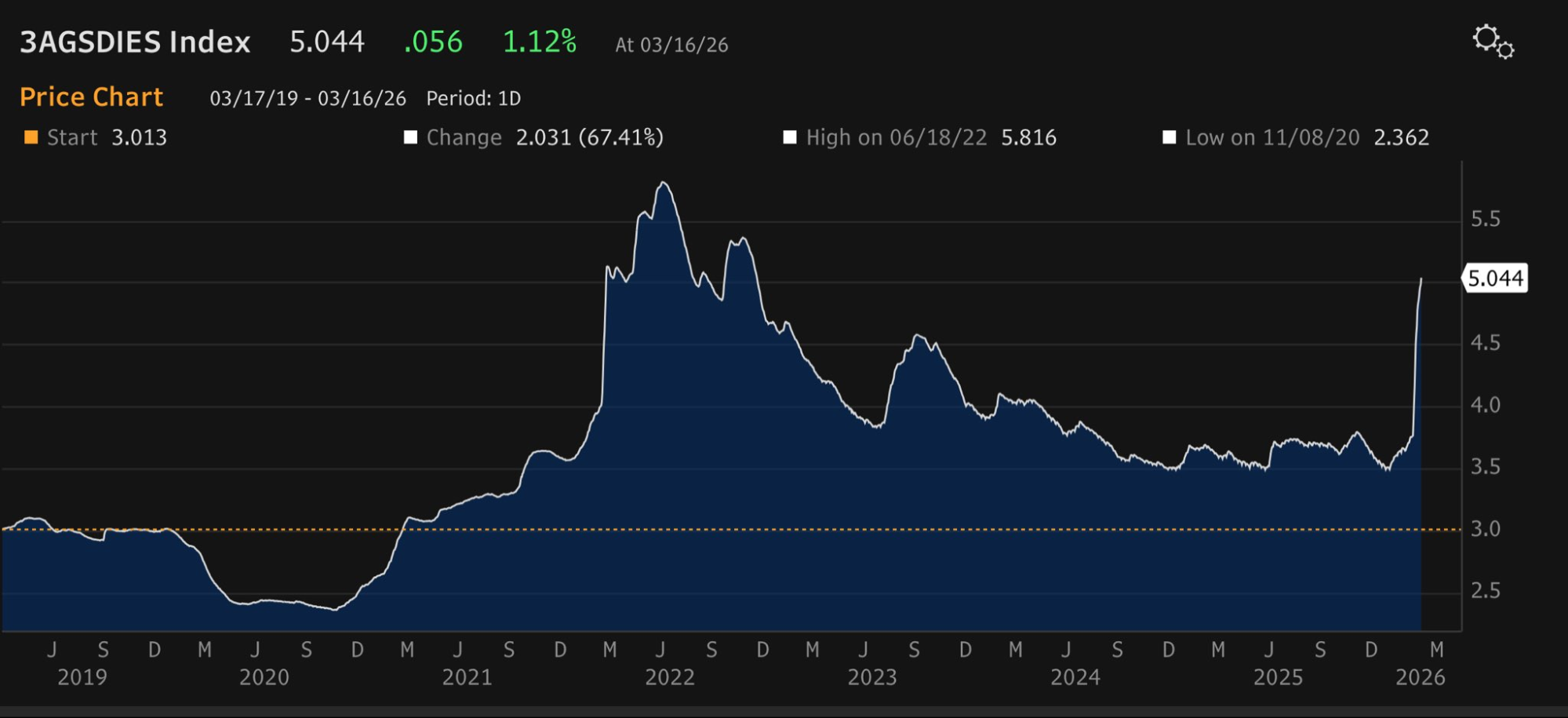 Diesel prices from 2019 to the present. Credit: Enrique Abeyta, Paradigm Press via Bloomberg
Who Burns Diesel?
Here’s the short list of who actually runs on diesel:
- The long-haul trucks hauling your food, medicine, and Amazon orders
- Farmers running tractors, harvesters, and grain dryers
- Construction crews with bulldozers, cranes, and excavators
- Freight trains and cargo ships moving raw materials across continents
- City buses, emergency backup generators, and some fire trucks
These aren’t optional activities. You can’t reschedule the harvest. You can’t park the freight train. These people and machines keep your world stocked, fed, and running.
And when diesel goes up, they can’t absorb the cost. They pass it straight to you.
Why Diesel Is the Real Inflation Engine
When gas prices spike, you feel it at the pump. That’s annoying. But your grocery bill doesn’t spike the next morning.
Diesel is different. It’s baked into the price of nearly everything you buy.
Think about a box of cereal. Diesel was burned to plant the grain. More diesel was burned to harvest it, haul it to the mill, run the factory, truck the finished product to a warehouse, and then move it to your store. Every step of that journey ran on diesel.
The same story applies to meat, produce, clothes, furniture, lumber, and appliances.
That’s why traders call it “the working man’s fuel.” And it’s why serious economists watch diesel prices more closely than gas prices. When diesel moves this quickly, it signals the entire physical economy, including trucks, farms, factories, and ships, is under pressure.
A diesel price above $5 is an economic warning shot.
Where You’ll Feel It
Higher diesel prices act like a tax on distance. The farther something travels, the more diesel it burns, the more you pay. Here’s where that shows up in your life:
At the store. Trucking companies add fuel surcharges to their invoices. Stores fold those charges into the price tag. You won’t see a line item called “diesel,” but it’s there — hidden inside the price of your bread, your beer, and your cleaning supplies.
In your food bill. Farming runs on diesel. When fuel costs more, farmers need higher prices just to break even. That means you pay more for beef, chicken, wheat, and vegetables — whether you shop at Whole Foods or Walmart.
In construction and rent. Every bulldozer and crane at a job site runs on diesel. When fuel costs rise, building costs rise. Builders pass that on through higher home prices and commercial rents. Your landlord didn’t get kinder — fuel got more expensive.
On small business owners. Independent truckers, small farms, and local delivery services run on thin margins. A diesel spike can mean the difference between staying open and closing. Some will raise prices. Others will cut service or staff just to survive.
In sticky inflation. Here’s the sneaky part. Even if oil prices fall, diesel can stay elevated for months due to refinery bottlenecks or local supply crunches. That keeps freight costs high and prices in stores elevated — long after the headlines have moved on.
What You Can Actually Do
You can’t set diesel prices. But you can reduce your exposure to them.
Buy closer to home. The longer the supply chain, the more diesel is burned, and the more price risk you carry. Local and regional producers cut out shipping miles. If the farmers’ market price is close to the supermarket price, you’re often getting a better deal once you factor in what you’re avoiding.
Batch your deliveries. Every box dropped at your door is a small diesel bill. Combine orders. Avoid rush shipping, as it’s fuel-intensive by design. Pick up heavy items in person when you can.
Stock the right things now. You don’t need a bunker. But some goods are almost certain to get more expensive as diesel stays high. Buy shelf-stable foods you know you’ll eat, like rice, beans, pasta, corn, and canned goods, cheaply now. Same with heavy household staples like pet food, paper goods, and cleaning supplies.
Protect your income if you’re on the front line. If you work in trucking, farming, construction, or delivery, you’re directly in the line of fire. Push for fuel surcharges if you can. Diversify your income streams. Don’t silently eat the cost increase; that’s how small operators go under.
Reset your budget expectations. Your food, delivery, and home improvement costs will go up 10%-20% over the next year… if diesel just stays where it is. Decide now where you’ll cut and what you’ll keep. A plan beats panic every time.
Wrap Up
Gasoline is the number you see on the sign at your local station.
Diesel is the number running your life.
When the price of diesel breaks above $5, it’s not just about truckers and farmers. It’s about everything those trucks and farms produce and transport, which is nearly everything you buy, eat, build, and live in.
This kind of inflation doesn’t care what the Fed says at its next press conference. It runs on roads, rails, and soil. And right now, it just got more expensive.

CLAUDE BAWLS!
Posted March 17, 2026
By Sean Ring

No Birthday Balloons This Year, Kid. There’s a War On!
Posted March 16, 2026
By Matt Badiali

Trump’s Long, Short War
Posted March 13, 2026
By Byron King
The Everything Problem
Posted March 12, 2026
By Sean Ring

Ghosted at Gunpoint
Posted March 11, 2026
By Sean Ring
