Posted August 28, 2023

By Sean Ring
Tucker to Interview Putin?
- On X.com (formerly Twitter), the news made the rounds.
- According to RT Editor-in-Chief, Carlson formally requested to interview Putin.
- What would be the Deep State response?
Good morning from a brisk Asti!
I’m back in Italy now, and it’s much colder than when I left. Currently, it’s 61F (18C) and only getting to 63F (19C). We had crazy rain last night, and the storm isn’t done with us yet.
That’s a far cry from the over-90s weather we had this weekend. But I love Northern European weather in the south.
Now that I’m back from holiday, alcohol-free, and in back-to-school mode, there are so many things I want to write about.
From China’s alleged economic implosion to my crazy vacation to Belgian beers and ales to the BRICS summit, I’m chock-a-block with ideas.
But, of course, X.com (formerly Twitter) had to intervene and put everything I wanted to write on the back burner.
Because this news is bigger than any other.
Tucker Carlson has asked for permission to interview Russian President Vladimir Putin.
Cui bono?
“Cui bono?” is Latin for “Who benefits?”
It’s one of the first questions cops ask when a crime is committed. And it’s the first question most people asked when Nordstream blew up. That’s why pointing the finger at the US was so easy.
But just because one benefits doesn’t mean one committed the crime. For instance, let’s say a disgruntled worker murdered his boss. Then, the boss’s daughter inherited millions. The boss’s daughter obviously isn’t guilty of a crime, though she benefited.
I ask who benefits here because laying out the playing field and how this might play out is essential. It’s not an exhaustive list.
The Beneficiaries:
- Tucker: Watching Tucker dunk on the Legacy Media is a treat. If he lands this interview and completes it, he’ll cement his place as the most influential newsman of his day.
- Putin: The Russian president will finally have a fair and unfettered chance to state his case. If Americans see Putin isn’t the raving lunatic Nuland, Blinken, and Sullivan make him out to be, funding for the war will dry up faster than the rain puddles in Southeast Asia.
- Peace lovers the world over: Those who want an end to this war without any further escalation (that is, the break-up of Russia) will be thrilled for the other side to get heard. There’s a far greater chance of this war stopping once the talking starts.
- The New Media: X.com and other alternative news sources crush the Legacy Media.
The Losers:
- The Deep State: They’re already losing badly. Between the arson dressed up as climate change failures, no one believing the COVID propaganda, and the US taxpayer tiring of funding the Ukrainians, the Deep State is on the back foot. If Tucker talks to Putin, this could be the last straw.
- The Legacy Media: If Tucker can interview Putin on X.com, what’s the point of Fox News, CNN, or MSNBC?
- Warmongers: Nuland, Sullivan, Blinken, the Kagans, and the rest of the Neocon Lunatics may finally be put to bed.
- The US Diplomatic Corps: Massive egg on their faces if Tucker’s interview leads to a rethink.
- Faux peace lovers who yearn for Russia’s destruction: Welp, there will be no Russia break-up for them. Seriously, lunatics like this exist inside of NATO and the EU:
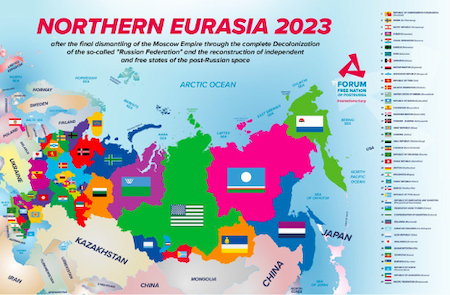
Credit: @GunterFehlinger
There are considerable risks to letting Carlson interview Putin, especially if you’re a warmongering neocon.
That’s because neocons don’t do diplomacy.
The Lost Art of Diplomacy
Over the last few decades, American diplomacy has become almost an oxymoron.
But it wasn’t always that way.
From Foreign Policy:
U.S. leaders had excelled in the diplomacy surrounding the end of the Cold War. President George H.W. Bush and Secretary of State James Baker built enduring relationships with diverse leaders across the Soviet bloc and the Middle East. They negotiated compromises that gave other leaders what they needed in return for endorsement of key U.S. aims: nuclear arms control, reunification of Germany, and the reversal of Iraq’s occupation of Kuwait. Bush and Baker were less successful in negotiating a peace agreement between Israel and its neighbors, but they made progress there, too. Baker was the great U.S. diplomat of the late 20th century, as seen by Burns, who served on the State Department’s Policy Planning Staff and frequently traveled with the secretary: “His skills, weight within the administration, relationships with all the key players in the region, and proven ability to deliver could not be easily replicated. He seemed like the right peacemaker at the right time.”
Bush and Baker’s international achievements left a void as their successors undervalued the diplomacy they had carefully crafted to reach those results. A unipolar post-Cold War hegemon, the United States possessed unmatched military and economic power, and its ideological righteousness seemed unassailable. Who needed difficult, slow diplomatic compromises when U.S. leaders could get what they wanted largely through pressure and force?
Did the unipolar moment destroy the American diplomatic corps?
It sure seems like it.
Why talk when you can drone?
Why negotiate when your defense contractors get rich, and your GDP grows?
Remember, defense spending is a part of government spending. The higher the government spending, the higher the GDP.
It can be argued the USG doesn’t do diplomacy because it wants war.
Remember what Mao said: “Political power grows out of the barrel of a gun.”
I’d love to be wrong about that, but look at the aerospace and defense sector performance versus the S&P 500 since September 10, 2001:
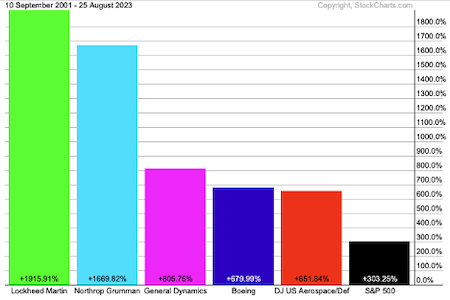
The SPX is up 303.25%. But it underperformed the aerospace and defense sector by over 50%.
Lockheed Martin returned nearly 2,000%. Northrop Grumman is up almost 1,700%. General Dynamics is up over 800%, and Boeing is up nearly 700%.
Diplomacy takes time and costs money.
With this kind of money on the line, I hope Tucker flies commercial to Moscow. Private planes are too easy to “disappear.” Just ask Yevgeny Prigozhin, the former Wagner CEO.
Wrap Up
I hope this interview happens.
If Tucker can get straight answers from Putin, the American taxpayer may finally find courage and say, “Enough is enough.”
Then, perhaps, the Democrats can return to doing what they usually do: spend all those taxpayer dollars inside the United States and rebuild the third-world infrastructure.
Have a great week ahead!

A Crude Awakening
Posted October 23, 2026
By Sean Ring

All That Glitters Is Diesel
Posted October 22, 2026
By Sean Ring

Treason’s Greetings!
Posted October 21, 2026
By Sean Ring

Zach’s Second Opinion
Posted October 20, 2026
By Zach Scheidt

A COLA, But No Smile
Posted October 20, 2026
By Zach Scheidt