
Posted March 13, 2026

By Byron King
Trump’s Long, Short War
“What the hell is going on with this Iran war?”
Does the question seem familiar? It is to me. The exact quote is from one of my sisters, and lately I’ve asked this of myself many times per day. Probably, it’s familiar to you, too.
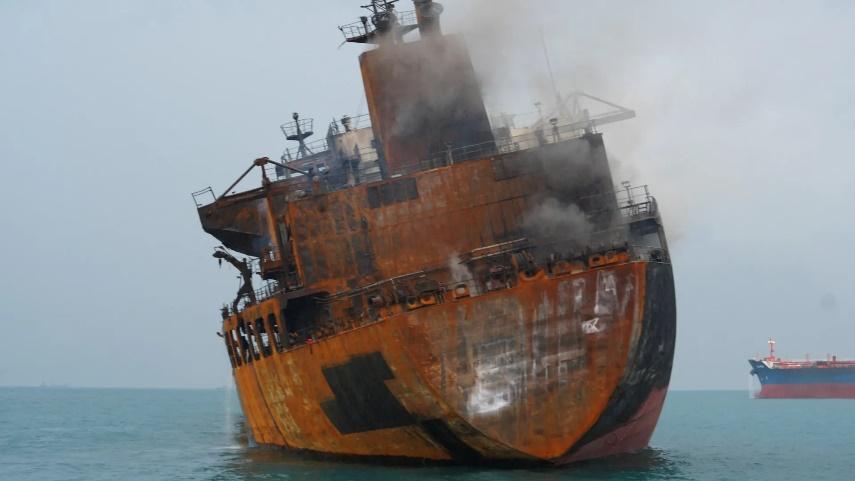 Wrecked, burnt-out tanker near Iraq, northern Arabian/Persian Gulf. Courtesy The-Sun.com/news.
At Paradigm Press, we see many versions of this “What the hell…” query. We’ve received notes from thoughtful subscribers who have written to comment on our articles, like these short, sincere, and deeply concerned excerpts:
“How did it really start?”
“Where is it all going?”
“How does this end?”
“How worried should I be?”
Well… Happy Friday the 13th. Let’s dig in and try to make sense of it all.
Two Weeks to Flatten the (Iran) Curve
Tomorrow marks two weeks since America awakened on a Saturday morning to news that U.S. forces – along with military forces from Israel – attacked Iran. My first thought was (if you’ll excuse the mixed religiosity), “Oh, for Chrissake.”
Then, into my head popped this quote from warrior-scholar Karl von Clausewitz: “No one starts a war – or rather, no one in his sense ought to do so – without first being clear in his mind what he intends to achieve by the war and how he intends to conduct it.”
 Karl von Clausewitz (1780 – 1831)
Clausewitz wrote this in the 1820s, as he reflected on his days fighting alongside Russians against Napoleon, who in 1812 marched his army across Europe, all the way to Moscow.
Of course, today things are different because now it’s the U.S. that has moved its fleet and aircraft across oceans and continents to hit Iran. And you see that difference, yes?
All kidding aside, if not the cynicism, when I heard the actual news of war breaking out, I had to think hard to process just some basic facts.
That is, President Trump campaigned against America getting into more wars (to be accurate, he was against “stupid wars”), and yet here we are, shooting missiles, wiping out air defenses, and in essence capturing the sky above Iran to enable follow-on attack waves to blow stuff up. And definitely, we are blowing stuff up (see below).
Of course, this war was neither unpredictable nor unforeseen. That is, for two months previous to kickoff, the U.S. assembled significant forces in the Middle East. Definitely, this whole thing was stewing and brewing. Planners were planning because that’s their job.
And there’s no doubt in my mind that U.S. military strength is mighty because I’ve “been there,” so to speak, and seen it up close. Our national power is un-freaking-believably good; our pointy-spear people and equipment are frosty and sharp; and (almost) always, we hit where we aim.
So, the U.S. can deliver a massive punch when and where it chooses, certainly across oceans and continents. And here we are, engaged in a serious, g0dd@mn shooting war, and…
Okay, timeout: Before I write another word, per law & regulation, I must state that I’m a retired senior Navy officer with three decades of active and reserve experience. And these comments are personal opinions. I do not hold a current security clearance, and I DO NOT speak on behalf of the Department of the Navy, Department of War, or U.S. Government.
Having said that, the very first thing that pops into my military- (and geologically-) trained mind is to hit the map room for a comparison of raw geography; and here it is:
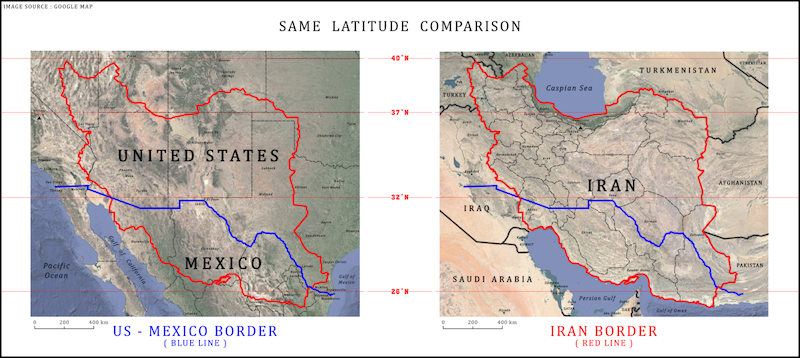 Size of Iran versus U.S./Mexico. Courtesy MapsOnTheWeb.Zoom-Maps.com
Iran is big, right? It’s the size of the Southwest U.S. plus northern Mexico. It’s twice the size of Texas, three times the size of California, five times Nevada, six times Arizona, etc. And I chose these areas for comparison because Iran is mountainous as well, much like the North American geography we see above.
On my end, I served and traveled in the Middle East, and I know things. But I mention the maps for readers who may not already understand the scope of the military-political challenge. Or per the old saying, “War is God’s way of teaching geography to Americans.”
The takeaway from the map room is that there’s much operational and strategic depth to Iran. There’s nothing “two weeks” about this campaign.
Politics By Other Means
Another famous line from Clausewitz is: “War is nothing but a continuation of politics with the admixture of other means.”
And Clausewitz was only writing about Russians, Prussians, and French people. I seriously doubt that he ever met anyone like the guys who run Iran, because they are a special breed.
That is, Iran has a population of about 90 million, which can be classified into various ethnicities such as Persians, Baluchis, Kurds, Azeris, and more. They are all quite different in many ways, yet at the same time, it’s fair to say that there’s a collective sense of nationality about being Iranian. Stated another way, Iran is no former Yugoslavia, awaiting its inevitable breakup.
Politically, Iran is run by ultra-zealous Mullahs, since back in 1979, a revolution that removed the old Shah and installed Ayatollah Ruhollah Khomeini as the supreme leader of a so-called “Islamic Republic.”
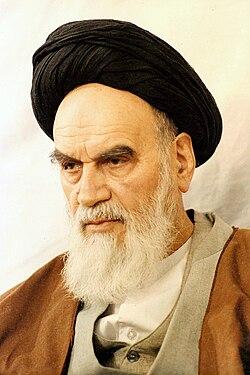 Ayatollah Khomeini (1900 – 89). Courtesy Govt. of Iran.
In turn, the Ayatollah and his followers created a security apparatus called the Iranian Revolutionary Guard Corps (IRGC), a religious-military organization that parallels the conventional military forces of the country. And they are truly a bunch of flinty, unyielding zealots.
One of the first things the Ayatollah did in 1979 was declare “war,” so to speak, on the U.S. and Israel. According to the ruling caste’s view of the world, the U.S. and Israel are the “Great Satan” and “Little Satan,” respectively. And for not quite 47 years, beginning with seizing the U.S. embassy in Tehran (1979-81), Iran or its proxies have attacked the U.S. and its interests.
I won’t belabor the last five decades, which time has transformed (to me, at least) from day-to-day news to lived experience, and now into history. But it’s worth noting that Iran or Iran-sponsored proxies attacked the U.S. on many occasions in incidents that ranged from the Beirut bombings in 1983, kidnappings in the late 80s, assaults in the 1990s, to extensive assistance to people who killed U.S. and allied troops in Iraq and Afghanistan in the 2000s.
On that last point, I recall a mid-2000s meeting with a senior researcher at a U.S. national lab whose work involved isotope analysis of copper components in bombs that were killing and maiming U.S. troops in Iraq and Afghanistan. And our intel knew the source down to the exact copper mine and refinery in Iran. (No, we didn’t bomb it.)
Meanwhile, I also recall that on occasion “we” – U.S. forces – hit back at Iran. Consider Operation Praying Mantis in April 1988, in which U.S. naval and air power whacked Iranian interests good and hard in the Gulf.
There were other times, though, when things went awry, such as the mistaken shootdown of Iran Air flight 655 in July 1988. I was on staff at Chief of Naval Operations at the time, saw the message hot off the press, and sat in a room full of admirals who collectively asked, “WTF just happened?” (exact quote).
Well, in a broad sense, here’s WTF happened, which gets back to Clausewitz: “Everything in war is very simple, but the simplest thing is difficult.”
When you’re engaged in combat, sh!t happens.
Trump’s Decision Point
Now, let’s return to the present, to the past two weeks. Yes, the U.S. had a military buildup in the Middle East region. On our U.S. ships, airplanes, and rocket batteries, the fuel tanks were topped off, and ordnance was loaded. But still, why did President Trump give the “go” signal?
One story is that there was intel that the (late) Ayatollah Khamenei – successor to Khomeini – and his entourage would all be in one place at the same time, so it was a chance to knock out the top guys: a so-called “decapitation” strike. Oh, and the Israelis were going to take their shot in any event, so the U.S. joined in to get ahead of whatever might come next.
Yeah… Okay… Maybe. But is that how Trump thinks? I’ve never met the Orange Man. And I dunno… But does he seem like a “me too!” kind of guy? Definitely, Trump is instinctual, but is he trigger-happy?
When it comes to starting a war with Iran, I’m more inclined to go with what I heard from Trump’s top negotiator, Steve Witkoff, who spent time meeting with Iranian reps.
That is, Witkoff’s mandate was to determine whether or not Iran would agree to give up its long-running, very deep, and extensive nuclear weapons program. And on behalf of the U.S., Witkoff essentially offered Iran a “free” nuclear power program if the country’s governing powers would curb the bomb-building angle.
You can find Witkoff’s full discussion on sites like Greta van Susteren and Mark Levin. He gave a couple of long interviews and laid it all out on the table. The short version is that Iranian reps told him that Iran would never give up its bomb program. They stated that their country already possessed the ability and materials to build eleven or more working weapons in a matter of a few weeks, with enough other nuclear material in the pipeline to build many dozens more.
Okay, yes… Over and over again, for many years, we’ve heard the story that “Iran is ready for a nuclear breakout,” or words to that effect. And it didn’t happen. So, what’s different now?
I can’t say with certainty what happened because I’m on the outside looking in. But I can say that I understand how Trump faced a true dilemma after Witkoff reported on the meetings. Trump could back away from military action and risk watching Iran go nuclear soon and then get blamed forever because it happened on his watch; or… do something now.
So, what did Trump do? I suspect he did what Presidents usually do: he called in the generals and admirals and, in essence, asked, “Do you have a plan?” And in essence, they said, “Yes, sir; it has risks, but we have a plan.”
And Trump said, “Okay, go with it.”
Which prompts another line from Clausewitz, that: “There are cases in which the greatest daring is the greatest wisdom.”
Wisdom… or Calamity?
On that note, where do things go from here? Wisdom? Calamity? What’s the theory of victory?
Well, here’s another line from Clausewitz: “There are very few men – and they are the exceptions – who are able to think and feel beyond the present moment.”
And that gem from Clausewitz works both ways… Because Trump is Trump, right? He’s been a public person for his entire life. New York real estate bigshot. National television celebrity. Presidential ranks for a decade. And as noted, he’s instinctual, which is to say that Trump lives in the present moment.
Then we have the Iranian guys in charge: total zealots; true believers; adamant towards what they see as Iranian interests; and indeed, many of the religious followers beat themselves with whips and chains (yes, seriously).
So, what happens now? Sorry to break the news, but… It’s us versus them. Period.
There’s no easy way out. The IRGC guys won’t give up easily. This won’t end soon. This is Trump’s long, short war. Definitely, it’s not a two-week conflict.
Indeed, since the beginning, U.S. and Israeli forces have bombed the living cr@p out of Iranian targets, over 7,500 distinct aim points: Command nodes. Air defense. Munitions storage. Aircraft. Concentrations of military people and/or leadership. Iran’s navy is gone. Its air force is smoking hunks of scrap. Army facilities are blown away. And now come the industrial sites, definitely the nuclear targets.
The U.S. assault began with cruise missiles and stealthy F-22s and F-35s, plus B-2 bombers. And many of the air-dropped munitions were stand-off weapons. But now we see B-1 bombers and even the venerable old B-52, with a radar reflection like an aluminum tennis court, closing on the targets with smart bombs and massive bunker-busters.
If there’s an identifiable target worth blowing up in Iran, it will be hit. There will be no U.S. letup.
Meanwhile, in the wake of losing its top-level leadership cadre, Iran has transformed into a political and command structure of 31 independent subsets of IRGC military districts, spread across its large landscape.
Each IRGC commander has his own people, weapons, and a list of pre-determined targets across the Middle East, such as critical facilities in Arab Gulf states and definitely U.S. assets where identifiable. All of this is supplemented, we are told in some news sites, with Russian and Chinese assistance in targeting.
And obviously, Iran is making a mess of international commerce by blocking the Strait of Hormuz. Indeed, that’s the idea. Iranian commanders aren’t stupid; they can peek out of their bunkers and see how U.S. bombs have ripped their military power to shreds. So, they are going asymmetric, attacking shipping and inflicting economic pain.
At this point, it’s a contest of wills. Not “just” Trump, either, because there’s an entire kinetic system in motion. Firepower has its own way of perpetuating. And of course, the Iranian bosses are dug in like ticks. This is their “death ground,” where they will make their stand.
So, what happens? Hey, we’ll have to live through it. Oil prices have risen and will likely rise more, along with prices at the pump. Global agriculture will feel the effects, and food prices will rise. Asia will pay more for energy, which means that Asian goods will rise in price.
U.S. inflation rates will rise, and the dollar will lose purchasing power, but what else is new? So, over time, hard assets will become more valuable.
And as for ending the war? Good luck… For a while, the Omanis were acting as behind-the-scenes intermediaries, but yesterday the Iranians blew up Oman’s main oil storage facility. So that phone line has gone dead.
Perhaps China will help negotiate a deal, because higher oil prices are bad for China, although the Iranians are allowing oil tankers to sail if the cargo is destined for China. We’ll see, right?
Yes, we have many unknowns. But those bring us finally to one last item from Clausewitz, which pertains to both sides. It’s timeless, and entirely apropos: “Of all the passions that inspire a man in a battle, none, we have to admit, is so powerful and so constant as the longing for honor and renown.”
Consider who the main actors are on this global stage, and what’s at stake. And there are your answers…
And that’s all for now. Thank you for subscribing and reading.
The Everything Problem
Posted March 12, 2026
By Sean Ring

Ghosted at Gunpoint
Posted March 11, 2026
By Sean Ring

The Best of All Possible Worlds
Posted March 10, 2026
By Sean Ring

Donald's Domestic Destruction
Posted March 09, 2026
By Sean Ring

The Pentagon Pays the Piper
Posted March 06, 2026
By Byron King
