Posted August 05, 2026

By Sean Ring
The Trap Door Bailout
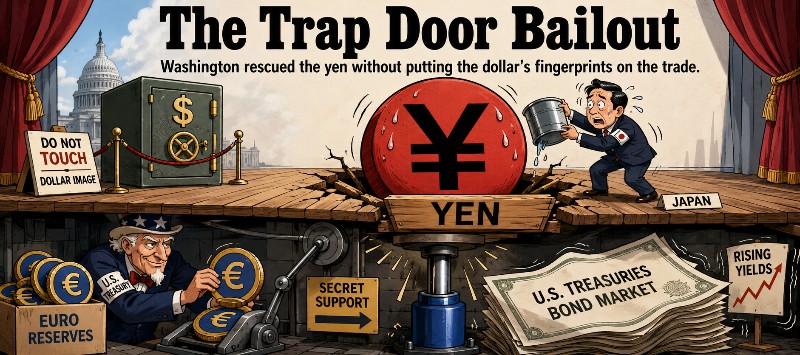
Last Friday night, Washington quietly rescued a foreign currency.
They made sure almost nobody saw them do it.
The currency was the Japanese yen. It had just hit its lowest point against the dollar in 40 years. Japan's government had already spent tens of billions of dollars trying to prop it up, and it kept falling anyway.
So the U.S. Treasury stepped in. For the first time since 2011, America directly helped defend the yen.
But here's the strange part. The Treasury didn't sell dollars to buy yen. That would be the obvious move. Instead, it sold euros to buy yen.
Why would the USG spend European money to fix Japan’s problem? Because in modern finance, nothing is separate anymore. The dollar, yen, and euro are all one connected machine. Last week, a warning light came on.
What Happened
Think of currencies like water levels in connected tanks. When one tank drops too fast, pressure builds everywhere else.
The yen tank had been draining for months. Japan's government was bailing water out with buckets, buying yen and selling dollars to slow the drop. On Thursday alone, Japan may have spent close to $59 billion doing this.
It wasn't enough. The dollar climbed to nearly 164 yen, a level not seen since 1986.
On Friday, U.S. Treasury Secretary Scott Bessent's own notepad, caught on camera during a meeting, had a note scrawled on it: "Buy Japanese Yen (JPY) $5-10 bil."
Hours later, the Federal Reserve Bank of New York executed the trade on the Treasury's behalf, using Goldman Sachs and Morgan Stanley as the brokers. The yen jumped. Crisis, for the moment, postponed.
The Trap Door
And yet the Fed didn't sell dollars. It sold euros.
Picture your neighbor's savings losing value fast. You want to help him. You could open your own wallet and hand him cash. Instead, you quietly trade away some foreign currency you happen to be holding in a drawer, and use that to buy what he needs.
Nobody sees your wallet open. Nobody can say you're short on cash. The help still arrives, but the fingerprints are different.
That's the trap door. The Treasury and the Fed keep a stash of foreign currency on hand, mostly euros and yen, for exactly this kind of moment. Selling euros to buy yen was the simplest tool sitting in the drawer.
But it's also useful for a second reason. If the world sees America selling its own dollars to prop up another country's money, it looks like weakness. It suggests the dollar itself needs defending, or that Washington is nervous. Selling euros avoids that message entirely. The job gets done, quietly, through a side door instead of the front one.
Why Washington Cared
You might ask: why does America care if the yen falls? Let Japan handle its own currency.
Here's the catch. Japan carries the largest pile of government debt of any major country on earth, somewhere around 250% of its entire economy. To fight the falling yen the normal way, Japan's central bank would need to raise interest rates. But a country that deep in debt can't raise rates much without the interest payments crushing its own budget.
So Japan is stuck. It can't hike rates fast enough to save the yen. And it can't let the yen keep falling either, because a cheaper yen makes everything Japan imports, like oil, food, pretty much everything, more expensive for its own people.
There's one more piece, and it's the one that touches your money directly. Japan is the largest foreign owner of U.S. government debt, holding well over a trillion dollars of it. When Japan needs dollars to defend its currency, one of the easiest ways to raise them is to sell some of those U.S. Treasury bonds.
Japan already sold nearly $30 billion of U.S. debt earlier this year. Every time it sells more, it adds pressure that can push U.S. borrowing costs higher too. Some analysts warned that continued turmoil in Japan's bond market could eventually force other large funds to dump over $100 billion in U.S. bonds as well.
In other words, Japan's currency problem was starting to become America's interest rate problem.
Wrap Up
The modern financial system isn't a collection of separate countries managing their own money. It's one giant, overleveraged structure held together by promises, and when one corner sags, the people holding up the other corners rush over to help, whether they admit it publicly or not.
The Treasury didn't announce a bailout. It didn't hold a press conference. It moved euros into yen on a Friday night and hoped you wouldn't notice the connection.
Paper promises between central banks bend in ways you'll never read about until after the fact. Assets with real value under them don't depend on Tokyo and DC quietly propping each other up on a Friday night.

A Crude Awakening
Posted October 23, 2026
By Sean Ring

All That Glitters Is Diesel
Posted October 22, 2026
By Sean Ring

Treason’s Greetings!
Posted October 21, 2026
By Sean Ring

Zach’s Second Opinion
Posted October 20, 2026
By Zach Scheidt

A COLA, But No Smile
Posted October 20, 2026
By Zach Scheidt