Posted June 29, 2026

By Sean Ring
The Tortoise and the Tesla
Since Sony first debuted the rechargeable lithium-ion battery three decades ago, that metal has dominated battery manufacturing. Lithium, cobalt, and nickel prices soared on battery demand.
And that was the state of the battery industry. Lithium was king. Cobalt and nickel were there, too. But it appears that a new technology is about to dethrone the king and court.
The Solid State of Things
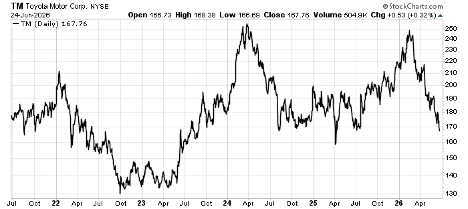
Toyota Motor Company (NYSE: TM) just quietly rolled out solid-state batteries that have twice the energy density of existing lithium-ion batteries. This is a game-changer.
Solid-state batteries were the holy grail of large-scale energy storage solutions. Unlike current lithium batteries, they don’t contain liquid. And Toyota’s version is outstanding. They recharge quickly. They last forever. They don’t explode. They don’t create unstoppable fires. And they store a lot more electricity per unit.
In other words, it’s a massive improvement on all counts.
This was always an engineering problem. And Toyota’s engineers are the first to market with an incredible solid-state battery. They have over 1,000 patents on solid-state technology.
Here’s the estimated performance improvements:
- Driving Range: Toyota Solid State: about 745 miles. Tesla EV technology: about 350 miles
- Charging Speed: Toyota Solid State: about 10 minutes. Mainstream EVs up to 25 minutes
- Lifetime: Toyota Solid State: currently 10 years, targeting 40 years. Mainstream EVs about 10 years.
- Safety: Toyota Solid State doesn’t explode or burn. Mainstream EVs can burn so hot they can’t be put out.
These are massive improvements. In fact, they’re so large they will change the battery industry. There will be some major implications for this technology. As with all major technological shifts, we’ll see winners and losers.
We Have a Winner!
The first winner was Toyota. They refused to roll out an inferior product. They kept their engineers and scientists working on this technology…and it paid off.
The company also plans to improve electric refilling stations. The new Toyota system refills batteries in about the same time as it takes to fill a gas tank. That means they need to move a lot of electricity quickly.
That puts all kinds of strain on the equipment and the grid. Our electric grid isn’t set up to handle a bunch of cars drawing massive amounts of power at the same time.
Toyota plans to install solid-state batteries at its charging stations. These would slowly charge over time, allowing EV recharging without impacting the grid at all. This is the holy grail of EVs – long range and fast recharging.
No More Grid Lock?
But beyond that, this battery technology has huge potential implications for grid storage. Today, energy use comes in waves. We use more in the daytime than at night. And there are “peak” periods in the morning and evening when we use the most power.
Electricity prices vary depending on demand. Peak periods are most expensive. That’s when utilities bring on big, natural gas turbines to add electricity to the system. Batteries that can recharge during low prices and discharge at peak periods can flatten the price curve. That could reduce the average price of power that we all pay.
That goes for both larger and smaller batteries, too. If they can scale these batteries, then they could displace Tesla’s hold on grid-scale batteries.
The Backup as a Starter
In addition, the new version would be useful for homes, particularly in storm-prone regions. In both Florida and North Carolina, I experienced week-long power outages due to storms. These safer, longer-lived batteries appeal to me. I could finally put in battery backup power at home.
And they get even better with solar panels. As electricity prices rise, we could see solar become more economical for home power generation. And these batteries can store electricity to offset expensive peak-hour power costs or to power a home when the power goes out.
Toyota’s patience and engineering resulted in an exciting breakthrough in battery technology. It’s a clear improvement on the Tesla model. And with Toyota’s existing infrastructure of car dealerships, it could easily displace Tesla as the premium EV seller in the U.S. and Canada.
Wrap Up
Finally, this battery technology could also displace Tesla’s grid-scale battery due to its safety and longevity. Tesla has a $1.4 trillion market capitalization built on the best EV on the market. Toyota is one-tenth the size and is about to dethrone it.
The play is long Toyota and short Tesla for the next year. We’ll check back periodically to see how the bet looks.

Dynamite Dolomites!
Posted June 26, 2026
By Sean Ring

Broken Window Press
Posted June 25, 2026
By Sean Ring

The Skunk at the Garden Party
Posted June 24, 2026
By Sean Ring

Black Box State
Posted June 23, 2026
By Sean Ring
Financial Fathers
Posted June 19, 2026
By Sean Ring