Posted August 31, 2026

By Sean Ring
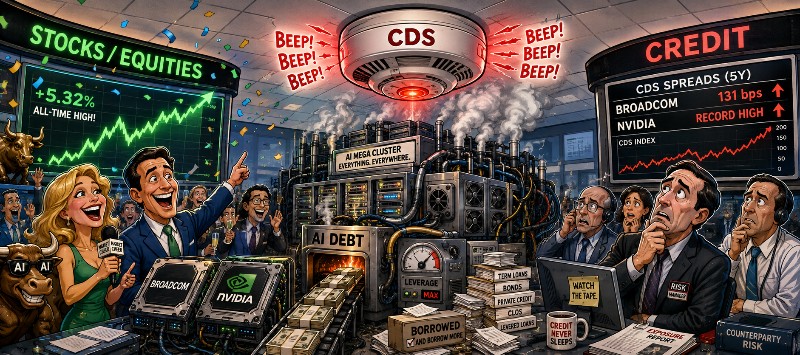
The Smoke Detector Is Beeping
Zero Hedge keeps posting the same chart. Every day, it prints a new record high.
The chart should lead every financial broadcast in the country. It doesn’t, of course. The anchors are too busy cheering the SPX.
It shows the cost of insuring Broadcom’s debt against default. That cost just jumped another 5 basis points to an all-time high of 131.
One basis point = 0.01%, or 1/100th of 1%. It’s easier to say 1 bp, pronounced “ one bip,” than to keep saying “zero point zero one percent.” Hence, 5 bps = 0.05%. 100 bps is 1.00%, and so on.
Nvidia’s debt insurance hit a record the same day. And the day before that. And the day before that. As Zero Hedge put it, "another day, another CDS blowout."
The instrument behind that chart is called a credit default swap, or CDS. Most investors have heard the term, usually in a sentence that also contains the words "2008" and "catastrophe." Few know what one actually is.
Today, we fix that. Because right now, the CDS market is telling you something the stock market refuses to hear.
What a CDS Actually Is
A credit default swap is a form of bond insurance.
That’s it. Strip away the jargon, and that’s the whole thing.
Say a pension fund owns $10 million of Broadcom bonds. The fund manager starts to worry that Broadcom might not repay him (default on the debt). He can’t sleep. So he calls a big bank and buys protection.
Here’s the deal they strike. The fund pays the bank a premium every quarter. In exchange, if Broadcom defaults on its bonds, the bank makes the fund whole. If Broadcom never defaults, the bank keeps the premiums and pays nothing.
The fund is the protection buyer. The bank is the protection seller. The contract usually runs five years.
That annual premium is the number you saw on the chart. It’s quoted in the basis points I mentioned above. Broadcom CDS now trades at 131 basis points. That means insuring $10 million of Broadcom debt costs $131,000 per year ($10,000,000 x 1.31% = $131,000).
A year ago, that same insurance cost a fraction as much. The price of protection has gone vertical.
One more twist. You don’t need to own the bonds to buy the insurance. That’s like buying fire insurance on your neighbor’s house. Ghoulish? Probably. But it means speculators who think a company is in trouble can put real money behind that view. And that’s what makes this market worth watching.
A Price Beats an Opinion
Now for the distinction that matters. A credit rating is an opinion. A CDS spread is a price.
You know the rating agencies: Moody’s, S&P, and Fitch. They assign letter grades to debt, from AAA down to junk. A committee meets, reviews the file, and publishes its judgment. The company being graded pays for the privilege. That conflict of interest is the whole story (and it explains the S&P analyst with poor eyesight in The Big Short).
Ratings move slowly and are backward-looking. They have no predictive power whatsoever. Enron carried an investment-grade rating four days before it filed for bankruptcy. Lehman Brothers was rated single-A in the month it died. The inspectors showed up after the fire.
A CDS spread is different. It updates every second the market is open. It’s set by traders risking their own capital, and nobody pays them to be polite. When the spread doubles, it means people with real money got nervous and acted on it.
A rating is the fire inspector’s certificate. It gets issued once a year, framed, and hung on the wall. Sometimes it’s still hanging there while the building burns.
A CDS spread is the smoke detector. It’s loud, immediate, and doesn’t care about anyone’s feelings.
The agencies still call Broadcom solidly investment grade.
The smoke detector agrees for now, with a wince.
Why It’s Beeping Now
On August 20, Bloomberg reported that Broadcom is arranging one of the largest debt deals in history. The structure calls for $60-$70 billion in senior secured debt, plus a junior slice of roughly $30 billion. The total could reach $100 billion, making it the largest deal of its kind ever.
The money buys AI chips, which get leased to customers, including Anthropic. Private credit giants Blackstone and Apollo are in talks.
The detail that made the CDS market gag is that the debt sits in a special purpose vehicle (SPV). That’s a separate legal entity created so that the borrowing doesn’t appear on Broadcom’s balance sheet, even though Broadcom guarantees a portion of the senior debt.
Off-balance sheet vehicles. Where have we heard that before? Enron ran on them. So did the 2008 mortgage machine.
The stock market shrugged. The credit market didn’t. Broadcom CDS has ripped wider every session since, hitting 131 bps at last count. Nvidia’s spread is making new daily highs, even after a coalition of banks announced half a trillion dollars in AI financing earlier this month. That announcement was only a memorandum of understanding, a comfort statement with no money attached. The detector ignored the press release and kept beeping.
Zero Hedge translated the credit market’s message into plain English: bondholders are done subsidizing overpriced GPUs, TPUs, and memory chips. The people lending the money want more compensation for the risk. They’re getting it, one record deal at a time.
When cheap money floods a sector, investors make the same bet simultaneously. When the turn comes, the bond guys blink first. Bonds led equities lower in 2000, in 2007, and in every cycle before and since.
Wrap Up
You can’t trade CDSs yourself. It’s an institutional market where contracts trade in multimillion-dollar blocks.
But you can read it, and the reading is free. Search "Broadcom CDS" or "Nvidia CDS" now and then. Watch the direction. When the cost of insuring a company’s debt keeps hitting records while its stock sits near highs, that’s a disagreement. One of those two markets is wrong.
To be fair, 131 bps implies a low chance of default. This isn’t Lehman in September 2008. But direction matters more than level.
The AI buildout runs on borrowed time and money. Now you know the instrument that keeps score. The equity crowd watches the stock's price. The credit crowd watches the price of survival.

A Crude Awakening
Posted October 23, 2026
By Sean Ring

All That Glitters Is Diesel
Posted October 22, 2026
By Sean Ring

Treason’s Greetings!
Posted October 21, 2026
By Sean Ring

Zach’s Second Opinion
Posted October 20, 2026
By Zach Scheidt

A COLA, But No Smile
Posted October 20, 2026
By Zach Scheidt