Posted August 06, 2026
By Sean Ring
The Situational Awareness Paradox
Before the opening bell rang on Wall Street last Thursday, one trade had already decided the day.
One fund sold. One fund bought. Billions in stock changed hands in a single block trade, done and dusted before most traders had poured their coffee.
The seller was a 24-year-old former OpenAI researcher named Leopold Aschenbrenner. The buyer was Ken Griffin's Citadel, one of the most feared and best-capitalized trading firms on earth.
This is the story of how a young man who claimed to see the future clearer than anyone alive lost track of something much closer to home: his own risk.
The Prophet
Two years ago, nobody knew Aschenbrenner outside a small circle of AI researchers. OpenAI fired him in 2024 over a safety dispute. Weeks later, he published “Situational Awareness,” an essay that argued “artificial superintelligence” was coming faster than anyone believed, and that only a handful of people understood it.
The essay went viral in Silicon Valley. It made Aschenbrenner famous. And it gave him something more valuable than fame: access to capital.
He launched a hedge fund and named it after his essay. Situational Awareness LP opened with about $225 million in mid-2024. Backers included Stripe's Collison brothers, GitHub's former boss Nat Friedman, investor Daniel Gross, and, notably, trading giant Jane Street. One of Wall Street’s most successful trading firms, Jane Street rarely gave any of its capital to other firms to manage.
In short, these weren't ordinary investors. They were the tech world's inner circle, betting on one of their own.
The bet paid off, spectacularly, for a while. By June 2026, the fund was up 439% net. Assets under management ballooned from $225 million to a peak near $45 billion.
The Fatal Ingredient
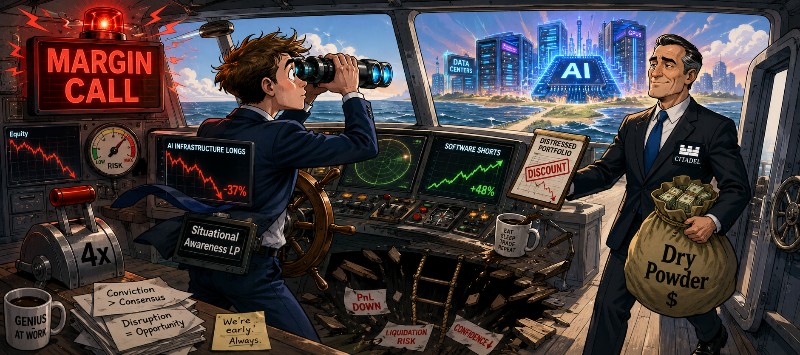
The returns weren't based merely on good stock picks. They were highly leveraged stock picks. Reports now put the fund's leverage at up to 4x its capital. With simple math, with 4x leverage, a 25% loss becomes a 100% loss.
To put that leverage in context, leverage levels for equity long-short funds were often somewhat lower than that before the 2008 crash, around 2 to 5x, then further tightened post-2008 to about 2 to 4x. So Aschenbrenner’s fund was at the high end.
Leverage is a magnifier. Sure, it multiplies your gains when you’re right. But it also magnifies your mistakes at a speed a 25-year-old’s judgment can't match. (To be fair, at 51, I’m not sure my judgment would suffice. But then again, I’m not 4x levered to begin with.)
The fund ran a 2-sided bet. It went long AI infrastructure names like SK Hynix, CoreWeave, Nebius, and Micron. At the same time, it shorted software companies like Adobe, wagering that AI would gut their business models.
Last month, both legs of the trade zigged when they should’ve zagged. The AI infrastructure longs fell off a cliff. Software stocks rallied hard. It’d be a bad time without the leverage. But with 4x leverage, that double whammy turns your trading book into strawberry jam.
The 6 Days That Ended It
On July 24, the fund quietly warned investors of trouble, according to the Financial Times. Word got out fast, as it always does. In the following days, positions kept falling.
Prime brokers, including Bank of America, Goldman Sachs, and JPMorgan, began demanding more collateral. When a leveraged fund can't post it, brokers force the sale. There's no negotiation once the math turns against you.
By Thursday, July 30, the fund had no room left to maneuver. It sold its entire public stock book, longs and shorts together, in one block trade before the market opened. Citadel bought the lot at a discount.
The fund's assets fell from a $45 billion peak to around $10 billion in days. Its private holdings, chiefly a stake in Anthropic, were reportedly left untouched.
The Paradox
“Situational awareness” is a real term. Pilots use it. Soldiers use it. It means knowing exactly what's happening around you, in real time, before it becomes a crisis. It's the skill that keeps you alive when conditions change fast.
Aschenbrenner named his fund after his own claim to that skill. He said he could see a decade of AI's future more clearly than anyone. He may even be right about that, long-term.
It’s worth noting that if Sam Bankman-Fried kept his nose clean, he may have been crowned the greatest venture capital investor in history. Analyses now estimate that, had SBF’s firm retained his stakes, the combined portfolio of Anthropic, Solana, SpaceX, Robinhood, and Cursor, to name a few, would be worth well over $100 billion today. However, that number is more conjecture than fact.
But Aschenbrenner lost track of the one thing situational awareness is built for: what's happening right now, to you, in the room you're standing in. He couldn't see the margin call 3 weeks out, even while forecasting artificial superintelligence a decade out.
Grand vision and immediate survival are two different skills. Markets don't reward the former if you fail the latter. That’s the paradox.
An Old Story, New Casting
F.A.Hayek called it the cluster of errors: when cheap, easy capital convinces smart people to make the same aggressive bet at the same time, in the same direction. It isn't random bad luck. It's synchronized conviction, and it always ends the same way.
We flagged Aschenbrenner's positioning back in May, when his fund's public filings first caught our eye. The pattern was visible even then. It just took a few more months to detonate.
There's a second lesson buried here, one Wall Street relearns every cycle. The winner in a forced liquidation is never the smartest forecaster. It's whoever has the driest powder and the least leverage when the selling starts. Ken Griffin’s Citadel didn't outthink Aschenbrenner on AI, nor did it play any dirty tricks. It just had cash when Aschenbrenner didn't, and bought his conviction at a discount.
Wrap Up
Less leverage and more patience let a trader live to fight another day.
Being right about the future isn’t the same as surviving the path to it. Aschenbrenner may still be right about AI. But you’ve got to survive a short-term margin call to see a decade-long thesis come to fruition.
As for you, own what you can hold through a storm. Keep enough dry powder so nobody ever forces your hand.
That's situational awareness.
The Trap Door Bailout
Posted August 05, 2026
By Sean Ring

The Hidden Diesel Tax
Posted August 04, 2026
By Sean Ring
The Price of Money Just Went Up
Posted August 03, 2026
By Sean Ring
History’s Greatest Bar Bill
Posted July 31, 2026
By Sean Ring
The Bond Market’s Fed
Posted July 30, 2026
By Sean Ring
