Posted May 20, 2026

By Sean Ring
The Ratchet Turns
Welcome to the second article in this series of developing your economic map. Today, we’ll talk about the government's interference in the markets. To start, I give you this priceless quote from none other than Ringo Starr:
Everything government touches turns to crap.
With that in mind, let us begin.
There's a tool in every mechanic's box called a ratchet.
It only turns one way.
Click. Click. Click. Each turn locks in. Pull to tighten. Repeat.
Ludwig von Mises, the greatest and most ignored economist of the twentieth century, identified the same mechanism in government policy 70 years ago.
He called it interventionism.
I call it The Ratchet.
Once you see it, you cannot unsee it. And it explains every policy disaster you have ever watched unfold in slow motion.
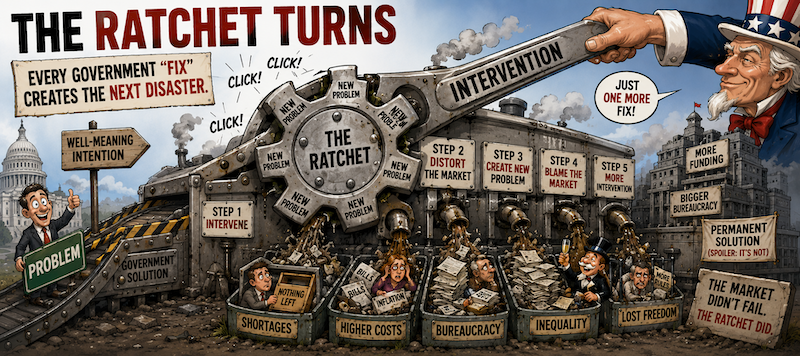
How The Ratchet Works
The logic is both elegant and brutal. And it’s completely invisible to most people.
- The government intervenes in a market. Price cap, subsidy, regulation, mandate, whatever… it doesn't matter. Pick your poison.
- The intervention distorts the market. It always does. Always. Because prices are information, overriding a price destroys information.
- The distortion creates a new problem. Shortages. Surpluses. Misallocations. Perverse incentives. The specific problem varies. The existence of a problem does not.
- This is the key click of the ratchet: the new problem is blamed on the market, not the intervention.
- The solution to the new problem is another intervention.
And now you're one turn deeper. The market is more distorted. The next problem will be larger. Therefore, the next intervention will be bigger.
The ratchet only turns one way.
The Rent Control Autopsy
You want a live specimen? Let's dissect rent control. It's almost too perfect.
A city, let’s call this one “Golden Gate,” decides housing is too expensive. Rents are high. People are struggling. The government must do something!
So, the city caps rents, solving the problem. Right? Not quite.
Since the price cap is below the market rate, landlords earn less than the market would pay. That means:
- New construction stops. Why build new apartments you can't price correctly?
- Existing landlords let properties deteriorate. Why maintain what you can't profit from?
- Tenants never leave. A below-market apartment is an asset… for the tenant. They stay forever.
- The housing stock shrinks, ages, and calcifies.
Inevitably, a housing shortage is right around the corner.
The city's response? "The market has failed to provide affordable housing. We need more intervention."
Subsidies, public housing projects, inclusionary zoning mandates, and the “required” bureaucracies to administer them all.
Each new intervention creates new distortions, and each new distortion justifies the next intervention.
San Francisco has been running this experiment for fifty years. The result is $3,500 studios and people sleeping on the sidewalk outside Twitter's old headquarters.
The Ratchet did that, not the market.
The Medical Billing Labyrinth
Here's one that hits every American directly, in the wallet and the gut all the way to the grave.
1945: The government freezes wages during World War II. Companies can't compete for workers with cash. So they offer health insurance instead, a non-wage benefit that escapes the freeze.
That's intervention one.
Post-war: The IRS decides employer-provided health insurance is tax-free. Now, insurance is artificially cheap if your employer buys it. As a result, nobody shops for healthcare on price. The price signal is severed.
That's intervention two.
1965: Medicare and Medicaid arrive. Government becomes the dominant buyer of healthcare. It sets prices administratively. Hospitals and doctors learn to game the billing codes. Complexity explodes. A new industry, medical billing, is born purely to navigate the bureaucracy.
That's interventions three through eleven.
Today, American healthcare costs 3x as much as comparable systems in Europe. That’s not because American doctors are greedy, or because American patients are sicker. It’s because 60 years of ratchet turns have so thoroughly destroyed the price mechanism that nobody, not the patient, the doctor, or the insurer, knows what anything actually costs.
The response from Washington? "The market has failed to deliver affordable healthcare. We need universal coverage."
Click.
The Student Loan Spiral
This one is almost elegant in its viciousness.
1965: The government decides college is too expensive for many Americans. Solution: federally guaranteed student loans. Now, anyone may borrow to attend.
Colleges notice their customers now have access to essentially unlimited credit. What do colleges do? They raise prices. Of course they do. That's what sellers do when buyers have more money.
Tuition climbs. Loans climb to match. Students graduate with debt loads their parents never imagined.
Washington's response? "College is too expensive. We need more loan forgiveness and more subsidies."
More money into the system. Prices rise again.
$1.7 trillion in outstanding student debt. Millions of graduates are in jobs that don't require degrees. An entire generation is carrying debt that (ready for this?) cannot be discharged in bankruptcy.
The Ratchet ran for 60 years. Now it's jammed so tight that every proposed solution, whether it’s debt forgiveness, free college, or income-based repayment, just turns it further.
Why The Ratchet Never Reverses
Here's the part Mises understood that most economists still refuse to accept.
The Ratchet doesn't keep turning because politicians are stupid or corrupt. Of course, most are one or the other or both.
But really, it keeps turning because of a fundamental epistemic problem.
Prices aren’t merely numbers. They are compressed information, the total demonstrated knowledge of all buyers and sellers, acting on their own circumstances.
When prices rise, producers make more and consumers buy less. When they fall, it the opposite happens. No matter how brilliant he may be, no central planner can replicate this signal. Not even a committee of them can do it, as history has shown time and again.
When the government overrides a price, it doesn't replace the information. It destroys it.
And you cannot solve a problem caused by missing information by adding more bureaucracy. The bureaucracy doesn't have the information either. Nobody does, except the market… and you just shut it down.
So the problems compound. The interventions multiply. The ratchet turns.
Mises wrote this in 1929. In a book called Critique of Interventionism.
He watched it happen in Weimar Germany. He watched it happen across Europe. He fled Vienna in 1934 when the ratchet reached its logical endpoint.
He spent the rest of his life trying to warn Americans.
We didn't listen.
Where The Ratchet Is Turning Right Now
You don't have to look at history. Look at this week's headlines.
- Energy. Decades of subsidies to wind and solar have not replaced fossil fuels. They've made grids fragile and electricity expensive. The solution on offer: more mandates, more subsidies, a bigger grid bureaucracy.
- Banking. Every financial crisis since 1913 has produced new regulations that protected large banks from competition while making the system more fragile. Silicon Valley Bank collapses. The response: consider more deposit guarantees, more Fed oversight. The next SVB, and we don’t know which bank it’ll be, is being built right now.
- Grocery prices. Inflation, driven substantially by money printing, has driven food prices up 25% since 2020, and that’s if you believe the official numbers. The political response in several countries: price controls on groceries. You already know what happens next.
Click. Click. Click.
Wrap Up
How can you protect yourself?
Well, you can’t stop the ratchet. Not alone. Not soon.
But you can stop pretending it isn't there.
First: when you see a policy crisis, whether it’s housing, healthcare, education, energy, ask one question before you accept anyone's explanation. What intervention came before this? There is almost always an answer. Find it.
Second: position your capital away from value traps, such as regulated industries with government-set prices. The distortions only deepen. Avoid them.
Third: own things that governments can’t easily intervene in. Hard assets. Real businesses with pricing power. Gold. The ratchet destroys paper promises. It cannot destroy a productive acre of land or an ounce of metal in your hand.
Fourth: stop waiting for the political system to reverse course. The ratchet doesn't reverse. The only exit is through the crisis that finally seizes the mechanism, forcing a reset.
Be ready for that moment by having some deployable cash on hand.
Mises saw it coming for decades before it arrived in Europe. He left with his manuscript and his life.

Give Me Liberty or Give Me Beige!
Posted October 19, 2026
By Matt Badiali

The Wright Stuff
Posted October 16, 2026
By Sean Ring

Crude and Unusual Profits
Posted October 15, 2026
By Dan Amoss

The Half-Life of a Bargain
Posted October 14, 2026
By Matt Badiali

Pump and Circumstance
Posted October 13, 2026
By Sean Ring