Posted September 04, 2026

By Sean Ring
The Palace of Fiscal Dominance
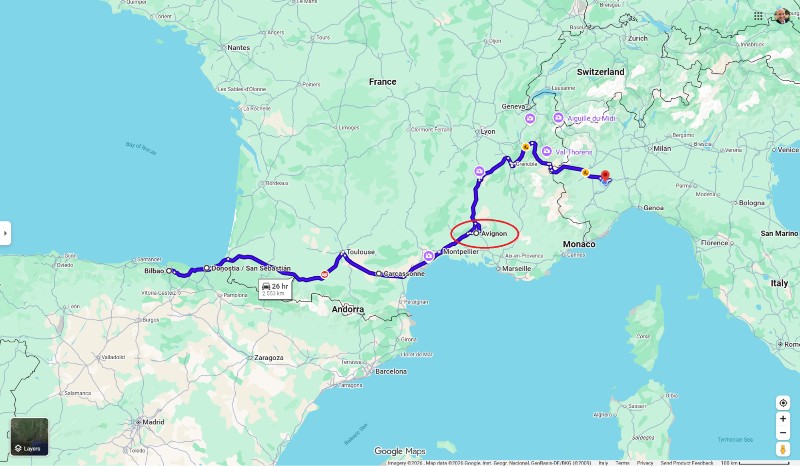
On our way home to Italy from the Basque Country, we stopped in Avignon overnight, as the drive would’ve been too long for one day.
Avignon is a walled city in the south of France. It sits on the Rhône River, an hour northwest of Marseille. We felt the mistral wind blowing down the valley hard enough to knock over our café lattes.
Our trusty Managing Editor and fellow world-traveling paesan Frank DeVechio recommended we visit the Palais des Papes, or, in English, the Palace of the Popes.
It’s a breathtaking fortress in the middle of the city that’s the size of four Gothic cathedrals.
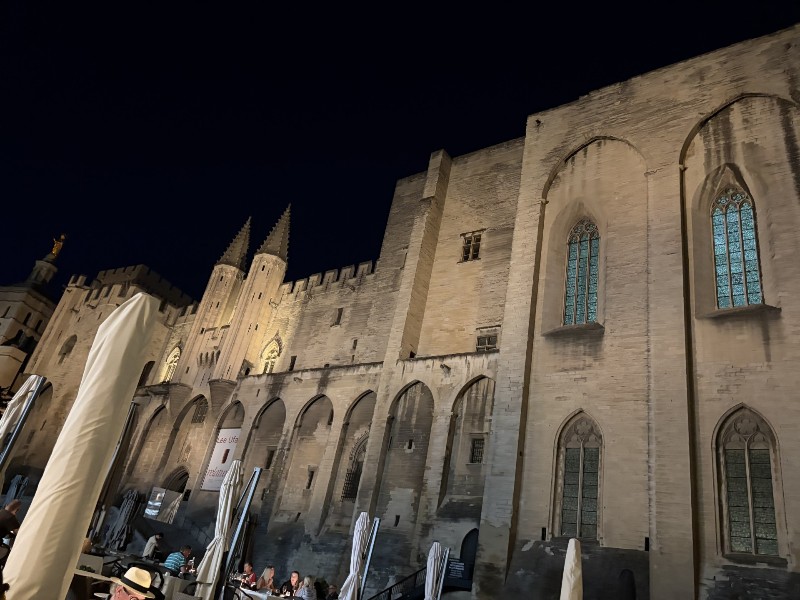 The Palais des Papes, from a café in the adjacent square. Credit: Sean Ring
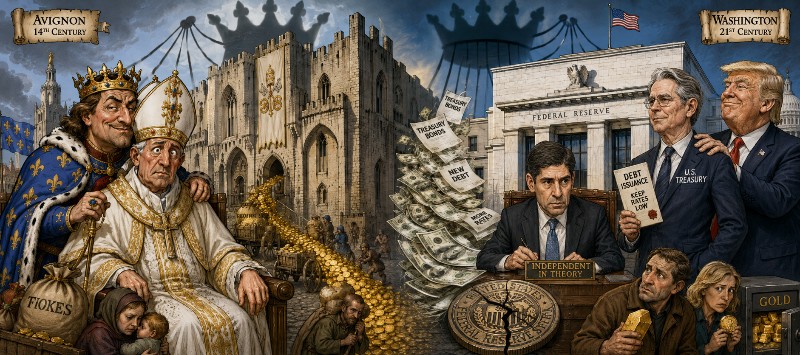
Most people don’t know that for most of the 14th century, the Pope didn’t live in Rome. He lived here, in the shadow of the French crown.
I’m going to relay a story that most Catholics, let alone Americans, have never heard. It’s one of the best lessons in monetary history, written in stone.
Avignon shows you what happens when a government captures an institution everyone is supposed to trust.
The parallel questions for us today are, “Will the USG capture the Fed like the French crown captured the Church?” and “If they do, what happens next?”
How the Pope Ended Up in France
Around 1300, King Philip the Fair of France picked a fight with Pope Boniface VIII. As always, the fight was about taxes. Philip wanted to tax the French clergy to fund his wars. Boniface said no king taxes the Church.
Philip's men stormed the Pope’s residence in Italy and, well, roughed up the old man. William McChesney Martin nods from the Great Beyond. Boniface died a few weeks later.
The church got the message. In 1305, the cardinals elected a Frenchman, Clement V. He never set foot in Rome as pope. By 1309, he had settled in Avignon, a stone's throw from French territory and power.
For the next 68 years, 7 popes ran the Church from this city. All of them were French.
The Italian poet Petrarch called it the Babylon of the West. The Romans called it the Babylonian Captivity. The institution that was supposed to stand above kings now lived next door to one.
The Best Tax Machine in Europe
An institution that moves in with power has to pay for the arrangement. So the Avignon popes built the most sophisticated tax machine in medieval Europe.
Pope John XXII, formerly a lawyer, perfected it. Every new bishop owed Avignon a year’s income for his post. Every document, appeal, and dispensation carried a fee. The papal treasury, called the Apostolic Camera, collected from every parish in Christendom, from Portugal to Poland.
Our old friend, the Cantillon Effect, rears its head again. This is the rule that new money enriches whoever stands closest to the printing press (or coin mint, in this case) before it reaches anyone else.
Avignon was the gushing spigot. Thanks to his proximity to the money, Clement VI bought the entire city in 1348 for 80,000 gold florins. Then, he finished the largest Gothic palace in Europe, filled it with banquets and paintings, and lived like the king he cowered to.
In the meantime, Rome fell apart. The true seat of the Church watched as its basilicas rotted and its population collapsed. The periphery paid, and the seat of power feasted.
Same as it ever was.
The Bill Comes Due
In 1377, Pope Gregory XI moved back to Rome. He believed returning to the Church’s headquarters would restore the institution.
It didn’t. He died within a year, and the wheels came off.
A Roman mob demanded an Italian pope, and the cardinals elected one. Then the French cardinals declared the election invalid and elected a rival, who moved back to Avignon. Now Europe had two popes, each claiming to be the real one, each excommunicating the other’s followers.
France and its allies backed Avignon. England and most of Italy backed Rome. In 1409, a church council tried to fix the mess and instead elected a third pope. For a while, 3 men wore the crown at once.
This Western Schism ran for nearly 40 years, until 1417. (Let’s not confuse it with the more famous Great Schism of 1054, when the Western and Eastern churches parted ways. This one was a civil war inside the Western Church, and Avignon caused it.)
Unfortunately, moving back to Rome didn't restore the trust. Once an institution sells its independence, the sale is permanent in the people’s minds. And when people stop trusting an institution’s impartiality, that trust is lost for good.
The Historical Rhyme
Now, let’s look at the current state of the Swamp.
The Federal Reserve is supposed to be independent, standing above the politicians the way the papacy was supposed to stand above kings. But the Treasury has to finance trillions in deficits, and it needs cheap money to do it. That’s fiscal dominance, and it’s turning up the pressure on the Fed to serve “the crown” with every FOMC meeting.
The reference to Martin above reminds us how then-President Lyndon Baines Johnson physically shoved the Fed Chairman around his Texas ranch, yelling in his face, “Boys are dying in Vietnam, and Bill Martin doesn’t care.”
Today, nobody is storming Kevin Warsh’s office in the Eccles Building. This is a gentler age. Now, the politicians are prisoners of a system that demands cheap money to function, just as Philip's wars demanded Church silver. Of course, they expect Warsh to respond to the State's needs, even if the State caused this mess to begin with.
Heck, savers expect Warsh to respond by cutting rates, and they're picking gold to prove it.
The cardinals of this system, the central bankers outside of America, have been buying it by the hundreds of tons. In fact, Norway’s sovereign wealth fund is the latest to propose cutting its Treasury holdings. That's no confidence vote, if we’ve ever seen one.
Wrap Up
The Palais des Papes still stands. So does the Church, which should give you hope. It cleaned its own house in time, though the reform came only after Luther and his 95 Theses forced the issue.
So institutions repent, but they won’t do that until all other possibilities have been exhausted.
Trust works like compound interest. Protect it, and it builds for centuries. Break it, and the losses compound too, long after the men who broke it are dust.
Seven hundred years of stone in southern France tells you which way the Church went when a sovereign leaned on it.
But will Warsh’s Fed cave the same way by cutting in he face of rising inflation? Even with 3 hawkish FOMC members dissenting at the last meeting, in favor of rate hikes?
For what it’s worth, according to FedWatch this morning, the market only gives a rate hike a 50/50 shot, down from the previous 67% probability.
For the record, I don’t think they’ll hike this coming meeting. But the mere threat will hang like the Sword of Damocles over the market until Warsh either hikes, or declares hikes are off the table.
We won’t know for sure for another 12 days.
In the meantime, it’s always a good idea to hold assets no committee can excommunicate: gold, productive land, real businesses with pricing power.
The faithful who kept the treasure through the schism handed it down intact to their grandchildren.
You can do the same.
Have a great weekend!

Obey, But Don’t Comply
Posted September 03, 2026
By Sean Ring
The Straitjacket
Posted September 02, 2026
By Jim Rickards

Sell Promises, Buy Things
Posted September 01, 2026
By Sean Ring

The Smoke Detector Is Beeping
Posted August 31, 2026
By Sean Ring
Play the Ball, Not the Referee
Posted August 28, 2026
By Sean Ring