Posted July 24, 2026

By Sean Ring
The Market Nobody Ordered
On Sunday, I was standing near the same window in Lower Manhattan that gave me Hercules Mulligan.
A step to the left, another painted panel caught my eye. A wooden sign, hand-lettered: “The Merchants’ Coffee House — News & Policks.”
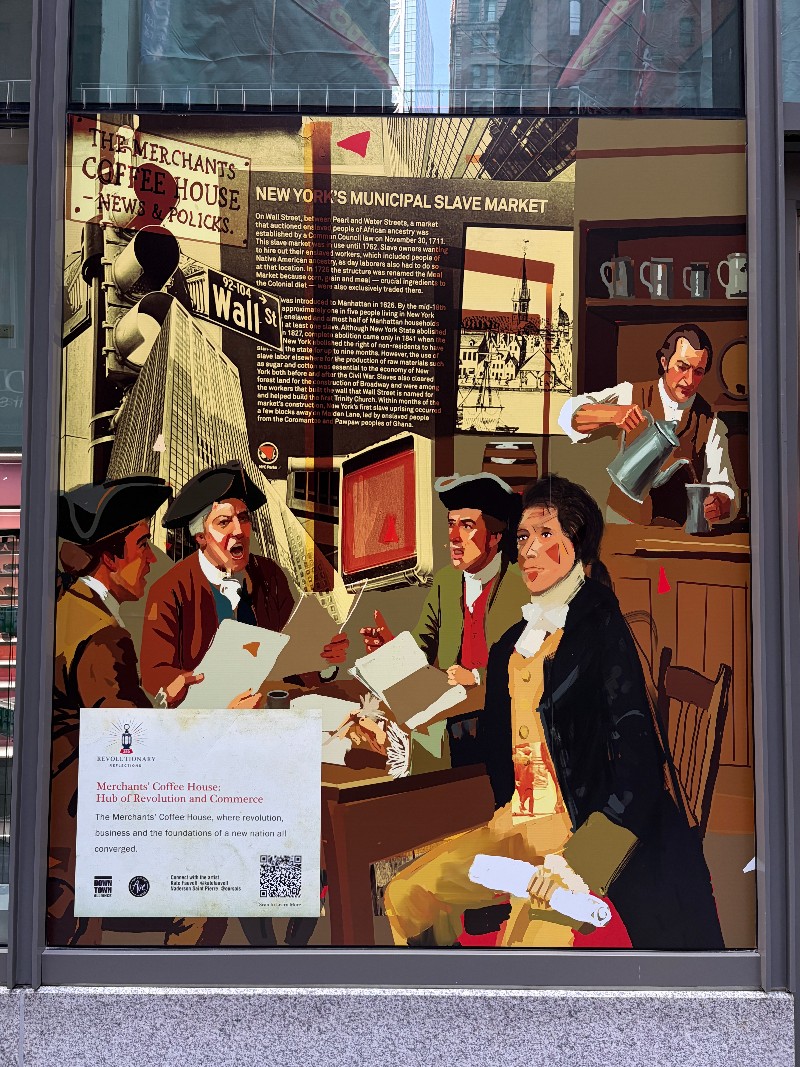
Now, I already knew coffee houses built London's money machine. Lloyd's of London, the great insurance market, started as a coffee shop on Tower Street. Traders were thrown out of the Royal Exchange for rowdiness, so they set up shop in Jonathan's Coffee House. That gathering became the London Stock Exchange.
What I didn’t know, until I stood at that window, was that the same thing happened here. On this exact corner. Wall Street and Water Street.
And the story is even better than London's.
The Corner Where Everything Traded
The Merchants’ Coffee House sat on the southeast corner of Wall and Water. By the 1780s, it was the busiest room in America.
Men came to read the papers, argue politics, and cut deals. They insured ships over coffee. They auctioned cargoes, real estate, and horses. The Chamber of Commerce met there. So did half the clubs and societies in the city.
In 1784, a group of merchants sat in that room and laid the plans for the Bank of New York. It was the city's first bank. Alexander Hamilton was in the thick of it. That bank still exists today. You know it as BNY (formerly Bank of New York Mellon).
In 1789, the same room welcomed President-elect Washington, a week before he took the oath a few blocks away.
And in 1790, sworn brokers held the first public sale of stocks right there.
No government agency planned any of this. No central authority drew up a blueprint. Men just kept showing up, cup in hand, and the deals kept getting bigger.
Grown, Not Built
Nobody ordered Wall Street into existence. No act of Congress said, “Let there be a stock exchange.” It grew.
When the coffee house got too crowded, the brokers moved. In 1792, twenty-four of them signed a short agreement, by tradition under a buttonwood tree at 68 Wall Street. That handshake deal is the founding document of the New York Stock Exchange.
Then they moved indoors again, to the new Tontine Coffee House up the street. That became the first real trading floor in America.
See the pattern? A market is not a building the state puts up. It’s what happens when free people are left alone to trade, trust each other, and keep their word.
Friedrich Hayek called this “spontaneous order.” Nobody designs it. Nobody runs it. It emerges from millions of small choices, and it works better than anything a committee could ever draw up.
The men in that room had their own money on the line. Get a deal wrong, and you paid for it yourself. That’s skin in the game. It’s why they were careful, and why the thing they built lasted 230 years.
The Other Panel
I owe you an honest word, because the window shows two panels, not one.
Next to the coffee house sits a darker sign: “New York's Municipal Slave Market.”
A block from that coffee house, the city ran a market where human beings were bought and sold. And here’s the ugly truth that fits our theme exactly: that market was not spontaneous. A government created it. The Common Council passed a law in 1711 to establish it. It was ordered into being by the state, by statute, on purpose.
The coffee house was no saint either. Among the goods it auctioned, shamefully, were people. Freedom to trade does not make men good. It only leaves them free to choose, for better and for worse.
But there is a thread of hope that came from the same room. The Society for Promoting the Manumission of Slaves also met at the Merchants’ Coffee House. The men working to end slavery in New York gathered under the very same roof. Mulligan, our tailor-spy, helped found it.
The worst market on that street was the one the government built. The movement to end it grew, like everything good on that corner, from free people choosing to meet.
Wrap Up
Over and over we are told markets need smart planners at the top. That without the experts steering, the whole thing falls apart.
Once you stand on Wall Street, you learn the truth. No one planned the most powerful financial center on earth. It brewed itself, one cup at a time, in a room full of merchants who simply wanted to trade.
There was no czar. Or mandate. And much to the chagrin of New York City’s current mayor, no five-year plan. Just coffee, conversation, and men who kept their word.
Next time someone tells you the economy needs a firmer hand from above, tell them about the corner of Wall and Water. Tell them Wall Street was the market nobody ordered.
Then finish your coffee. You’re standing in better company than you know.

The Magic Pill’s Real Trick
Posted July 23, 2026
By Ray Blanco
Dead Cat Bounces
Posted July 22, 2026
By Sean Ring

Crude Lies
Posted July 21, 2026
By Matt Badiali

The SPR Boomerang
Posted July 20, 2026
By Zach Scheidt
Silver’s Double Whammy
Posted July 17, 2026
By Sean Ring