Posted July 23, 2026

By Ray Blanco
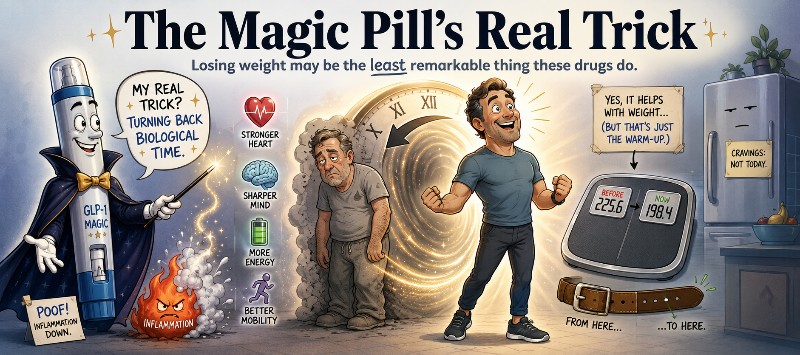
The Magic Pill’s Real Trick
Last month, Sean Ring talked about his fourth month on tirzepatide — the drug he's taken to calling "the Magic Pill."
Sean and I have been talking about these drugs for years — not as patients, but as analysts and traders. I share research with Sean. Sean tells me when a chart is screaming buy or sell.
We were trading GLP-1 peptide small caps years before either of us ever filled a prescription.
So when his doctor wrote him a prescription this past March, the conversation turned personal, and it went about like this: he asked if it worked, I told him I'd lost 45 pounds on it, and I told him he'd feel fantastic.
Three months later he was messaging me that he couldn't believe what it had done. The weight, sure — but more than that, the quiet. Walking past the refrigerator with the indifference of a man who no longer hears it calling. Awake for the first time in years. One beer in six months, and it tasted like nectar, but one was enough.
I know the feeling, because I'm in it too and I feel like I did ten years ago.
So consider all that the field notes of a two-man clinical trial. No control group. Just one shared suspicion that the American food supply might be the real disease.
Here's the part worth paying attention to, though. What Sean and I are feeling may be bigger than the number on the scale.
It may be the life clock itself.
Sean talked about tirzepatide, saying it was a "GLP-2." That’s close, but not quite. GLP-2 is a real hormone, just a different one.
Tirzepatide is a dual agonist: it works two receptors at once, GIP and GLP-1, where plain old Ozempic works just one. And Sean's instinct was dead right — it does do more than Ozempic. And that turns out to be the story, because the more of these receptors a drug engages, the more it seems to do.
Hold that thought for a minute.
Unexplained Goodness
Now for the mystery. In 2023, a trial called SELECT put semaglutide — Ozempic's active ingredient — against a placebo in roughly 17,600 people who were overweight but not diabetic. The result: a 20% drop in heart attacks and strokes.
That’s remarkable on its own. But then the researchers went digging to find out why — and here's the part that grabs me. Only about a third of that heart benefit could be explained by the weight the patients lost. Two-thirds came from something else.
Something else. That's the phrase that turns a diet drug into a genuine scientific riddle. If most of the good these drugs do has nothing to do with the number on the scale — then what, exactly, are they doing inside the body?
Part of the answer is that these drugs turn down inflammation — the low, invisible fire that smolders under nearly every disease of aging, from clogged arteries to failing memory. Damp that fire and a great many things improve at once, and you don't just see it on the scale; you feel it. That quiet energy Sean is feeling, the fog lifting, the naps he no longer needs — that's not just the weight. That's a fire going out.
But here's another finding that makes me sit up.
We can now measure how old you are biologically — not by the candles on your birthday cake, but by the mileage on the cells.
The tools are called epigenetic clocks. They read chemical marks that accumulate on your DNA in a predictable rhythm as the years pass — like a molecular speedometer. And in a real, randomized, placebo-controlled trial published this year, semaglutide slowed that speedometer down.
On one clock, the pace of aging dropped by about 9%. On another — the one built specifically to predict your overall odds of dying — the drug slowed the reading, too.
To my knowledge, this is the first time a drug has been shown, in a controlled human trial, to actually put the brakes on a person's aging clock.
For twenty years, the longevity crowd has pinned its hopes on stuff like rapamycin and metformin. And I love the science — but let's be honest about what it is: gorgeous results in mice, and a great deal of hope in humans.
The GLP-1 drugs walked into the room holding the thing everyone else was still promising — real human endpoints.
So when Sean tells you the Magic Pill has made him feel a decade younger, the emerging science says he may be more right than he knows. Under the belt notches, the machine really does seem to be running younger.
But as with everything else in life, there are a couple of catches.
Restore, Not Resurrect
The first is what "younger" means. So far, these clock studies were done in people whose clocks were already running fast — bodies under real metabolic stress. What the drug seems to do is bring a racing clock back down toward normal.
That's restoration, not resurrection. It's undoing the damage modern life did to you — which, if we all remember what the lockdowns did to our waistlines, is exactly the point. It is not yet proof you can take a perfectly healthy man and run his clock below the factory setting. Repair first. Reversal, someday, maybe.
The second catch is muscle, and it's the one nobody prints on the billboard. These drugs strip weight fast, and some of what comes off is muscle right alongside the fat. That’s not unique to GLP-1 drugs. Any plan that takes weight down fast takes muscle along with fat.
Muscle is your retirement account for old age — it's what lets you climb the stairs and catch yourself when you stumble at eighty. So if you're on these things: pick up something heavy a few times a week, and eat your protein. That isn't a warning against the drug. It's the instruction manual. Follow it, and you keep the good and reduce the bad.
Which brings me to the next part — and back to Sean's receptors.
There’s Another
Remember how the drug does more the more receptors it hits? Tirzepatide does two. A new one under late-stage trials hits three.
It’s called retatrutide, and it adds a third target — glucagon — on top of the two tirzepatide already carries. That glucagon receptor does something the others don't: it tells the body to burn fuel, including the fat wedged around your liver and organs, the nastiest, most inflammatory fat you carry. Which is why retatrutide posts the biggest weight loss in the entire class and the deepest cleanout of liver fat anyone has measured. It goes straight at the fire, at its hottest source.
And the muscle news is better than you'd fear. Even though retatrutide takes off more total weight, the ratio holds — the same healthy, mostly-fat split the gentler drugs manage — most likely because that GIP receptor lends muscle a hand. More total loss, same quality.
That's the direction the whole field is moving: not just stronger, but smarter. Combinations built to spare muscle. Pills coming to retire the needles. Every year, more effect and less friction — and, increasingly, aging itself in the crosshairs rather than merely the scale.
So where does that leave the two of us — and you?
Not at the fountain of youth. But plausibly at the first pill that bends the actuarial tables the right way — and here is what sets it apart from every dutiful statin you've ever choked down: you can feel this one working. Sean can feel it. I can feel it.
That's new, and it's why this class is one of the defining medical stories of the decade.
I won't hand you a ticker today. Just know that the two companies behind these drugs, Eli Lilly and Novo Nordisk, are on that list, and the small-cap peptide names Sean and I have been kicking around for years sit downstream of the very same wave.
And if slowing a racing clock back toward normal impresses you — wait until you hear about the enzyme that just walked out of an AI, and into a lab, and stripped forty years of molecular damage off human tissue the entire field had sworn was permanent.
That's not slowing the clock. That's running it backward. But that's a story for next time.

Dead Cat Bounces
Posted July 22, 2026
By Sean Ring

Crude Lies
Posted July 21, 2026
By Matt Badiali

The SPR Boomerang
Posted July 20, 2026
By Zach Scheidt

Silver’s Double Whammy
Posted July 17, 2026
By Sean Ring

America 250: Roll On, Big Boy… Roll On!
Posted July 16, 2026
By Byron King
