Posted September 25, 2026

By Sean Ring
The Lost Round Trip
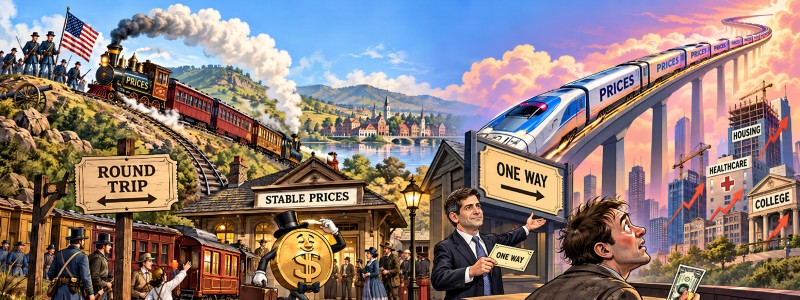
In 1884, a dollar bought roughly what it had bought before the Civil War.
America had fought its bloodiest war, printed greenbacks by the wagonload, and endured a roughly 75% surge in prices. And then the inflation went away. Twenty years later, prices had made the round trip.
The dollar went to war and, after a decent interval, came back home.
For most of American history, prices ebbed and flowed normally. But today, it seems that once something gets expensive, it stays expensive. Think of housing, healthcare, and college tuition. Anything the USG gets its grubby, greedy hands on, really.
But since it wasn’t always that way, I thought I’d show you why.
When Prices Fell
Peter Bernstein wrote about inflation his famous 1996 book, Against the Gods. He claimed that from 1800 to 1940, U.S. prices rose only about 0.2% a year and ended just 28% higher.
I love that stat, but then I went and checked it.
The Minneapolis Fed keeps a price index that reaches back to 1800. On that series, prices in 1940 weren't 28% higher than in 1800. They were about 17% lower.
Neither number is the gospel truth, because there wasn’t a national CPI in 1800. (And if the BLS is inaccurate today with all its computing power, just imagine how ridiculously wrong the numbers would’ve been back then.)
Those early figures come from Vermont farm records and older academic studies. The Fed itself calls anything before 1913, the infamous year of its founding, an estimate. So treat those numbers as a sketch.
But every version of the sketch shows the same outline.
Up the Mountain and Back Down
Let’s start with the wars.
The War of 1812 pushed prices up about 24% in 2 years. By 1824, they sat 35% below where the war began.
The Civil War lifted prices by 75%. They were back to prewar levels 20 years later.
World War I doubled prices between 1915 and 1920. By 1932, they had given back nearly 67% of that rise.
Prices had climbed in wars (always an expensive proposition) and booms (thanks to the credit expansion). Then they came back to earth. Between 1800 and 1940, the price index actually fell in more than 50 separate years.
Now, let’s cross over to the other side of 1940.
Prices rose an eye-watering 71% from 1940 to 1948. They never came back down. Since 1948, the index has posted a yearly decline just 3 times: in 1949, 1955, and 2009. Each drop was only 1% or less.
The round trip became a one-way ticket.
Remember, Congress created the diabolical Fed in 1913. In the 113 years before that, prices fell about 42%. In the 113 years since, they've risen more than 30x(!). What cost $1 in 1913 costs about $34 today.
Falling Prices Aren’t Always Bad News
Of course, Keynesian economists think that deflation means depression, and falling prices translate to breadlines.
To be fair, sometimes they do. The early 1930s were brutal. When money and credit collapse, prices fall because the money supply collapses.
But the late 1800s show a different outcome. Prices meandered lower for decades as America built railroads, steel mills, and modern factories. As a result, output soared. Goods and services got cheaper because Americans got better at making them. That’s “economies of scale” at work for you.
We call that “good” deflation. It’s the reward for progress, handed straight to the customer. The dollar bought more each year because the country grew more productive.
Of course, debtors hated it. Farmers who borrowed in cheap dollars had to repay in expensive ones. At the Democratic National Convention in Chicago in 1896, William Jennings Bryan told a roaring crowd that the country shouldn’t crucify mankind on a cross of gold. He spoke for the borrowers. A rising dollar made every debt heavier. Telling the crowd what they wanted to hear got him the nomination. Same as it ever was.
Keep that in mind, as it explains everything that came next.
Why the Ticket Only Goes One Way
Today, the biggest debtor on earth is Uncle Sam. As you know well by now, US federal debt tops $40 trillion.
So it’s little wonder why The Donald, his administration, and Congress want lower rates and a softer dollar. A dollar that gains value makes that debt heavier every year. A dollar that loses value melts it away. Any leader who wants to keep his job picks the melt.
But more importantly, the borrowers, the banks, and the spenders who keep them in office all want a softer dollar. Paradoxically, nobody in that coalition gains when the common voter’s savings grows on its own.
So the Fed made it official. In 2012, it named 2% inflation as its target. In Fedspeak, “price stability” now means prices that rise forever.
It sounds small, doesn’t it? Except it isn't.
Using the Rule of 72, at a rate of 2% a year, prices double every 36 years. A dollar you save at 30 buys half as much when you’re retired at 66. That’s how cheap money punishes the saver. The Fed’s stated goal actually hurts the citizenry.
Economist Charles Goodhart warned that when a measure becomes a target, it stops being a good measure. The CPI became the target. But now the target is a price level that only climbs… and it’s not even an accurate measure.
Where the Round Trip Still Runs
The round trip still runs wherever markets work freely. That is, when government regulations can’t keep up with innovation. Televisions, phones, and computing power get cheaper year after year. High productivity still drags prices down. Every time you buy electronics, you get more bang for your buck.
Of course, prices only increase when the government intervenes: college, health care, and housing. Stacking interventions on top of each other is an expensive habit indeed.
Gold tells the same tale. From 1834 to 1933, the government fixed an ounce at $20.67. For a century, the price barely needed to move, because the dollar held still. As of writing, gold trades at $4,275. Gold didn’t get more valuable. What you buy the gold with got less valuable.
Wrap Up
My grandfather used to tell me his popcorn costs 5 cents a bag. Since my popcorn cost $5 a tub, I thought my popcorn must’ve been better.
But popcorn is just popcorn. The truth is his dollar was far better than mine.
For most of America’s history, a saver could expect his money to hold its value. Sometimes it grew just by sitting still.
The people who understand the one-way ticket stop mistaking it for prosperity. Now you're one of them.
Have a great weekend.

The Wright Stuff
Posted October 16, 2026
By Sean Ring

Crude and Unusual Profits
Posted October 15, 2026
By Dan Amoss
The Half-Life of a Bargain
Posted October 14, 2026
By Matt Badiali
Pump and Circumstance
Posted October 13, 2026
By Sean Ring
The Crusade That Never Paid
Posted October 12, 2026
By Sean Ring