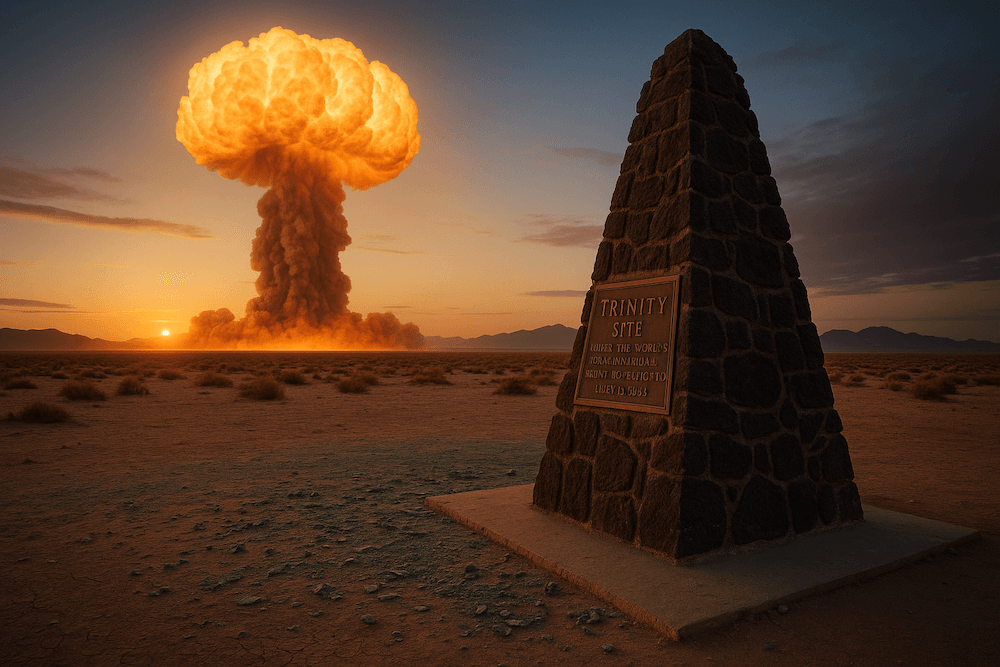
Posted July 18, 2025

By Byron King
The Flash That Created Our World
As the past week unfolded, it was easy to overlook the 80th anniversary of a significant event. As in, what did you do on Wednesday, July 16?
Sure… you were busy; we were all busy. Job, family, living life, and wondering what President Trump might do next. What’s happening with Tariffs? Ukraine? The Fed? Epstein? You name it…
But the anniversary came and went, and I suspect you didn’t notice. Because really, how often do you dwell on long-ago occurrences, indeed from 1945? Still, something happened that changed the world, and I mean changed it in microseconds. And today we live with the fallout, in every sense. (Heck, it’s why Trump bombed Iran last month.)
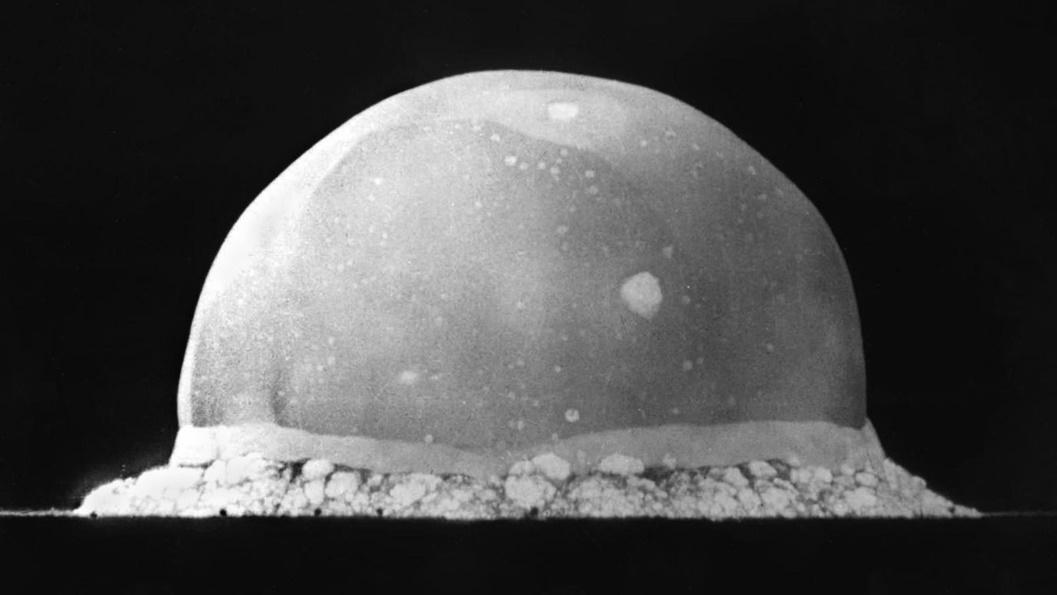
World’s first nuclear explosion; July 16, 1945, at Trinity. Courtesy Department of Energy.
A Flash, a Blast, Then Heat and Radiation
I’m referring to what happened at “Trinity,” deep in the New Mexico desert. And there, atop what used to be a 100-foot steel tower, on July 16, 1945, the U.S. Army conducted the world’s first nuclear explosion. The actual device was created as part of a top-secret, national-priority effort in World War II known as the Manhattan Project.
If you saw the movie Oppenheimer a few years ago, then you have the Hollywood version. That is, a super-smart guy named Robert Oppenheimer assembled a super-smart team that developed the math, physics, chemistry, and basic engineering for an atom bomb, at least when they weren’t play-acting in a soap opera like we saw on the silver screen.
But believe it or not, there’s more to the story than what the movie makers showed. Indeed, much was left on the cutting room floor, so to speak.
Here are the basics, courtesy of the Los Alamos National Lab, where many secrets were kept:
An incredible flash of light illuminated the sky as air temperatures rose to over 9,000 degrees Fahrenheit. Within seconds, witnesses saw the first mushroom cloud ever created by atomic weaponry. To most observers—watching through dark glasses—the brilliance of the light from the explosion overshadowed the shock wave and sound that arrived some seconds later. A multi-colored cloud surged 38,000 feet into the air within seven minutes. Where the tower once stood was a crater one-half mile across and 8 feet deep. Sand in the crater was fused by the intense heat into a glass-like solid, the color of green jade. This material was given the name trinitite. The explosion point was named Trinity Site.
And here’s an aerial photo, taken the day after by an Army reconnaissance airplane:
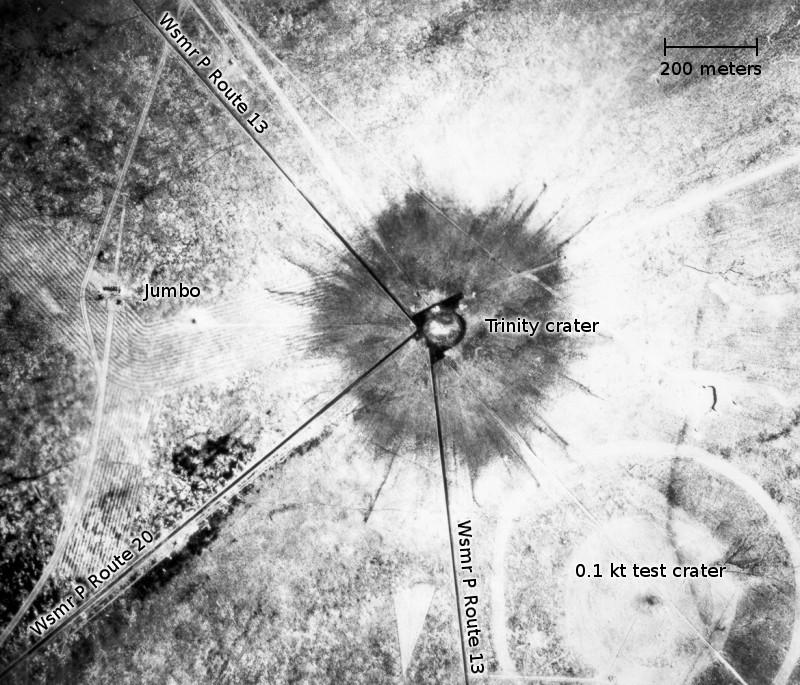
Trinity blast site and crater. Courtesy Department of Energy.
Trinity and the Jornada del Muerto
Again, there’s much to discuss beyond the movie, so let’s begin with some history. As in, why did Robert Oppenheimer and his Manhattan Project colleagues decide to test their bomb out in this particular patch of dirt?
Part of the answer dates back to the 1550s, when Spanish conquistadores arrived in the region, now known as “central New Mexico.” More precisely, those old Iberian soldiers were west of what is now Alamogordo and Holloman Air Force Base. They explored across a vast area of flat, dry, desolate outback that now comprises the Army’s White Sands Missile Range.
Of course, there were no roads back then; just a few, scattered native trails that wound through broken rock, patches of sand, clumps of stinging plants, and nests of rattlesnakes and scorpions.
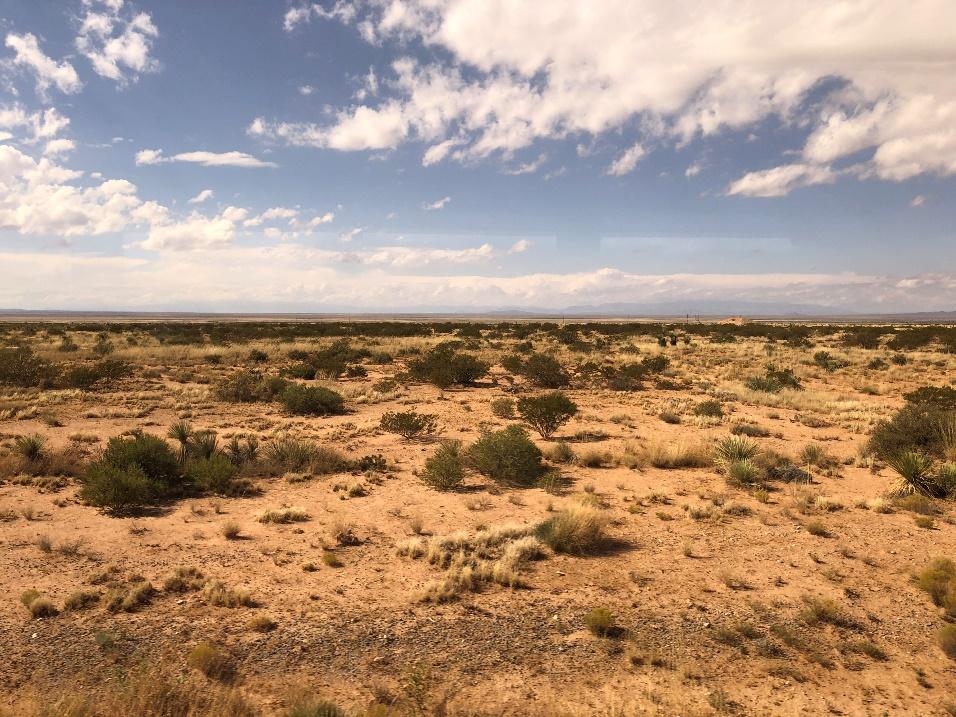
The landscape of Trinity, aka Jornada del Muerto. BWK photo.
Cautiously, as you can imagine, the Spaniards moved ahead on foot or horseback. They trekked north across a vast, harsh flatland that lay between two mountain ranges. All in all, the crossing covered about 160 miles, and at the end of the trail, the explorers named the region Jornada del Muerto, loosely translated as the “Route of the Dead Men.” And even today, if you look around the locale, it’s not hard to understand what the Spanish were thinking. The place can kill you.
With that, let’s now fast-forward four centuries, and that hostile region of remote nature is precisely what the U.S. government sought during World War II, when the Army and Navy needed a training range where pilots could practice dropping bombs. Thus, a large amount of the landscape in the area was condemned and became a government military reserve.
Soon afterwards, came the Oppenheimer (mentioned above), who realized in mid-1944 that he needed a place to test his bomb. And out of a list of possible sites that ranged from California to Texas, the atomic scientist chose this place, Jornada del Muerto; except he renamed it Trinity.
One wonders what was going through Oppenheimer’s head when he assigned a new name to this old landscape, formerly described by the Spanish word for death. The word "Trinity" has religious connotations; it refers to the Christian concept of the Godhead, which is understood as one God in three persons: the Father, the Son, and the Holy Spirit.
Meanwhile, despite the legendary brilliance of Oppenheimer and his team, nobody knew what might happen when their handiwork went off. Indeed, there was scientific speculation that a nuclear detonation might set the Earth’s atmosphere on fire. And in this sense, between the Jornada del Muerto and Trinity, there’s a particular religious symmetry to it all. Trigger the device and find out, eh?
Black Basalt and Green Glass
Well, we’re all still here, which means that Oppenheimer and his bomb didn’t destroy the world in a single moment. Last year, I visited the Trinity site, located deep within the highly restricted White Sands military installation.
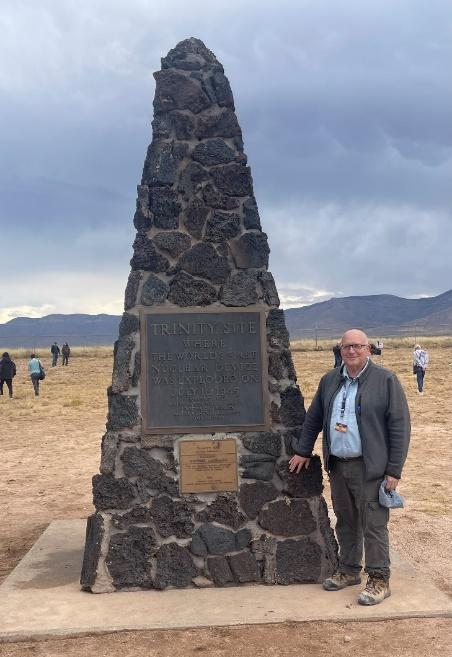
Your editor at Trinity, Ground Zero. BWK photo.
Of course, based on its history, Trinity is a national historical locale, now marked by an obelisk constructed of black basalt; see photo above. But at the same time, the area is sealed off good and tight from the public, guarded by guys with machine guns.
Still, for a few hours on just one day per year, the Department of Defense allows a relatively small number of people to enter this isolated stretch of real estate, walk around, and have a look. And I assure you, it’s not easy to get onto those Trinity grounds.
In fact, I spent two years on a waiting list and had to submit a checklist of personal information to the facility security manager. But there’s much to be said just to go there, take in the sense of it all, walk the grounds, and feel the sand crunch beneath one’s boots.
And yes, it’s sand, after a fashion; much of it trucked in to bury the mostly greenish glass called “trinitite,” a substance created by the energy of the blast and noted in that Los Alamos history passage above. Here’s an image of one small chunk:
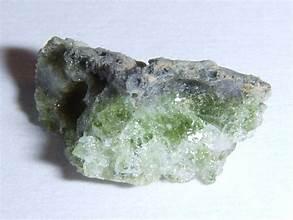
Trinitite, a nuclear-melted form of glass. Courtesy Stanford University.
Most trinitite is a greenish glass, although, to be thorough, I’ll add that some is reddish, black, or brown; the chemistry varies.
Technically, and in terms of mineralogy and chemistry, the substance is an “amorphous solid,” which means that there’s no crystal structure to the atoms inside. Oppenheimer’s nuclear blast vaporized gravel and sand on the desert floor, which then evaporated into a fireball. Over a short period, temperatures in the fireball dropped, and these elemental vapors formed into smallish glass globs that essentially rained down from the mushroom cloud to the surface.
Right after the blast, the Trinity crater was filled with this trinitite material. And back in the olden days (i.e., the late 1940s), visitors and government employees snagged samples, which over time made their way into mineral collections, including mine. Anymore, though, it’s illegal to collect trinitite samples at the site. So, if you want a specimen, you must find the right rock shop or maybe keep an eye on eBay.
From Trinity to Our New Trinity, the “Triad”
Oppenheimer understood that he was tasked to construct a weapon of great power. And as the narrative goes, and per the official Los Alamos history, when the scientist witnessed the first detonation of his creation, a piece of Hindu scripture ran through his mind: “Now I am become Death, the destroyer of worlds,” a sentence that is, perhaps, the most well-known line from the Bhagavad Gita.
To shorten many decades of events into a few words, out of everything that occurred at Trinity – out of that successful test blast – came the final chapter of World War II relating to Japan. And post-war came the nuclear-armed Cold War, from 1945 through… Well, it sort of ended in 1991 with the collapse of the Soviet Union, but now it’s rebooting in its way.
That is, I’m sure that many subscribers are old enough to recall their upbringing in the 1950s, 1960s, 1970s, or 1980s. You lived through the Cold War between the U.S. and the Soviets, with civil defense drills in schools and routine discussions about the number of bombers, missiles, submarines, and weapons each side had in its arsenal.
In both the U.S. and the Soviet Union, each government devoted immense levels of money, energy, and resources to building nuclear weapons and ways to drop them on the other side. And again, we’ll skip the vast details of history, other than to recall phenomenal national commitments to those bombs and delivery systems.
Which brings us to now, when the U.S. is engaged in another similar effort, because America’s Cold War nuclear complex has aged-out into an expensive assortment of legacy articles; that is, a so-called “triad” of land-based missiles, submarines and sea-based missiles, and aerial forces to deliver nuclear weapons, plus, the nuclear weapon packages themselves.
For the U.S., many Cold War systems are at or near the end of their operational lifespan. In many respects, we have a massive, geostrategic issue here, with block obsolescence for the nukes.
For example, America’s B-52, B-1, and B-2 bombers are aging and wearing out, despite receiving extensive maintenance. The land-based Minuteman missiles are similarly antique, as such things go, and are decades beyond their 1960s-era design life. At the same time, the Navy’s missile-launching Trident submarines are still out there, on patrol, but with a life expectancy that’s plotted on relatively short timelines.
This brings us to the new defense budget, which is expected to be in the range of a trillion dollars for the 2026 fiscal year. And a large whack of that will go for nuclear, or so-called “strategic” systems.
The Air Force has a program for a new, land-based missile. However, it’s over budget, despite the technical merits of the upgraded design, with prime contractor Northrop Grumman Corp (NOC) and numerous subcontractors.
Meanwhile, that same Northrop company is in the early stages of testing and producing a new bomber called the B-21. And, as with the price tags for everything, the new bomber rings up cash register numbers in the multi-hundreds of millions per unit, with some systems totaling into the billions. So, yes, there’s big money at stake.
Meanwhile, the Navy has been diligently developing a new missile-firing submarine, known as the Columbia class. However, as is the case with much else that comes from the long-neglected U.S. industrial base, the vessels are slipping on the calendar, while costs continue to climb.
The primary submarine builder for the missile-shooters will be General Dynamics (GD), with a substantial body of work from Huntington Ingalls Industries (HII), as well as numerous subcontractors.
There’s plenty more to say about the U.S. defense budget and where or how it gets spent, but not just now. In this note, my focus was on noting a vital date and anniversary from this past week.
Namely, Trinity was 80 years ago, and it changed the world in ways that still affect us; indeed, what occurred then and there has shaped national and international development for three generations and more. And in that sense, if nothing else, we all live at ground zero, where the ground underfoot crunches due to that unique form of green sand.
With that, I’ll sign off, wish you success in your investing, and thank you for subscribing and reading.

Rickards on Venezuela
Posted January 19, 2026
By Sean Ring

And The Queen’s Bank Was No More…
Posted January 16, 2026
By Sean Ring

Passing Notes to Avoid War
Posted January 15, 2026
By Sean Ring

RIP, Scott Adams
Posted January 14, 2026
By Sean Ring

Worldwide Whack-A-Mole
Posted January 13, 2026
By Sean Ring
