Posted March 12, 2026

By Sean Ring
The Everything Problem
Remember 2020? Markets spent two years blaming "supply chains" for inflation, as if cardboard boxes and containerships had spontaneously decided to cause a crisis. It was never really about the boxes. It was about what was in them and who could pay for the fuel to move them.
This time, the problem is older, simpler, and considerably more vicious.
War in Iran and an effective closure of the Strait of Hormuz don't just delay goods. They choke off the fuel, feedstock, and fertilizer that make modern trade possible in the first place.
COVID gave us a logistics crisis with plenty of energy. A sustained shutdown of the Strait of Hormuz will become an energy crisis that drags logistics, manufacturing, and food production down with it.
The result is a messy, nonlinear smash-up of demand destruction, cost-push inflation, and panicked policy. Think 2008 plus 2020, not a rerun of the 1970s. The 1970s, at least, had the decency to move slowly.
From Oil Shock to Everything Problem
The transmission mechanism starts with energy prices, but it doesn't stay there long.
When a significant portion of seaborne oil and LNG is suddenly trapped, the world loses a key marginal source of relatively cheap, flexible energy. Yes, there are alternative routes and pipelines. But they're slower, smaller, and more expensive. The market doesn't care that "there's still oil somewhere." It cares that the swing supply just upped and vanished.
Then, higher oil and gas prices filter into everything: diesel for shipping and trucking, jet fuel for aviation, natural gas for heating and power, gas-linked feedstocks for fertilizer and petrochemicals. Input costs jump for anyone who moves, makes, or grows stuff. Episodes like this raise civilization's overhead costs.
Next comes the demand destruction. Households spend more on energy and food, and less on everything else. Companies see their margins squeezed between rising costs and customers who can't pay up. At some point, companies stop hiring (see: Silicon Valley), cut capex (AI will be finished then), and start protecting cash. That's how an energy shock morphs into a demand shock, and why the casualties will extend far beyond the Persian Gulf region… into your backyard.
More Macro Toxic Than COVID
There are at least three reasons this episode can be more damaging than the container crisis.
First, the bottleneck is upstream, not downstream. During COVID, the world had energy. Ports, containers, and labor were just misaligned. Once the kinks were worked out, goods flowed. An energy chokepoint is different. If molecules can't move, nothing downstream matters. You can't optimize your way around zero fuel.
Second, the shock hits essentials first. Energy, fertilizer, and basic chemicals sit at the base of the production pyramid. (Basic chemicals are the chemicals that build all the other stuff. They sit just above oil and gas in the value chain.) When they spike, the pain hits food, heating, and electricity. That's a politically explosive mix: inflation in consumer staples (products you need) and a recession in consumer discretionary (products you want, but can no longer afford).
Third, the policy trade-offs are nastier. In 2020, governments and central banks could flood the system with counterfeit money and call it stimulus. In an energy-constrained world, shoving demand into a broken supply side risks turning a recession into stagflation (higher prices with no growth). Do policymakers support growth and accept higher inflation? Or crush inflation and accept a deeper slump? There are no clean exits, only different levels of harshness in the trade-offs.
The 2008-Meets-2020 Policy Playbook
If the shock persists, the macro script is fairly predictable even if the timing isn't.
First comes volatility and risk-off behavior as markets try to price an unknowable path for energy, growth, and policy. Then comes the central bank dilemma: headline inflation rising, growth indicators weakening, policymakers talking tough about not repeating the 1970s.
Then comes the pivot. Something, somewhere, breaks. This cycle’s prime candidate is private credit. The conversation flips overnight from "too much inflation" to "we must stabilize the system." Rate cuts (thank you, Mr. Warsh!), swap lines with allied central banks, microwaved QE, and selective bailouts… think 2008's ER-like operations layered onto 2020's massive intervention, all set in a world with little real-world capacity.
At that point, the inflation that prompted the tightening hasn't gone away. It's just been politically outranked by the panic.
Who Gets Hit, Who Gets Lucky
Not all sectors suffer equally. The injured form two lines: energy intensity and demand elasticity. Airlines, shipping, trucking, chemicals, and parts of agriculture see costs spike, but can’t pass on price increases.
Highly leveraged real estate, consumer finance, and speculative growth names suffer from tighter financial conditions even before the real economy fully rolls over. We’re seeing that already. Discretionary consumer brands discover that when energy and food claim a larger share of household budgets, they're first against the wall. That’s coming to a theater near you.
The relative winners? Upstream energy producers with barrels and molecules that can move, at least until windfall-tax chatter turns confiscatory. Energy-advantaged regional industries, like US Gulf Coast petrochemicals, look far better than European counterparts lacking local cheap gas. Firms tied to energy efficiency and grid resilience are also desirable because substitution and reliability drive capex toward infrastructure.
Daily Reckoning Editor Adam Sharp’s Petrobras (PBR) call looks more prescient (and rewarding) by the day.
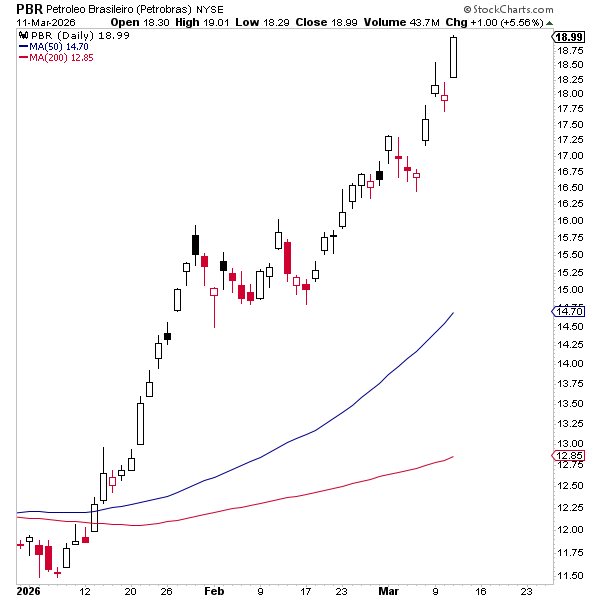
PBR, year-to-date, daily candles.
Gold, Silver, Copper… and the AI Elephant in the Room
One category of "relative winner" deserves particular skepticism right now: high-multiple tech and AI.
On paper, their cash flows are far in the future, making them extremely sensitive to changes in discount rates and risk premia (the return investors require).
There’s one enormous problem. Data centers, AI training clusters, and cloud infrastructure are voracious power consumers. In the early stages of an energy-driven shock, these names are in double trouble. First, through valuation, as investors finally and mercifully realize that their triple-digit P/Es look ridiculous. Second, through cost structure, as power prices spike and grid reliability becomes a genuine constraint on scaling compute.
Today's AI heroes may still grow into their valuations over time. But they aren’t immune to an energy-driven slowdown. They may be more vulnerable in the short run than old-economy producers of the molecules needed to keep the GPUs humming.
For investors looking at protection rather than performance, the classic metals still do their jobs… though not at once.
Gold's role is the clearest. In the initial "everything sells" phase, it can get dragged down as a source of liquidity. But once policymakers pivot, gold reasserts itself as a hedge against negative real yields and policy error, though I’ve been assured “the smartest guys in the room” won’t let that happen this time.
The 2008 and 2020 playbooks both ended with gold near new highs.
The high-beta, half monetary metal, half industrial-commodity silver is trickier. During sharp downturns, it often underperforms gold badly. Its moment comes in the second act, when stimulus floods a damaged supply side, and liquidity goes hunting for hard assets. Silver thrives in greed, not fear.
Copper tracks the real economy most faithfully. It rallies early on scarcity themes, then mean-reverts hard when demand destruction hits industrial activity. That’s Dr. Copper diagnosing the recession in real time. The structural bull case for copper reasserts itself only later, when the world resumes investing in grids, electrification, and infrastructure under a new stimulus regime.
In short, gold hedges the monetary consequences of the crisis. Silver and copper are leveraged plays on the eventual reflation and rebuilding… not insurance for the downturn itself.
Wrap Up
As a result, I’m offloading my copper and silver mining holdings and holding those proceeds in cash. I’m keeping PBR and my uranium holdings. I’m just not comfortable with the macro outlook and the impending supply shock.
Even if The Donald calls time on this incursion now, I’m not sure the Iranians will let him off scot-free. It seems they’d rather not get bombed again next year. And the longer this situation persists, the rougher the outcome for the world economy.
Iran can’t beat America militarily. But it can cut off the things that make America’s military great, and it’s attempting to do just that.
The world’s most important artery is clogged. The world is being prepped for surgery. Whether the surgeons know what they're doing is, as always, the big question.
If this situation magically goes away, we can just buy back in.

The Wright Stuff
Posted October 16, 2026
By Sean Ring

Crude and Unusual Profits
Posted October 15, 2026
By Dan Amoss
The Half-Life of a Bargain
Posted October 14, 2026
By Matt Badiali

Pump and Circumstance
Posted October 13, 2026
By Sean Ring

The Crusade That Never Paid
Posted October 12, 2026
By Sean Ring