Posted September 11, 2026

By Sean Ring
The Bypass Bullseye
Saudi Arabia’s Plan B caught fire last night.
Satellite sensors picked up 6 hotspots along the kingdom's East-West Pipeline at roughly the same moment Wednesday evening. NASA’s fire-detection system flagged heat readings more than twice that of a normal desert blaze. Imagery showed a black smoke plume tracing the pipeline route southeast of Medina. Some estimates put it at almost 100 kilometers long.
The Financial Times reported a drone attack on the line, with damage still being assessed. Aramco declined to comment. Riyadh has confirmed nothing.
Incredibly, the attack came only a couple of hours after Washington announced a 2-week ceasefire with Iran.
We know the satellite data is real, but the story isn’t official yet. This pipeline has been hit before, both in 2019 and again this past April. Fortunately, both times the damage was repairable. And that may be the case again.
But whether this strike turns out to be a gash or a graze, the lesson doesn’t change.
The bypass was never the magic pill.
Why This Pipeline Matters
The East-West Pipeline, also called the Petroline, runs about 746 miles from the oil fields of Saudi Arabia’s Eastern Province to its port of Yanbu on the Red Sea coast.
The Saudis built it in the 1980s during the Iran-Iraq War for one reason: to move crude without sailing it through the Strait of Hormuz.
For 40 years, it sat there as insurance. This year, it became the main supply route.
With Hormuz effectively shut since the war with Iran began, Riyadh rerouted most of its exports through Yanbu. Only 7 tankers transited through the Strait on Wednesday, against a 10-day average of 14. Yanbu has been carrying roughly 4 million barrels a day, down from the 7-plus million the kingdom shipped before the shooting started, but that’s better than nothing.
Every analyst note this summer said the same thing. Yes, the Strait is a mess, but Saudi had the bypass. That bypass became the market's comfort blanket.
Some lucky shots in Yemen (or were they?) just set the blanket on fire.
The 750-Mile Problem
The Saudis can defend a port. They can ring Abqaiq with Patriot batteries and point everything at the sky. It’s one location that’s only a few square miles, and worth every missile you can fire at the incoming drones.
They can’t defend 750 miles of steel lying in open desert. No one can.
Again, this is simple arithmetic, something markets and government have surprising trouble with on occasion.
A defender has to protect every millimeter of pipeline for every microsecond, forever. An attacker has to nip 1 seam with 1 lucky shot. A drone that costs less than a used pickup truck can force a shutdown of a line that moves 4 million barrels a day. Each interceptor the Saudis fire costs more than 100 of the drones it's chasing.
That math never works for the defense.
Remember, redundancy is the first rule of survival. (Thank you, Nassim Taleb.) But a backup that sits exposed across 1,000 kilometers of flat sand isn't redundancy. It’s a ginormous bullseye. The hopium-inhaling Mr. Market priced the pipeline as a guarantee, but the pipeline has a glass jaw.
The Bigger Board
On Monday night, the Houthis launched a bunch of missiles and drones at Abha, Jazan, Najran, and Khamis Mushait. 73 people were wounded. Several energy facilities suspended operations. Brent spiked through $100 for the first time since July.
The Houthis have also seized Mocha, a Red Sea port near the Bab al-Mandab Strait. Shipping through that chokepoint is already down about 60%. If the Houthis gain control of both ends of the Red Sea approach, they will render Yanbu inoperative.
As a result, Saudi Crown Prince Mohammed bin Salman called President Trump (twice!) on Thursday, asking him to strike the Houthis. According to Axios, The Donald declined.
It’s hard not to read that as betrayal of an ally and of America’s own interests. But a better way to look at it is through incentives. Voters want cheap gasoline and don’t want new offensives. Another Middle East bombing delivers the latter but not the former.
Riyadh’s royal family spent decades renting American protection, but now the lease terms have changed. Leaders on both sides are doing what their coalitions demand. That’s all any of them ever do.
One last thing, but treat this with skepticism. Unconfirmed reports claim a Saudi battalion surrendered to Houthi forces inside Yemen. That’s the fog of war until proven. But that serious people find it plausible tells you how Saudi’s ground campaign is going.
Gaming It Out
Why can the Houthis suddenly hit what they aim at?
Sit down, if you’re not doing so already. Trust me.
Are you sitting?
Ok, here goes.
Anthropic, the AI company that built Claude and whose hotly anticipated (and rushed) IPO is coming late this year, disclosed that it disrupted a Yemen-based weapons-engineering cell that used Claude to develop missile guidance software.
I’m no military expert, but I rate that as “really not good.”
Now, low IQs aren’t an impediment to ballistic missile technology. And they didn’t even use China’s DeepSeek to cut costs! The knowledge that once required a state, a budget, and a lab full of German scientists now sits on a decent MacBook Pro.
What’s next? Will they beat Anduril’s Jetson ONEs with full self-driving flying carpets? Palmer Luckey, beware!
In any case, precision used to be the rich man's monopoly. Those days are over. Now every fixed asset on earth, and that’s every pipeline, refinery, and power station, is decorated with a highly capital-intensive bullseye.
What It Means for Oil
Brent traded at $109.97 this morning, up around 80% this year, but still below March’s high of $119.50. Goldman Sachs warns Brent could clear $120 next year if Gulf output stays 4 million barrels a day below prewar levels.
The market has been treating each strike as a one-off. They’re not. Each hit is a part of a campaign against the workaround. If the Houthis take out the bypass, Hormuz’s closure becomes a siege.
At Paradigm, we've banged the energy drum all year, while the crowd chased AI story stocks. Now, crude oil is up 80%, as the barrel beat the narrative (and the SPR releases).
Wrap Up
I expect Aramco to announce minor damage today, and the line pumps will be on. Whatever.
The lesson stands either way. A 746-mile pipe in open desert can't be a fortress, and the market's comfort blanket has holes so big in it, they’re visible from space.
That makes sense, as anything indispensable eventually becomes a target.
Position for persistence. This won’t be over for a long time, something I asserted in early March.
The risk premium in crude is the new floor. Energy producers, tankers, and hard assets keep working.

Pardon My Financial French
Posted October 02, 2026
By Sean Ring

For Whom the Debt Tolls
Posted October 01, 2026
By Sean Ring

Spend It Like You Stole It
Posted September 30, 2026
By Sean Ring
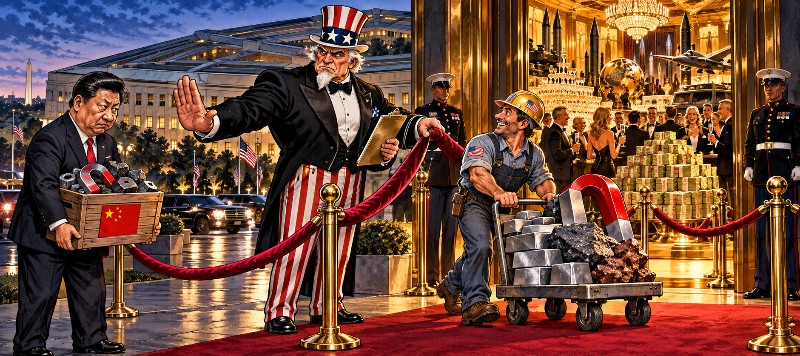
The Pentagon’s Velvet Rope
Posted September 29, 2026
By Sean Ring

From Athens with Contempt
Posted September 28, 2026
By Sean Ring