Posted November 19, 2026

By Sean Ring
The 270-Vote Trap
After the Democratic victories on Election Day, the party is busy announcing its plans for the next two years, with an eye on the 2028 presidential election. Most of the plans are obvious, including investigations, hearings, subpoenas, and grandstanding, all designed to embarrass Republicans in general and Donald Trump in particular.
These efforts will include attempts to impeach Secretary of Defense Pete Hegseth.
One such attempt, led by Republican Rep. Thomas Massie, has already been tried and failed in the lame-duck Congress now meeting. The House voted 211–204 to send the impeachment resolution to committee, effectively killing it.
Eleven Democrats missed the vote, with several blaming a traffic incident near the Capitol. That’s a pathetic excuse. D.C. has traffic jams every day. But the Democrats will certainly try again in January.
President Trump himself will likely be impeached (for the third time) next year. This will turn into a major media spectacle, but none of it will matter in terms of policy substance. The Senate will not have the votes to remove Trump from office.
As for laws Congress may manage to pass, Trump will veto them unless he regards them as substantively good for the country. Again, little of substance will happen.
And there’s a serious flaw in the Democrats’ plan for attacking Trump on a full-time basis. The Democrats themselves are facing their own internal war.
The Civil War in Congress
Among those elected to the House and Senate in the Blue Wave were candidates backed by the Democratic Socialists of America (DSA), which represents the socialist wing of the Democratic Party.
DSA-aligned members are already causing a stir on the Democratic side over leadership elections for the new Congress in January. Hakeem Jeffries is likely to be elected Speaker of the House. But he’s catching grief from the party’s far-left faction. They don’t worry that Hakeem is radical. They worry that he’s not radical enough.
This points to where the real drama will be for the incoming 120th Congress. It won’t be between Democrats and Republicans. The Democrats are too powerful for that.
It will be between moderate (even progressive) Democrats and the far-left socialists. AOC and the Squad tentatively side with the DSA on this. The most radical members have little interest in compromise. That’s how they roll. So don’t expect this tension to go away.
As for the U.S. Senate, many assumed Chuck Schumer was a sure thing for Senate Majority Leader, given the Democrats’ strong midterm performance.
But Sen. Chris Van Hollen of Maryland formally announced his challenge to Schumer for Senate Majority Leader on Nov. 12. He already has the backing of Bernie Sanders and several newly elected Democrats.
Van Hollen claims to have at least 15 votes, while Schumer insists he has enough support to retain his leadership position. The showdown is expected in early December, though efforts are underway to move the vote up.
The Republicans have already conducted their leadership elections for the new Congress. Jim Jordan will be the new House Minority Leader. He defeated Steve Scalise in a Republican caucus vote, 106–73. Current Speaker of the House Mike Johnson declined to run for Minority Leader following the magnitude of the Republican losses.
On the Senate side, John Thune was elected Republican Minority Leader. He is the Majority Leader in the outgoing Congress, but that’s over in January. His election was rushed through. Sen. Ron Johnson (R-WI) was so upset with the rush that he walked out before the vote.
I’m with Johnson. Thune’s election as Minority Leader was a joke. How do you lose eight Senate seats, with a ninth still in play, surrender your majority, and somehow keep your leadership job?
Thune says he wants to use the lame-duck session to confirm as many of Trump’s judicial nominees as possible before Republicans lose control of the Senate. Why wasn’t that done a year ago? Those nominees could have helped the Trump agenda if they had been on the bench.
Instead, we were stuck with Autopen Biden and Obama judges who thwarted Trump at every turn. That’s just one example of Thune’s incompetence as leader.
Current Senate Minority Leader Chuck Schumer and House Minority Leader Hakeem Jeffries face growing pressure to maintain cooperation between moderate Democrats and DSA-aligned members when the new Congress convenes in January.
But the most radical socialists don’t compromise. They start with radical positions and push for even more radical policies as the process unfolds. They dig in their heels and are prepared to damage their own party unless they get what they want.
Some DSA members and other far-left progressives have advocated policies ranging from abolishing ICE and replacing the Electoral College to expanding the Supreme Court, establishing Medicare for All and imposing steep taxes on the wealthy. Some have also called for restructuring or abolishing the Senate.
These are deeply held ideological convictions, not bargaining chips. The most radical members have no intention of compromising on their demands.
While Republicans are licking their wounds after a crushing electoral defeat, Democrats may soon discover that the greater threat comes from within their own party, where the far left is holding them hostage.
270 Votes to Bypass the Electoral College
The agenda of the socialists and radical progressives who were swept into office in the midterm elections is not hidden. They used to speak and write in euphemisms and code words to hide what they were really all about. Not anymore.
They openly advocate abolishing the Electoral College.
The Electoral College was set up by the Constitution in 1787, in part to give smaller states a slightly larger voice in the selection of presidents. A straight popular vote would have given greater power to the big states in 1787, especially Virginia, New York, Massachusetts, and Pennsylvania.
Today, the big states are California, New York, Texas, and Florida, but the idea is the same. If a small number of big states with a large share of the total population dominate the popular vote, then everyone else in the country risks being effectively disenfranchised.
By giving each state at least three electoral votes, including small ones like Delaware and New Hampshire (where I live), the power to pick a president is distributed more evenly across the country. In close elections, you’ll often find candidates campaigning in smaller states because every electoral vote counts.
Many observers say the threat to the Electoral College is overblown. It would take a constitutional amendment, which requires supermajorities in Congress and the states. Even with the big Democratic wave on Nov. 3, there are enough conservative members of Congress and conservative states to keep that from happening.
But the radicals have a plan to bypass the constitutional amendment process that they have been working on for years. It’s called the National Popular Vote Interstate Compact. It’s basically a deal approved state by state.
States that approve it promise to cast all their electoral votes for the national popular vote winner, regardless of the popular vote in their state.
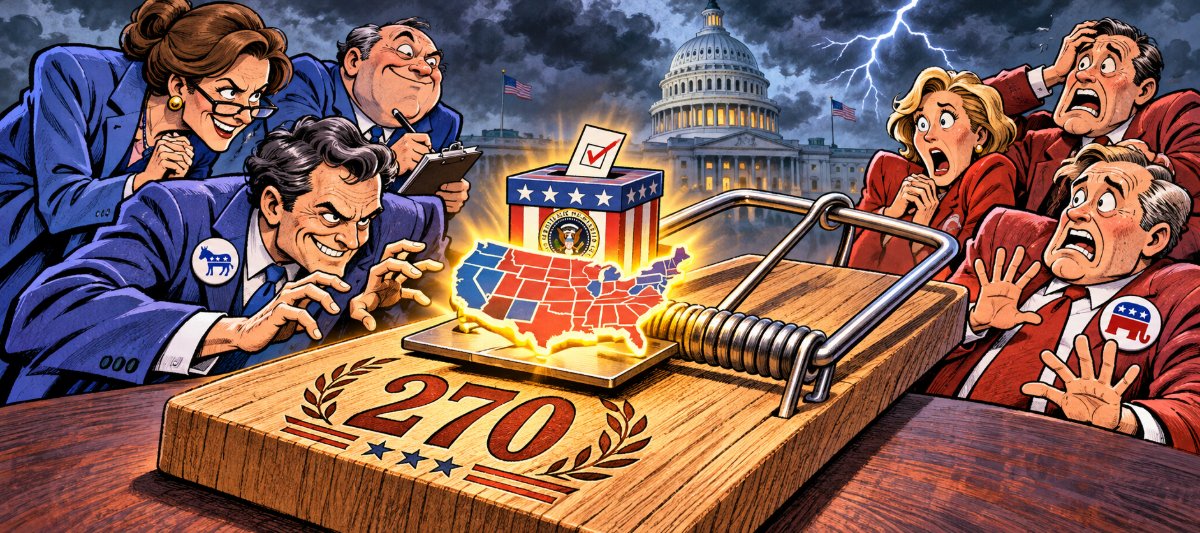
The compact is designed to take effect once participating states control at least 270 electoral votes, the number needed to win the presidency.
So far, 18 states and Washington, D.C., have signed on, accounting for 222 electoral votes. That leaves the compact just 48 votes short of taking effect, although legal challenges could follow.
After the midterm elections, Democrats gained full control of the legislatures and governors’ offices in Pennsylvania, Michigan, Arizona, Wisconsin and Nevada. Those states have not joined the compact yet, but if all five do, their combined 61 electoral votes would push the total to 283, well over the 270 needed.
Supporters of the compact now have an opening to press those newly Democratic-controlled state governments to join. No constitutional amendment would be required, although legal challenges would most certainly follow.
Under the compact, the national popular vote winner would receive all the electoral votes of participating states, regardless of which candidate won the popular vote in each state. Voters in states like New Hampshire would have their electoral votes determined by a nationwide popular vote rather than their own state’s result.
If you live in Vermont, Wyoming, Delaware, or Alaska, your state’s popular vote could have less influence over the allocation of electoral votes in compact states. You might as well stay home on Election Day.
This entire plan could take effect before the 2028 presidential election. The far left will stop at nothing to get what it wants. And this interstate compact proves it.

Divide Your Rulers
Posted November 18, 2026
By Sean Ring

COUNTERPUNCH!
Posted November 17, 2026
By Sean Ring

Don't Leave Your Kid's $1,000 in the Swamp!
Posted November 16, 2026
By Enrique Abeyta

The Market Doesn't Check Your Birth Certificate
Posted November 13, 2026
By Sean Ring

Jensen Huangs Himself
Posted November 12, 2026
By Sean Ring