Posted August 10, 2026

By Sean Ring
The $2 Million Fly Swatter
In October 2023, the USS Carney sailed into the Red Sea and made history.
Over a few hours, the destroyer shot down waves of missiles and drones the Houthis launched from Yemen. Every intercept worked. The crew performed flawlessly. The Navy called it a success, and by every military measure, it was.
Now let's do the accounting.
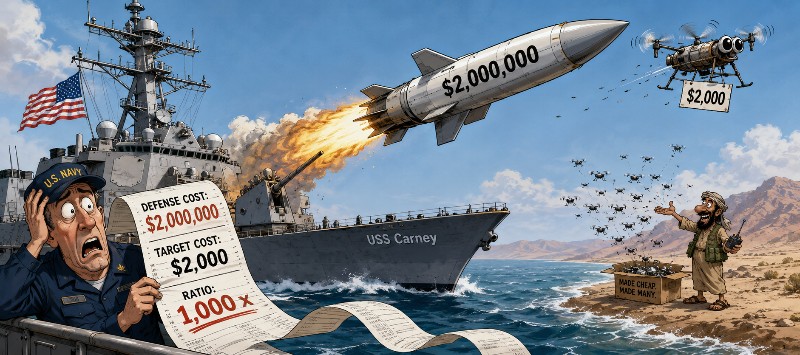
The Carney fired Standard Missile-2 interceptors at many of those targets. Each one costs about $2 million. The Houthi drones they destroyed cost a few thousand dollars apiece. Some were little more than hobby aircraft with explosives strapped on.
$2,000,000 to swat a $2,000 fly.
The Houthis, a sandal-wearing militia in the poorest country in the Arab world, discovered something the Pentagon spent decades trying not to notice. You don't need to beat the US Navy. You just need to make defending cost 1,000x more than attacking. Then you reload, and the world's richest military bleeds money on every exchange.
The US Navy wins the battle. The US taxpayer loses the ledger.
The Math Nobody in DC Wanted to Do
Ukraine turned this arithmetic into a production line.
A first-person-view drone costs a few hundred dollars. A workshop of volunteers can build dozens a day. And one of them, flown by a kid who learned on video games, can destroy a tank that costs millions and takes a year to build.
The exchange ratio isn't 2 to 1 or 5 to 1. It's often 1,000 to 1 or better. At those ratios, the side with the expensive equipment doesn't lose because its gear is bad. It loses because its gear is uneconomic. Warfare has a price mechanism too, and the price of destruction just collapsed.
Longtime readers should feel a familiar itch right now. We've seen this movie in the markets.
When the cost of something falls by 99%, and the incumbents keep building the old, expensive version anyway, that's not strategy. That's malinvestment, the same synchronized mistake we walked through in The False Boom. Everyone builds the wrong thing at the same time because the signals, and the incentives, tell them to.
So why did the signals lie?
Why the Pentagon Built the Wrong Military
Our generals aren’t fools. The system pays them to build the wrong thing.
Think about who decides what the Pentagon buys. Prime contractors want programs that run for decades, employ thousands, and cost billions. Congress creatures want those jobs in their districts. Officers who manage big platforms get promoted; there's no admiral's track for cheap plastic drones.
Every incentive in the building points toward the exquisite: the $13 billion carrier, the $80 million fighter, the $2 million missile. Nothing points toward the $500 drone that any machine shop can make, precisely because any machine shop can make it. There's no empire to build on top of cheap.
That's not a scandal in the movie sense. Nobody needed to break a law. The machine did exactly what it was built to do, which is the most damning thing you can say about it.
And while our machine perfected the expensive, we did something worse. We gave away the cheap.
We Ate That Seed Corn, Too!
Remember the question we asked in Who Ate the Seed Corn? America consumed its industrial base for decades and called the savings prosperity. Then COVID hit, and we couldn't make masks.
Now apply that to drones.
The small-drone supply chain (the motors, the batteries, the flight controllers, and the airframes) lives almost entirely in China. One Shenzhen company, DJI, dominates the world's commercial drone market.
If a shooting war started tomorrow, the country that invented powered flight would struggle to mass produce a $500 aircraft, while its main rival could turn them out like cell phones.
Ukraine builds drones in garages because it has to. America outsourced its manufacturing might 30 years ago.
The conclusion is that the threat is cheap and infinite, while our defenses are expensive and finite. The industrial base that could’ve, and should’ve, fixed that gap got shipped across the Pacific and down to Mexico when U.S. inventories looked full.
That's not one mistake. That's three of our old frameworks stacked on top of each other: bad incentives, malinvestment, and capital consumption, all presenting the bill at once.
The Turn
The good news is that DC can't ignore the arithmetic TikTok videos deliver daily. Every clip out of Ukraine and the Red Sea is a $2 million receipt. And this year, for the first time, the Pentagon's budget request suggests somebody in the building finally did the long division.
The numbers involved are staggering. The largest proportional funding shift for any weapons category in modern American history is now sitting in front of Congress, and almost nobody outside defense circles has read the fine print.
We have. Tomorrow, I'll show you where that money is, how it's structured (that part is a story in itself), and why Wall Street's quiet moves around it become public this Friday.
Wrap Up
You didn't need a security clearance to see this coming. You needed a framework.
Bad incentives produce malinvestment. Malinvestment consumes capital. And consumed capital stays invisible until the day it's needed, when the revelation is fast and brutal. We've applied that pattern to housing, shale, crypto, and the Fed itself.
Now it's wearing a uniform. It’s the same pattern, but the stakes are higher. Infinitely higher.
The fly swatter era is ending. Follow the money that replaces it.
Have a great week ahead.

A Crude Awakening
Posted October 23, 2026
By Sean Ring

All That Glitters Is Diesel
Posted October 22, 2026
By Sean Ring

Treason’s Greetings!
Posted October 21, 2026
By Sean Ring

Zach’s Second Opinion
Posted October 20, 2026
By Zach Scheidt

A COLA, But No Smile
Posted October 20, 2026
By Zach Scheidt