Posted December 11, 2025

By Sean Ring
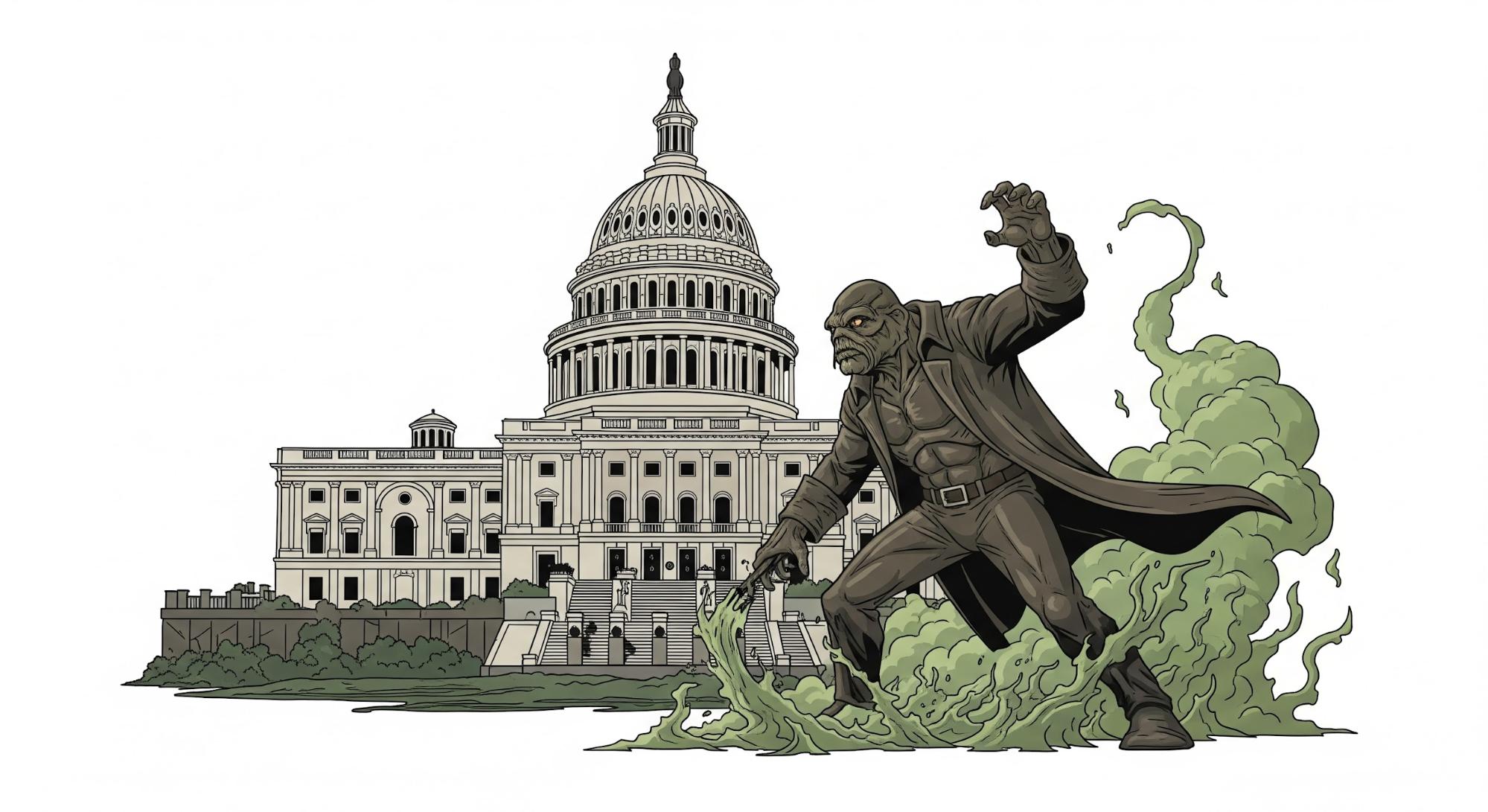
Swamp Thing
Every election cycle, Americans briefly remember that their capital was built on a swamp. A real swamp.
The name stuck because the behavior did. It’s the perfect metaphor: a dense ecosystem of creatures that survive by feeding on whatever wanders too close.
And while we’re all supposed to pretend The Swamp is just a catchy 21st-century slogan, the truth is older. Long before Trump and Reagan, even back to early-20th-century muckrakers, people knew the federal government had quietly become its own habitat. It became a self-sustaining biosphere of insiders, incentives, and institutions that outlive any election.
Trump simply branded it.
But did he actually drain the thing?
Well… that depends on whether you define “drain” as “nuke the swamp” or “rotate the reptiles.”
Let’s walk through it.
What the Swamp Really Is
I used to picture a handful of cigar-chomping lobbyists on K Street, but I was thinking too small.
The swamp is an ecosystem. A whole food chain. And it includes:
- Lobbyists and K Street firms that ghostwrite legislation for paying clients.
- Defense contractors and federal firms whose existence depends entirely on taxpayer dollars.
- Think tanks funded by corporations, foreign governments, and wealthy donors, all churning out “expertise” that magically aligns with their funders’ interests.
- Revolving-door bureaucrats, appointees, consultants, and law-firm partners who shuttle between government and industry like it’s a merry-go-round.
All of them feed on the same nutrient-rich sludge: federal money, federal rules, and the power to influence both.
This is why your boss’s list (Brookings, Heritage, Cato, K Street, the military-industrial complex, consultants, think-tankers, and the permanent government known as the civil service) all sit under the same swamp umbrella.
Different species, same ecosystem.
Why the Metaphor Works
You don’t need a poli-sci degree to understand why “drain the swamp” lands with voters. Everyone knows the feeling of being governed by people who never seem to face consequences.
Bureaucrats don’t get fired. Think tank economists don’t get term limits. Lobbyists don’t die; they multiply.
Meanwhile, ordinary citizens get one vote every few years and maybe a pothole filled. Maybe.
For one crowd, “drain the swamp” means purging corruption.
For another, it means dismantling bureaucracies.
For still another, it means cutting cash flows that feed the whole DC ecosystem.
This ambiguity is why the slogan works, and why every politician who uses it later gets to redefine it.
Trump’s Promise: Drain It, Torch It, Rebuild It
When Trump ran in 2016, “drain the swamp” was arguably his most potent message. He wasn’t selling technocratic reform; he was selling revenge on the bureaucrats, the elites, the unelected experts, the lobbyists, and the lifers who seemed to run Washington no matter who won.
To his supporters, he was finally going to make the gators fear the tourists.
While in office, The Donald made several visible moves:
- He signed Executive Order 13770, which imposed lobbying bans on former appointees.
- He rolled back regulations aggressively.
- He declared war on parts of the administrative state.
This was the scorched earth phase.
But the execution… well…
Let’s just say the swamp didn’t evaporate.
It adapted.
How Trump Ended Up Growing the Swamp (Even While Attacking It)
Here’s where the ecosystem wins.
Despite the vows to break the revolving door, Trump ended up with the highest number of lobbyists in political appointments in modern history—over 280 by mid-term, far more than Obama or Bush.
The administration also handed out ethics waivers like Halloween candy, letting lobbyists work on the exact issues they had lobbied on.
Then, in the final hours of his presidency, Trump did the ultimate un-draining move: He revoked his own ethics order, reopening the revolving door completely.
That’s not draining the swamp. That’s improving its irrigation system.
The Conflicts of Interest Problem
And then there was the business issue.
By keeping ownership of his companies, Trump created thousands of conflicts—foreign governments booking rooms at his hotels, domestic political groups holding events at his properties, and policy decisions that benefited industries aligned with Trump World donors.
Ethics watchdogs didn’t mince words: they called it one of the most conflicted presidencies in U.S. history.
Supporters may argue that Trump was simply bypassing the establishment power brokers.
Fair point.
But bypassing the swamp’s elites isn’t the same as removing the swamp.
It just cleared space for new reptiles.
So, Did He Drain Anything?
Actually… Yes. But not the way people hoped for.
Here’s the most intellectually honest way to put it: Trump didn’t drain the swamp. He shook the swamp.
He disrupted those who held power, flipped the table, and forced bureaucrats, lobbyists, and think tankers to operate in a new political landscape.
To his base, this felt like draining. And in a psychological sense, it was.
The establishment was weakened. Traditional networks got sidelined. The old hierarchy lost its monopoly.
But the swamp itself? It’s still there.
In fact, it’s thriving. It just has a different pecking order.
Trump didn’t drain Washington. He re-sorted its ecosystem.
He removed the water moccasins. And now it’s full of crocodiles.
Wrap Up
Did The Donald keep his promise?
If by “drain” you mean eliminating corruption, reducing lobbying, ending the revolving door, and limiting conflicts of interest?
Then no. The numbers are clear.
If by “drain” you mean dethrone a ruling class and replace it with another one more aligned with your political tribe?
Then yes, he absolutely succeeded.
And that brings us to the uncomfortable truth:
Washington isn’t a swamp because of who runs it. Washington is a swamp because of how it’s built.
You can replace the creatures. You can pump in new water. You can change the food supply.
But the habitat remains.
Until the incentives like money, regulation, and the scale of government power change, the swamp will never drain.
WAR! What’s It Good For?
Posted March 02, 2026
By Sean Ring
The Biggest RINO of Them All
Posted February 27, 2026
By Sean Ring

Sports, Predictions, and Morons
Posted February 26, 2026
By Sean Ring

SOTU or STFU?
Posted February 25, 2026
By Sean Ring

Building an AI-Proof Portfolio
Posted February 24, 2026
By Sean Ring