Posted August 26, 2026

By Sean Ring
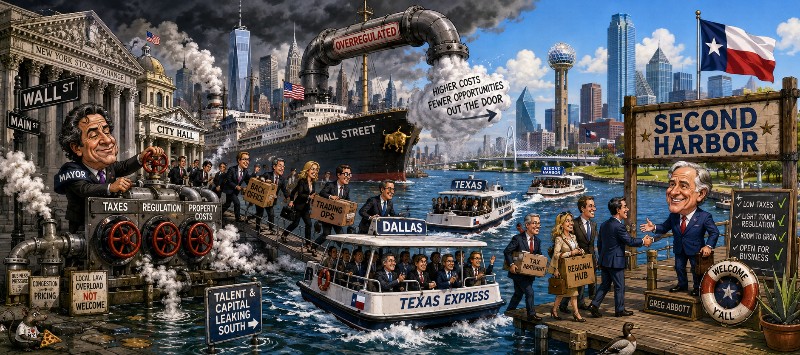
Second Harbor
In 1585, Antwerp was the richest trading city in Europe.
Then the Spanish closed the River Scheldt. It strangled Antwerp’s port. Merchants, bankers, and printers packed up and sailed north to a swampy little town called Amsterdam.
Within a generation, Amsterdam had the world's first stock exchange, the first central bank worth the name, and the Dutch East India Company.
Amsterdam didn't win that prize. Antwerp handed it over.
Keep that in mind when you read what the Texas governor says about Wall Street moving south.
The Headline
Greg Abbott says Texas is "the new financial capital of America."
The LinkedIn crowd is cheering. Morgan Stanley just picked Dallas over Alpharetta, Georgia, for a regional hub. The plan calls for up to 4,800 jobs and a $1.3 billion, 709,000-square-foot tower on McKinney Avenue, with the bank moving in around 2031 on a 16-year lease.
Goldman Sachs is building an 800,000-square-foot campus a mile away for 5,000 people. Bank of America is putting up a tower in the same neighborhood. The Texas Stock Exchange went fully live on July 31. The NYSE and Nasdaq both opened Texas outposts to avoid being left out.
That’s a lot of concrete. The governor is doing what governors do. But the claim is wrong, and you should know exactly why before you nod along.
The Numbers Behind the Bluster
New York's financial services industry generated $330 billion of gross regional product in 2024. That's 71% more than Texas.
The New York City securities industry was on track for roughly $60 billion in profits last year, a record. The city still has more securities jobs than any other city or state in the country.
Then there's the trick in the "Texas has more finance jobs" headline. Texas had 519,000 financial sector workers in 2024, compared with New York's 507,000. But that's the whole state, Dallas, Houston, Austin, and San Antonio included, against one state. And it leaves out insurance and real estate. Dallas alone has about 317,000 financial activities workers. That's less than half of New York City's total.
What is Morgan Stanley really doing? Those 4,800 jobs are 5.8% of the bank's 83,000-person workforce. The city records show a slower move than the headlines do. Roughly 1,500 jobs will be added by 2031, 3,800 by 2035, and the last 1,000 by 2039. Dallas paid for the privilege with an $18.5 million grant tied to hiring benchmarks and a 90% property tax abatement for 10 years.
That's a back office and middle office hub following the incentives. The headquarters is still at 1585 Broadway. JPMorgan just opened a $3 billion tower in Midtown. Goldman isn't leaving New York, either. It's adding Dallas.
As for the exchanges, NYSE Texas and Nasdaq Texas are dual-listing venues. Companies list there at no extra cost and keep their New York listing. TXSE is the real thing, with $275 million raised and its first primary listings coming from Texas Capital Bank. But it doesn't expect its first IPOs until 2027. Indeed, that's a promising startup. But it’s not a capital.
So no. Texas isn't the new financial capital of America. Not this decade, and probably not the next one, either.
Why the Trend Is Real Anyway
Nevertheless, Albany shouldn’t rest on its laurels.
Since February 2020, financial services employment in Dallas is up 23.2%. In New York City, it's up 6%. Chicago, Boston, and San Francisco are still below their pre-pandemic levels. Over the past decade, Texas's financial GRP grew by 121%, versus 72% for New York. In 2025, recruiters posted 9% more finance jobs in Texas than in New York.
Taxes and cost of living explain some of it. The Central Time Zone explains a little more. But the timing of the Morgan Stanley decision tells you what you need to know.
The bank started looking outside New York this year, right after the city elected a declared socialist as mayor, who campaigned on taxing the rich, raising property taxes, and reining in corporate real estate. Zohran Mamdani has since picked a public fight with Ken Griffin over his Manhattan apartment. Jamie Dimon warned shareholders that residents and businesses "vote with their feet." Treasury Secretary Scott Bessent told the city not to expect a bailout.
In our sister publication, the Daily Reckoning, I wrote about the Curley Effect. A politician who drives out the people who vote against him doesn't see it as a loss. He sees a smaller, more loyal electorate. Boston did it in the 1920s. New York is doing it in 2026.
Texas isn't stealing Wall Street. Texas is where Wall Street goes when New York turns up the pressure. It's a relief valve. The valve doesn't create the steam.
A Word of Caution on Y'all Street
I'd be lying if I said the Texas side was all clean.
The Dallas Fed's 2026 outlook noted that the state grew in 2025 without adding jobs, the first time that's happened since 2002-2003. Most of the Texas job growth that exists is in commercial construction for AI data centers, not in finance. And the Dallas towers are being bought with the same tax abatements and "deal-closing grants" that every state uses to poach from every other state.
So this isn’t a wholesale upgrading of the American financial map, but a Dallas real estate and Texas banks story. And that’s fine.
Wrap Up
Antwerp lost its crown to a closed river, not a better city.
New York City, for all its sins, is still the financial capital of America. The profits, listings, headquarters, and deal flow are still there. Unfortunately, the city government has started acting like the Spanish crown on the Scheldt, and the banks are quietly building a second harbor away from the madness.
Abbott's claim is at least a decade early. But he doesn't need to be right. He just needs Mamdani to keep doing his job for him.
The governor is the second biggest reason Wall Street is looking at Texas. The biggest one works in New York’s City Hall.

A Crude Awakening
Posted October 23, 2026
By Sean Ring

All That Glitters Is Diesel
Posted October 22, 2026
By Sean Ring

Treason’s Greetings!
Posted October 21, 2026
By Sean Ring

Zach’s Second Opinion
Posted October 20, 2026
By Zach Scheidt

A COLA, But No Smile
Posted October 20, 2026
By Zach Scheidt