Posted May 29, 2026

By Sean Ring
Powered by Oil, Governed by Idiots
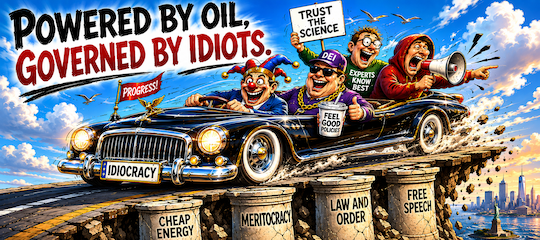
Michael Shellenberger, author of Apocalypse Never, once told Tucker Carlson, "We know that the pillars of civilization are cheap energy, meritocracy, law and order, and free speech, and all four of those pillars are currently under attack."
The subconscious mind immediately recognizes and accepts truth. As long as private property is included in the category of law and order, I’m on board. All freedom springs from private property, which is why the other team quotes (and misinterprets) Proudhon all day long. After all, if property can be stolen, it must exist in and of itself first in the possession of an owner and, therefore, cannot equal theft.
It’s also why many Americans will never forgive Jefferson for changing the Declaration of Independence’s words from “life, liberty, and property” to the more cheerful but far more vague “life, liberty, and the pursuit of happiness.”
In 1689, John Locke argued in Two Treatises of Government that political society existed to protect "property," which Locke defined as a person's "life, liberty, and estate.” Jefferson would have done posterity a world of good had he been a bit less lavish with his words.
Civilization has always been built upon certain foundational elements enabling growth and prosperity.
These components fuel our world's physical and economic engines and shape our societies' moral and intellectual framework.
Let’s dive into civilization’s pillars without knocking them over.
Cheap Energy: The Dynamo of Progress
The first pillar, cheap energy, is the lifeblood of modern civilization. In its absence, the machinery of economic progress grinds to a halt. From fossil fuels to renewable sources, cheap energy powers our homes, industries, and transportation. It’s the driving force behind economic growth and technological advancement. Access to affordable energy is so pivotal that it directly correlates with a nation's quality of life and economic development.
With cheap energy, the West is a powerhouse. Without it, it’s a damp squib. Just look at Germany’s deindustrialization since it closed down its nuclear plants and sanctioned Russia. It’s a disaster in slow motion.
Historically, civilizations that harnessed energy effectively, whether through windmills, water wheels, or coal-fired steam engines, innovated and grew wealthy.
Pursuing more efficient and sustainable energy sources continues to shape the world, especially with the closure of the Strait of Hormuz. But those sources can’t be expensive.
Meritocracy: The Ethos of Fairness and Excellence
Meritocracy, the second pillar, is the principle that positions talent, effort, and achievement as the basis for progress and recognition in society. It’s a cornerstone for fairness and is instrumental in nurturing talent and hard work. In a meritocratic system, individuals are given opportunities based on their abilities and merits rather than their social status or background.
This system fosters a culture of excellence and innovation, motivating people to develop their skills and contribute effectively to society. Meritocracy is significant because it fosters a sense of justice and equality, which is essential for social cohesion and stability. It also drives economic efficiency and productivity, as the most capable individuals take roles where they have the greatest impact.
The most glaring example of the lack of meritocracy must surely be in US college admissions. There are so many colleges to choose from, and almost no one is going to the right school for themselves.
Why? Because the process is no longer meritocratic.
Check out this post from 2023:
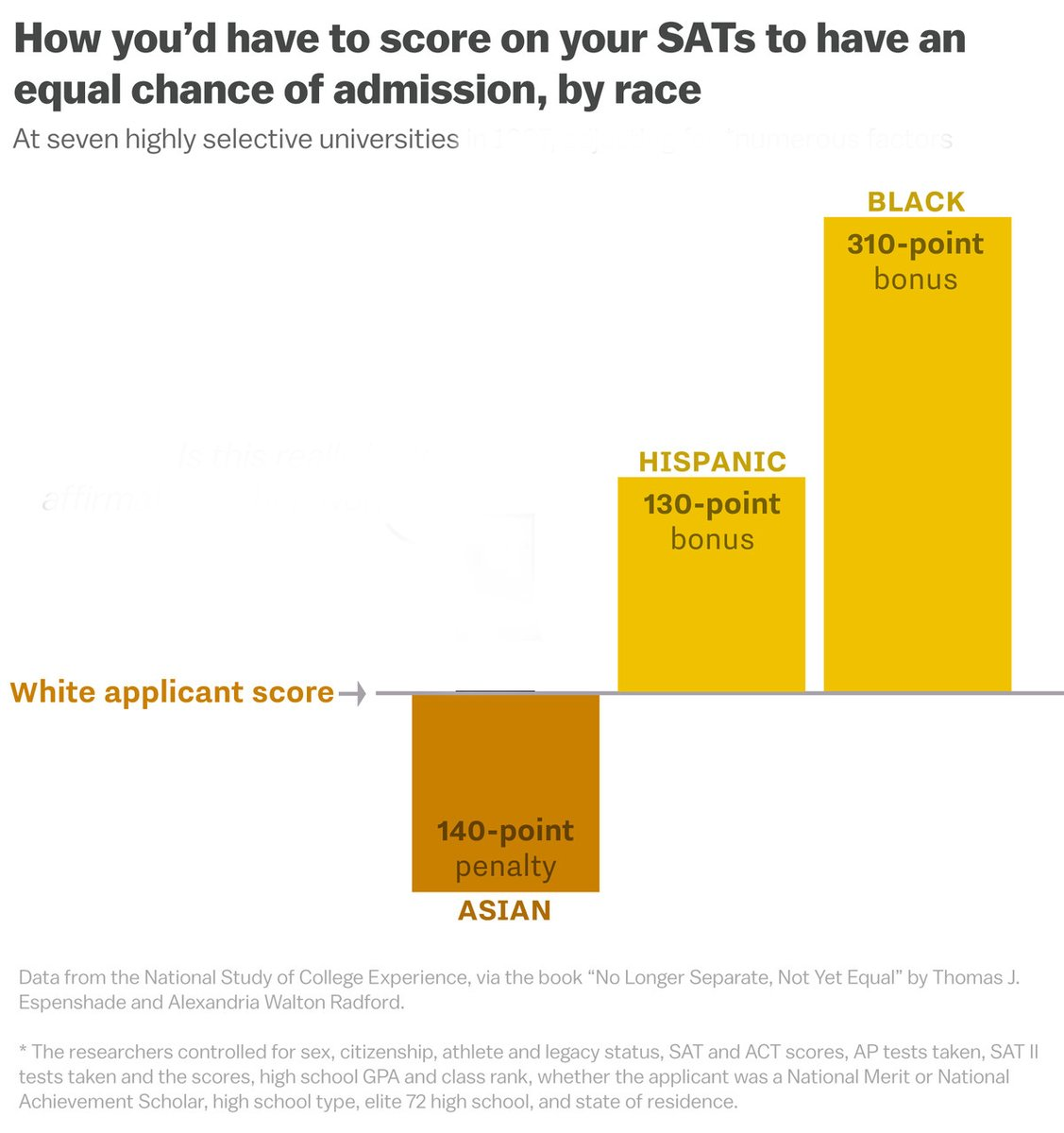 Credit: @TheRabbitHole84
After finding that many of its students couldn’t read or write at the college level, Yale announced it would join Harvard in using the SAT again to evaluate applicants. (Yes, the test is much easier these days than in the 20th century. But it’s a start.) The University of California is following suit, as well.
Helping is good. Pandering is not. The US no longer has the world’s best universities, just the most expensive ones.
Law and Order: The Framework for Stability and Justice
Law and order form the third pillar, providing the legal and moral framework essential for the functioning of society. This pillar encompasses the laws that govern behavior, the institutions that enforce these laws, and the judicial systems that interpret them. The rule of law is fundamental in safeguarding rights, ensuring justice, and maintaining social order. It creates an environment where individuals exercise their freedoms while respecting others' rights.
In societies where law and order are strong, citizens feel safer, and businesses operate more efficiently. This pillar is critical in upholding democracy, protecting property rights, and ensuring that society operates in a predictable and orderly manner. Without it, there is a risk of chaos, injustice, and the breakdown of civil society.
There are so many examples to choose from. But I’ll save you a thousand words by merely posting a picture of the 2020 Minneapolis riots, where police arrested precisely zero people.
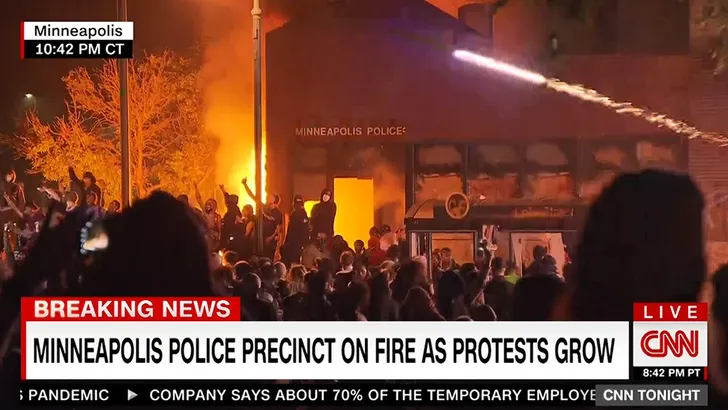 Credit: TMZ
Free Speech: The Vehicle of Expression and Innovation
The final pillar, free speech, is a fundamental human right. It allows for the exchange of ideas, debate, and dissent. Free speech is crucial to societal development, as it fosters an environment where creativity and innovation can flourish. It enables questioning the status quo, which is essential for scientific advancement, social progress, and the fight against injustice.
Moreover, free speech is integral to the functioning of a democratic society. It ensures governments remain accountable to their citizens. Societies that uphold free speech tend to be more resilient, adaptive, and anti-fragile.
Conversely, the suppression of free speech leads to stagnation, oppression, and social unrest.
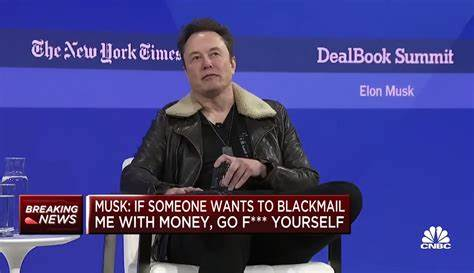
Remember the days before Elon owned X? I’d rather not.
Wrap Up
These four pillars - cheap energy, meritocracy, law and order, and free speech - are the lifeblood of modern civilization.
Cheap energy powers our economies and innovation. Meritocracy ensures fairness and rewards hard work and talent. Law and order provide the necessary framework for societal stability and justice. Free speech fosters an environment of creativity, accountability, and progress.
Together, these pillars support a society that’s economically robust and efficient, and also just, fair, and conducive to the well-being and development of its citizens.
As we navigate the complexities of the 21st century, fighting those who’d knock down these pillars is essential to rebuilding the West.
Have a great weekend!
The War Tax on Hard Money
Posted May 28, 2026
By Sean Ring

Mamma Mia, Maranello!
Posted May 27, 2026
By Sean Ring
Pump Fiction
Posted May 26, 2026
By Matt Badiali
The Knowledge Problem
Posted May 25, 2026
By Sean Ring
The False Boom
Posted May 22, 2026
By Sean Ring