Posted August 28, 2026

By Sean Ring
Play the Ball, Not the Referee
Let’s go back to London, England, in September 1992.
A sharp young analyst named Scott Bessent was working in the London office of Soros Fund Management. His research on Britain’s housing market helped make the case that the Bank of England can’t defend the pound sterling (GBP). British homeowners had held floating rate mortgages. Every rate hike to protect the GBP hits their monthly payments directly. The homeowners, and hence the British government, can’t take the pain.
The Bank of England was doing this because of the European Exchange Rate Mechanism (ERM). Not sure if they wanted to be in the eurozone, the British chose the middle path of linking the pound to the European economy without making a firm commitment.
But as West Germany had just swallowed East Germany and inflation took off, the Bundesbank (the old German central bank) started raising interest rates to fight that inflation. The increasing rates led to a rise in the value of the Deutsche Mark.
The Bank of England also increased its base rate, solely so the pound could keep pace with the mark. In short, the Brits were raising their interest rates for reasons unrelated to the British economy. As a result, the policy was unsustainable.
Stanley Druckenmiller and George Soros bet roughly $10 billion that the Bank would fold, meaning that sooner or later, it would have to let the sterling drop to the free market’s unfettered price level.
On September 16th, now known as Black Wednesday in the City of London, the Bank of England indeed folded. Sterling crashed out of the ERM. Soros’ fund made over $1 billion in one day. Impressive. To this day, if you mention the name “Soros” within earshot of Threadneedle Street, where the Bank of England is, you’ll give an English economist the tremors.
Every man in Soros’ office carried this lesson for life: When a government defends a price the fundamentals won’t support, the market wins. Always. The only question is when the market will win.
Nearly 3 ½ decades later, Bessent is the government.
Doing What He Condemned
As I mentioned in yesterday’s Rude, in January 2024, while still running his own macro fund, Bessent wrote to clients about his predecessor, Janet Yellen, and her preference for issuing short-term Treasury bills when rates were low. He warned it was a risky strategy that "creates the potential for a financial accident."
He went further that June. He accused Yellen of having "taken control of monetary policy" through her debt choices. He amplified the now-famous Miran-Roubini paper that coined the term “activist Treasury issuance.” Bessent charged Yellen with flooding the market with bills to hold down long-term yields and flatter the economy before the election.
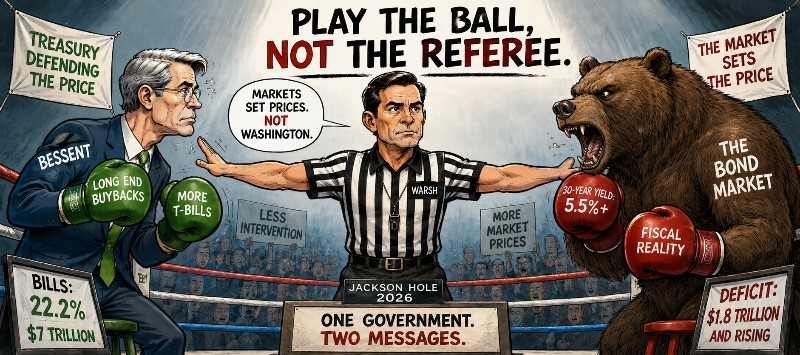
Now look at his work. Bills are a staggering 22.2% of marketable debt (about $7 trillion), far above the advisory committee’s recommended range of 15% to 20%. Though not innocent, Yellen never pushed it that far.
Last week, after the 30-year yield hit a 19-year high, the Treasury said it would double its long-end buybacks from $2 billion to $4 billion per operation, starting September 9th. It buys long bonds and funds the purchases with more short-term bill issuance. It’s not quantitative easing per se, but it’s certainly a duration swap.
The man who wrote Yellen’s indictment now runs her scheme on a grander scale.
The Mentor’s Letter
On Monday, the Wall Street Journal ran an op-ed titled "Let the Bond Market Speak."
None other than Stanley Druckenmiller authored it. Yes, he, of the famous sterling trade, who happened to be Bessent’s mentor.
He didn’t mention 1992. He didn’t have to. "Governments defending prices against fundamentals always lose," he wrote.
In his view, the buybacks weren’t liquidity management, but price management, and a mistake far larger than $4 billion suggests. He wrote a 30-year that needs 5.5% to clear isn’t a crisis. It’s the bill come due for fiscal prolifigacy. He said the long bond yield is the most important price in the world, and muffling it removes the last check on The Swamp’s borrowing.
Bessent’s response came on CNBC. "We have a big toolkit," he said. Bessent insisted the yields don’t reflect the underlying fundamentals. The poacher-turned-gamekeeper had changed his tune. Lord Action was right: absolute power corrupts absolutely. But does Bessent have absolute power? Or does the market?
The Bank of England thought it had a big toolkit, too, until that fateful afternoon on September 16, 1992.
The Referee Speaks Today
Today, the referee enters. Kevin Warsh took over the Fed on May 22nd. This morning, he gives his first Jackson Hole speech as Chair.
Warsh has one stated ambition. He wants markets to set prices again. He killed forward guidance. And his most telling line came earlier this summer: market participants are learning to "play the ball, not the referee."
Note the timing. Treasury’s buyback barrage came just weeks after that quote. One arm of the government preaches market prices. The other arm sets them from a desk in the Treasury building.
We know Warsh and Druckenmiller are old allies. They co-wrote critiques of easy money in the Journal a decade ago. The Fed Chair and the mentor stand on one side. The Treasury Secretary stands on the other, running the trade both of them taught him to bet against.
As of its most recent reading, the consumer price index (CPI) sits at 3.4%. Three FOMC members dissented at the July meeting, calling for a rate hike. That’s a hawkish committee under a Chair who prizes independence above all, speaking to a market that still prays for cuts.
The Rollover Trap
Will Warsh cave and be the Company Man that The Donald hired him to be?
Because all it takes is a neutral speech. Warsh doesn’t even need to attack Bessent this morning. He doesn’t need to mention the bond market at all.
Warsh doesn’t need to sound hawkish; he just needs not to be dovish, and the game is up.
T-Bills reprice constantly. The aforementioned $7 trillion rolls over in weeks and months, not decades. Every basis point (0.01%) of hawkishness flows almost instantly into Treasury’s own funding cost. Net interest is already running near $1 trillion this fiscal year. For the first time, that ridiculous line item matches the base defense budget.
Bessent himself had warned about this exact trap. His 2024 letter said that concentrating issuance in short tenors exposes the Treasury to refinancing risk. Correct.
It’s sterling in 1992 all over again, with the roles reversed. Britain defended a currency peg with rate hikes it couldn’t afford. Bessent defends the long end with bill issuance he can’t afford if rates stay where they are. The deficit is running $1.8 trillion with two months left in the fiscal year. The defense consists of buybacks and jawboning.
We’ve seen this before. So has Bessent.
What About Gold?
If Warsh sounds hawkish on Friday, the immediate math is ugly for metals. Front-end yields jump. The dollar pops. Real yields rise. Gold and silver get smacked in the mouth. Ray Dalio told everyone this week to sell bonds and buy gold. A hawkish Warsh makes that call look bad for at least a few days.
But keep the sizes straight. Central banks bought 288.9 tonnes of gold in the second quarter, up 62% from a year earlier and a record for any second quarter. They bought while prices fell. They aren’t trading Jackson Hole. They’re front-running the fiscal dominance trap: The Fed that can’t hike much without blowing up the USG’s funding, and can’t cut without reigniting consumer inflation.
So treat any post-speech selloff in metals as a sale, not a signal. The structural case won’t die on Warsh’s Wyoming platform.
Wrap Up
Today, Kevin Warsh steps up for his first Jackson Hole speech as Chair. He may say nothing about rates. He’s promised big structural questions, and this year’s theme is payments plumbing. Fine. The contradiction stands either way.
Thirty-four years ago, 3 men in a London office learned the same lesson from the inside: markets beat governments defending indefensible prices. This week, one of them wrote it in the Journal. The other is defending the price. And the referee, who’s been preaching that lesson for decades, has the market’s undivided attention today.
You don’t need to predict the speech. You just need to know which side of the trade history favors.
Have a great weekend!

A Squeeze, Refined
Posted September 18, 2026
By Matt Badiali

The Real Fed Chairman
Posted September 17, 2026
By Sean Ring

The Untied Kingdom
Posted September 16, 2026
By Sean Ring

The Great AI Alibi
Posted September 15, 2026
By Byron King

A Tribute to Washington
Posted September 14, 2026
By Sean Ring
