
Posted March 16, 2026

By Matt Badiali
No Birthday Balloons This Year, Kid. There’s a War On!
One of the downstream impacts of the war in Iran will hit birthday parties and chipmakers within two weeks. There’s a good chance that there won’t be any balloons at all in 2026.
Of course, I’m talking about helium. It’s number 2 on the periodic table of the elements. These rare gas molecules are so small that they can escape our atmosphere. That makes it a finite resource. And we’re currently running low due to the war in Iran.
You may not have known this, but helium is critical for chipmakers like TSMC, Samsung, Intel, Micron, and SK Hynix.
Huh? Bear with me for just a moment.
Helium and Microchips
Helium is vital for making computer chips because it lets factories run their machines extremely hot, clean, and precisely without messing up the tiny circuits. It’s a noble (inert) gas, so it doesn’t react with the materials used to build chips. That helps keep the environment inside the machines very pure.
Helium also carries heat away really well, so it cools wafers evenly during intense processes, preventing them from cracking or warping.
On top of that, it helps stabilize the plasmas used to carve out the microscopic patterns on chips and is used to check for leaks in the vacuum systems, since its small atoms are easy to detect.
Put simply, without helium, it would be damn near impossible to make fast, reliable chips at the tiny sizes we use today.
There’s No Substitute
Taiwan Semiconductor Manufacturing Company (NYSE: TSM) controls over 50% of the global chip-making market. And it’s the largest consumer of the one element that could shut down its manufactory.
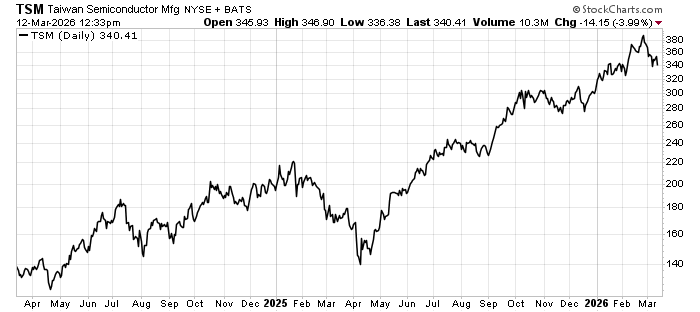
Like copper in electric motors, there isn’t any substitute for helium in that role. Companies began capturing and recycling the gas, but that’s not enough.
Chipmakers consume 20% of the world’s helium. They have just eclipsed cooling MRI magnets as the primary consumer of the gas. Aerospace applications for rocket fuel systems, propellant lines, and launch hardware account for the third-largest application.
What’s War Got To Do With It?
Here’s why the Iran war is critical to helium: it's produced as a byproduct of natural gas extraction in Qatar. The country produces between 6 trillion and 7 trillion cubic feet of natural gas per year. Its giant Ras Laffan complex is one of the world's largest helium producers. The complex shut down on March 2, after Iranian drones struck parts of it.
That immediately cut the world’s helium supply by 25% to 36%. Helium expert Phil Kornbluth, president of Kornbluth Helium Consulting, told a Gasworld webinar that if the outage extends beyond two weeks, it will disrupt suppliers for months.
Here’s the thing: helium prices don’t matter to chip prices. In 2025, helium prices rose 400% to as much as $117,000 per metric ton. But the impact on the per-wafer price was negligible.
The problem is that without enough helium, you can’t make the chips at all.
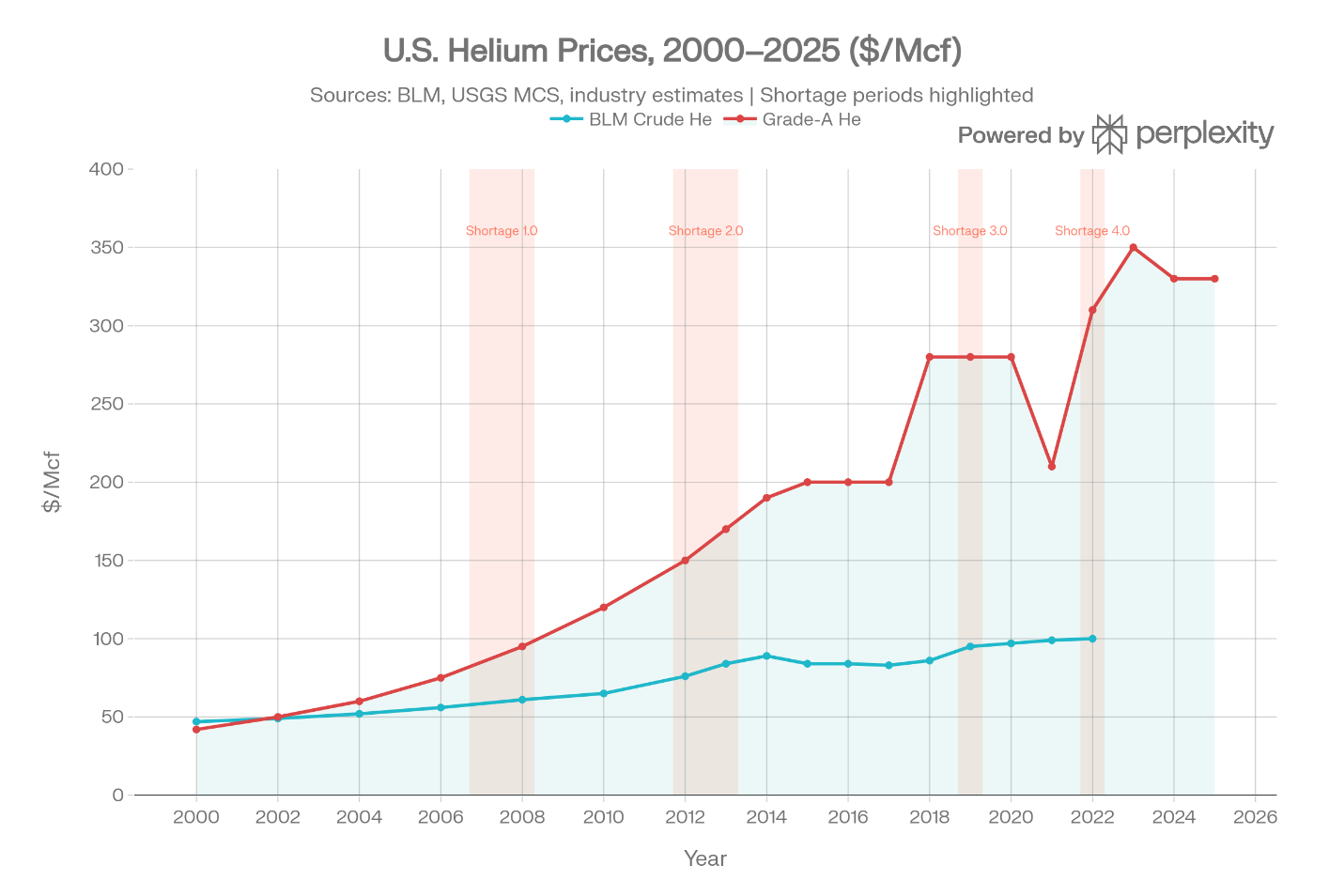
It’s like water in bread making. The cost of the water is nothing compared to the price of the bread…but you can’t make bread at all without the water.
That’s how critical helium is to chipmaking.
The current shutdown in Qatar could significantly reduce global chip manufacturing if plants can’t get enough helium. That’s what we face right now. If Qatar’s Ras Laffen complex remains shut down, helium supplies to Asia won’t be enough.
A shortage of AI chips will dramatically increase prices.
Right now, South Korea’s chipmakers (Samsung and SK Hynix) are in the most trouble. They imported nearly 65% of their helium from Qatar. South Korean producers account for 18% of the world’s semiconductors.
The VanEck Semiconductor ETF (NYSE: SMH) holds most of these companies. And as we can see, it’s well off its February high:
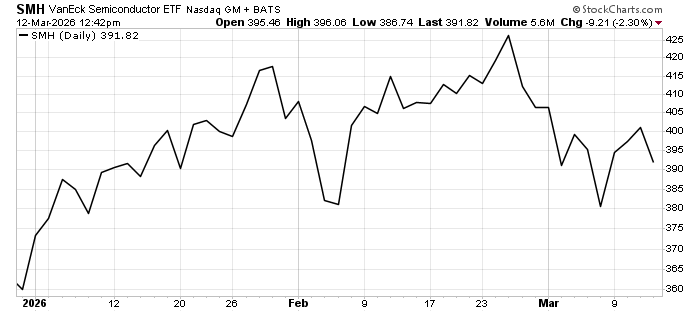
Right now, there is no indication that Qatar will (or even can) resume operations at Ras Laffen. A significant percentage of the world’s LNG ships (which transport natural gas and helium) are stuck in the Strait of Hormuz.
For traders, this situation could be a good opportunity to short either SMH or TSM.

Trump’s Long, Short War
Posted March 13, 2026
By Byron King
The Everything Problem
Posted March 12, 2026
By Sean Ring

Ghosted at Gunpoint
Posted March 11, 2026
By Sean Ring

The Best of All Possible Worlds
Posted March 10, 2026
By Sean Ring

Donald's Domestic Destruction
Posted March 09, 2026
By Sean Ring
