Posted May 11, 2026

By Matt Badiali
Keto by Force
Bread prices are about to go the way of gasoline.
Here’s the setup. We had a huge crop last year, which led to lower prices. Farmers planted less wheat this year, just 43.8 million acres. That’s the lowest area planted in wheat since we began keeping records in 1919.
Only 35% of the current U.S. winter wheat crop falls in the good to excellent category. That’s down 48% from last year. A severe drought hit half the crop. That means the existing half of the wheat crop is of poor to very poor quality. That means it’s going to feed animals, not into bread.
Like oil, wheat is a global commodity. It’s easy to ship, so it’s fungible. But the world’s wheat crop outlook isn’t great today, either. That’s mostly due to the high price of nitrogen fertilizer.
This chart shows the relative change in nitrogen fertilizer prices. It’s an index, so it doesn’t show the actual price, just the increase. The current price is the highest it's been since early 2023.
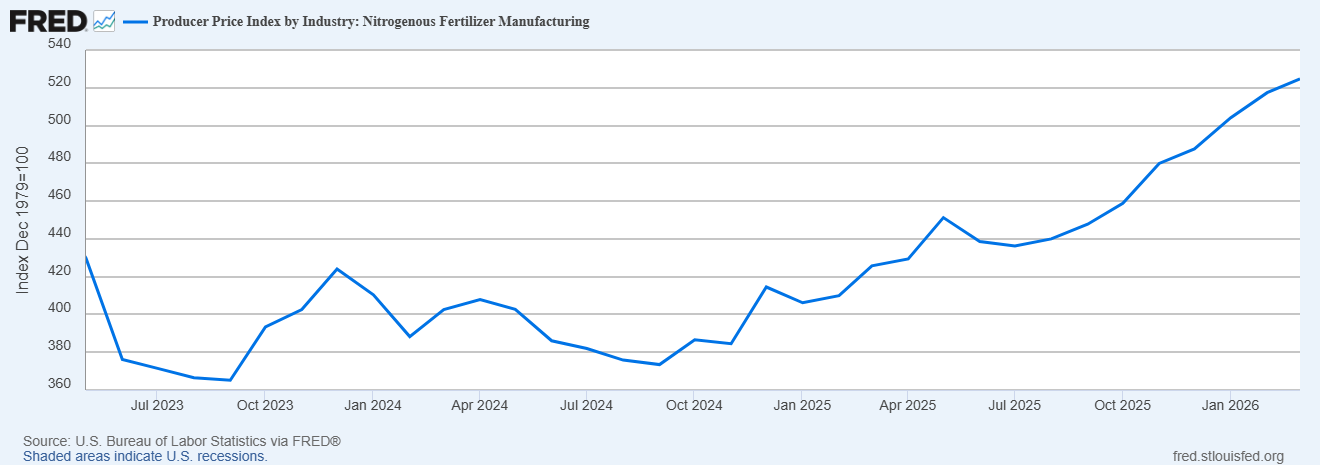
Remember, most of the world’s nitrogen fertilizer comes from the Middle East. And it was either bombed out or stuck behind the Strait of Hormuz, thanks to the war in Iran.
Nitrogen is the main cost variable for wheat farmers. The higher the protein (think bread flour), the higher the nitrogen requirements. And the price of nitrogen fertilizer rose 22% so far this year…before the Iran war issue.
High nitrogen prices push farmers to substitute crops. Instead of high-nitrogen-consuming crops like wheat and corn, they plant soybeans, which create their own nitrogen. In 2026, about 4 million acres were converted to soybeans (a 5% increase).
Farmers planted a historically small U.S. wheat crop this year. The world faces a massive shortfall of nitrogen fertilizer and much higher prices for what’s left. And bad weather led to a poor harvest this winter.
The weather looks poor also. The El Niño–Southern Oscillation (ENSO) transitioned from La Niña to El Niño. Simply put, ENSO describes the weather conditions associated with warming or cooling a large stretch of the Pacific Ocean off the coast of South America.
El Niño tends to impact what crops in the U.S., Australia, China, and parts of Europe. Experts look for a strong to extreme El Niño this year. So that’s another headwind for wheat crops.
Higher prices are coming, driven by low stored supply, a poor current harvest, historically small planted acreage, expensive fertilizer, and unfavorable weather forecasts.
Fortunately, there’s a way to invest to hedge against higher food prices. Teucrium has a Wheat Fund (NYSE: WEAT):
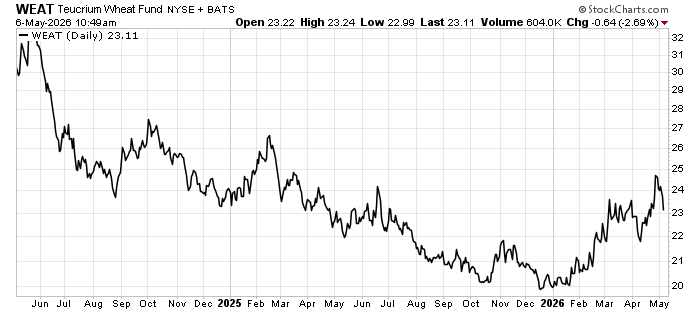
The chart reflects the excess wheat in 2025. And it’s starting to react to the poor 2026 winter wheat harvest. With the current setup, this should be an outstanding trade through the end of the year.

The Wright Stuff
Posted October 16, 2026
By Sean Ring

Crude and Unusual Profits
Posted October 15, 2026
By Dan Amoss

The Half-Life of a Bargain
Posted October 14, 2026
By Matt Badiali

Pump and Circumstance
Posted October 13, 2026
By Sean Ring

The Crusade That Never Paid
Posted October 12, 2026
By Sean Ring