Posted October 29, 2026

By Matt Badiali
In God We Trust. In Gold We Hedge.
The lady behind the glass at the currency exchange laughed at me.
“I’m sorry, sir,” she said with a smile. “We don’t exchange Iraqi dinars.”
Well, that was a bummer! I had a couple hundred dollars’ worth of dinars from my trip to Erbil and no way to get my dollars back. I thought I would get something for them in Dubai…but nope. What ever happened to Arab brotherhood? Or even good old-fashioned greed? I guess that’s what I got for not doing the exchange in Erbil itself.
Fortunately for me, my “fixer” on the trip took some of them in payment. But I still ended up with a stack of artistically designed, but ultimately worthless paper.
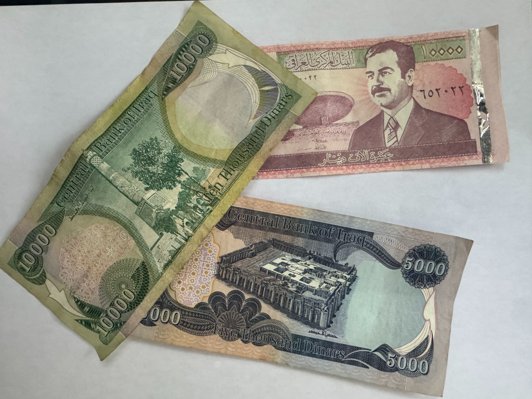 Worthless souvenirs from my Iraq excursion.
Where? Why?
What on earth was I doing in Iraq, you ask? In October 2013, during my merchant-adventurer days, I traveled to Erbil in northern Iraq to visit some Canadian oil companies. I got caught by the “official” exchange rate when I bought them. I got 1,170 dinars per dollar. But I later found out no one outside Iraq wanted them.
For Iraqis, that was a problem.
It meant that if you didn’t have anything besides paper money to sell, you couldn’t leave. So they resorted to history’s simple solution: gold.
The photo below comes from the bazaar in Erbil. Don’t believe for a minute that everyday Iraqis wandered around looking like Mr. T.
Their jewelry was a store of value. It’s easily portable wealth. As you well know, when paper money falls in value, it takes more of the stuff to buy gold.
That’s inflation.
 A not-so-bizarre bizare
Many Europeans learned that lesson the hard way. As a result, cultures began giving gold and precious metals as gifts. China, India, the Middle East, France, Italy, and Switzerland all give babies traditional gold gifts. That tradition spread to many South American countries, too.
It comes from a bone-deep cultural knowledge that paper money doesn’t last, but gold does. Many learned this hard lesson by watching their currencies collapse.
So did Americans once. But unfortunately, most Americans don’t know that lesson. They look at other countries with soaring inflation and scoff.
It can’t happen here, right?
But we have seen it here before…we just forgot the story.
Confederate Confetti
In 1861, the Confederate Congress authorized a national currency. It started with Montgomery notes, paper money issued to pay for arms, troops, and rations. Between 1861 and 1865, the Confederate government issued millions of Confederate dollars. It created massive inflation (partly due to rampant what we call “counterfeiting,” but what the Fed calls “quantitative easing”).
Noted economist Eugene Lerner studied Confederate inflation. He found that money supply increased 11.5 times in the first three years of the war. And commodity prices rose 28 times over that same period. Today, even the most amateurish economists admit that more money chasing the same scarce goods creates massive inflation.
In total, the Confederacy issued over $1.7 billion in 72 different note designs. They ranged from $0.50 to $1,000. However, the notes were not backed by gold or other precious metals. By 1864, faith in the Confederacy was gone. The exchange rate on the Confederate Dollars was about 3 cents. Food and supplies became unaffordable.
This is a painful lesson from history. But if you don’t understand it now, you may learn it the hard way.
Doomed to Repeat?
The U.S. is in a bad place. We’re in the grip of historic inflation. Perhaps bizarrely, the government has no incentive to get us out of it.
In fact, it’s in their interest to keep inflating. The Wharton School projected that raising the inflation target from 2% to 3% could cut the U.S. government's debt by 7%. The study says raising it to 5% would reduce the debt even more.
The U.S. owes over $40 trillion today. And we all know how the government pays for it. They issue bonds…to themselves. It’s a convenient arrangement, isn't it?
This Ivy League study provides the “evidence” to support the government’s continued printing.
As always, the Academy provides “intellectual” cover for the State to keep itself gainfully employed.
The Flip Side
Fighting inflation works only when debt is low. Raising interest rates decreases spending. Higher rates push down inflation. You have fewer dollars chasing goods. We see that in real estate today.
The graph below shows U.S. home sales. In January 2022, you could get a mortgage at about 3.22% interest. By October 2022, that spiked to 7.0%. And it had a dramatic impact on home sales.
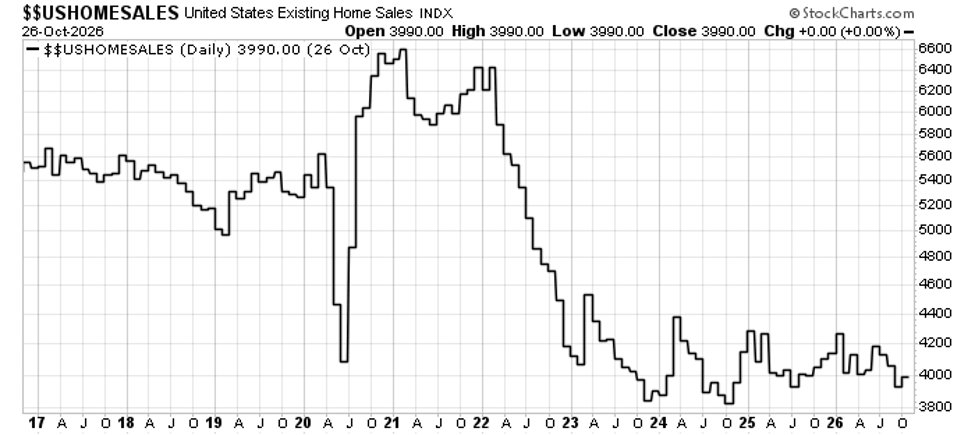 Credit: StockCharts.com
In 2021, home prices rose by 18% in a year. Low mortgage rates and work-from-home programs drove sales. But rising rates brought that down to 11% in 2022, 5% in 2023, and 2% this year.
That doesn’t mean home prices fell. It just means home price increases are less than inflation today. Borrowing costs are so high because the bond vigilantes are fighting the government’s profligate spending on our behalf.
Of course, the government doesn’t want higher interest rates, because they make it harder to pay down the national debt.
The problem for us is holding dollars. If you are a saver, on a fixed income, or live paycheck to paycheck, you are the State’s piggy bank. The government destroys your wealth by decreasing the value of the dollars in your bank account.
In short, the Fed taxes you via inflation because Congress can’t pass tax-raising bills… if the Congress Creatures want to keep their jobs.
Wrap Up
This should worry everyone, because hyperinflation is real. And when it comes for you, you need to be prepared. I’m not saying you need to dump all your dollars today. But I am saying there are lessons to learn from how folks in older societies hedged their paper money.
They buy gold. Boring, stodgy old gold.
Because insurance comes in many forms. Gold is insurance against State theft.
Make America Make Again
Posted October 28, 2026
By Sean Ring
The Club You Ain’t In
Posted October 27, 2026
By Sean Ring

Brazilian Backfire
Posted October 26, 2026
By Sean Ring

A Crude Awakening
Posted October 23, 2026
By Sean Ring

All That Glitters Is Diesel
Posted October 22, 2026
By Sean Ring