Posted July 31, 2026

By Sean Ring
History’s Greatest Bar Bill
I stood on the corner of Pearl St. and Broad St. last week and looked up at a brick building most people walk right past.
Fraunces Tavern.
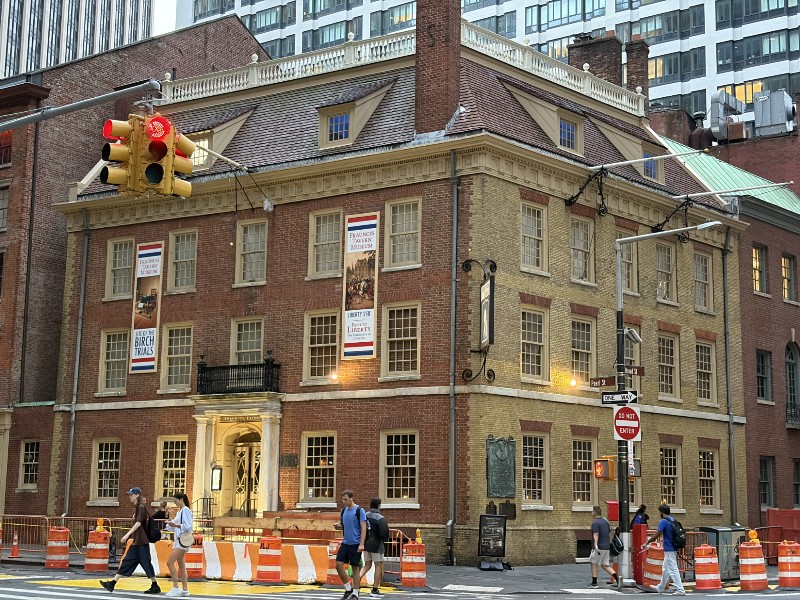 Fraunces Tavern, Credit: Sean Ring
It's still there. Still serving. There's a portrait of Washington in the window and a bronze plaque on the wall. Tourists snap a photo and move on. They have no idea what happened inside.
Most folks assume it was a victory bash. That the general and his men drank the place dry after beating the British.
That's a great story. It's just the wrong tavern, and the wrong night.
What happened here was quieter. And, I think, far greater.
The Room That Fell Silent
The date was December 4, 1783.
The war was won. The Treaty of Paris was signed. Nine days earlier, the last British troops had sailed out of New York Harbor. The city was finally free.
Washington asked his officers to meet him upstairs, in the Long Room. Fewer than 30 came.
He didn't give a speech. He couldn't.
He raised a single glass of wine and managed one sentence: “With a heart full of love and gratitude I now take leave of you.”
Then he stopped. He couldn't go on.
The only man who wrote it down was Colonel Benjamin Tallmadge, who ran Washington's spy ring. He described the general as “suffused in tears.” One by one, Washington embraced every officer in the room. He started with Henry Knox. Nobody spoke. Grown men in uniform wept and didn't bother to hide it.
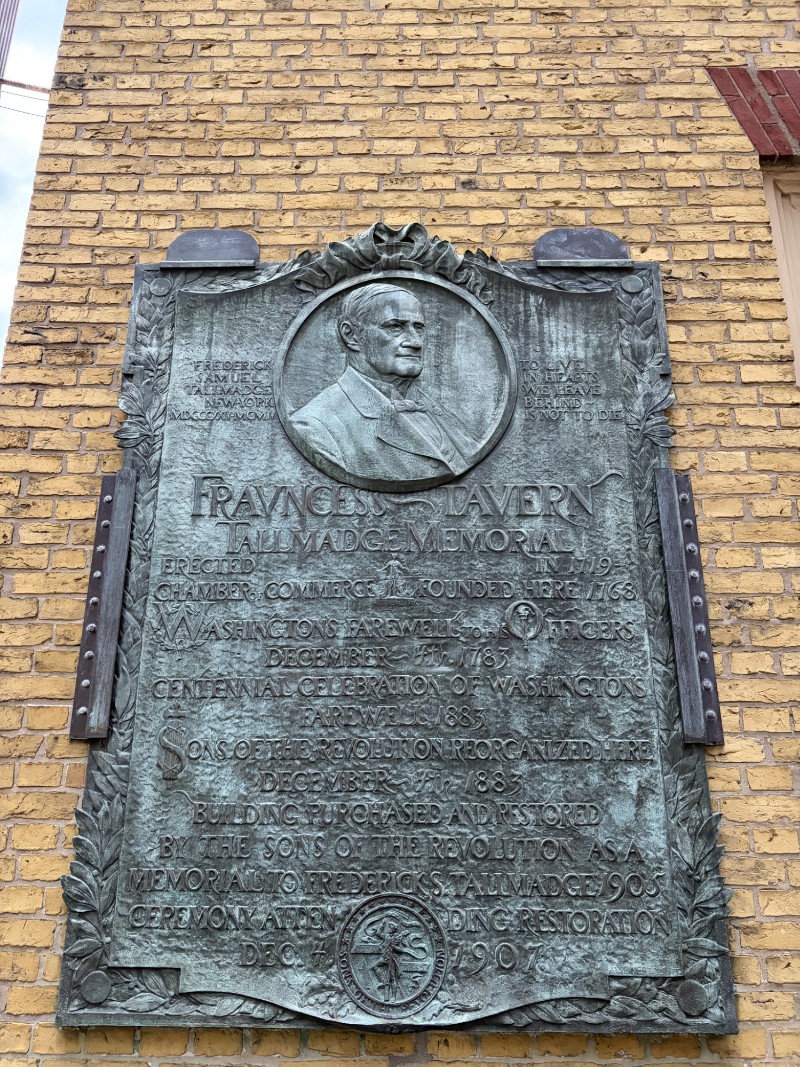 The Tallmadge Memorial outside Fraunces Tavern, Credit: Sean Ring
Then he walked out, down to the ferry, and left.
No toast list. No drinking contest. Just goodbye.
The Man Who Handed It Back
Washington had an army. It loved him. It had just beaten the most powerful empire on earth. Congress was broke, weak, and unpopular. The soldiers hadn't been paid.
Every incentive pointed one way: keep the sword. Take the country. Make yourself king.
Throughout history, the man who controls the guns keeps the power. They rarely give it back. History is a graveyard of generals who “saved” their nations and then ran them into the ground.
Washington did the opposite.
He rode to Annapolis. On December 23, 1783, he stood before Congress and resigned his commission. He gave the power back to the people. Then he went home to Mount Vernon to farm.
As the story goes, King George III heard what Washington planned to do and said that if he actually did it, he'd be “the greatest man in the world.”
He did it. Twice, in fact. He'd walk away from the presidency, too.
As far as history is concerned, only one other man did that: Cincinnatus. He was the Roman farmer who took command in a crisis, won, and then gave up the power the moment the job was done. For 2,000 years it was a legend. Washington made it real.
The Bill Worth Paying
Now for the party you were promised, because there was one. It just came 4 years later.
By September 1787, the Constitutional Convention in Philadelphia was almost finished. The hard fighting over the new government was done. The men who built the republic were about to sign it and go home.
So they threw Washington a farewell dinner at the City Tavern.
The First Troop Philadelphia City Cavalry hosted. These were the same volunteer horsemen who'd ridden with Washington years before. Now they cut loose.
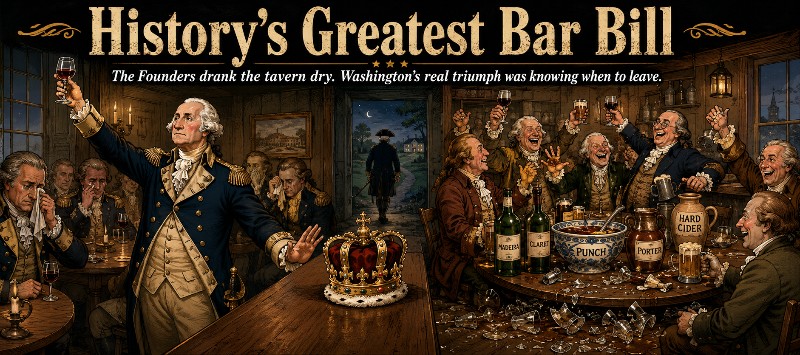
The bar bill survived. Pepperdine University professor Gordon Lloyd dug it out of the archives. For 55 gentlemen, the tab read like this:
54 bottles of Madeira. 60 bottles of claret. 8 of whiskey. 22 of porter. 8 of hard cider. 12 of beer. And 7 big bowls of punch.
Friggin’ legends!
That's more than two bottles of wine per man, and we haven't even counted the punch.
At the bottom, the tavern keeper added one more line. Breakage. They'd smashed the glasses.
In today's money, the whole night ran north of $15,000.
Three days later, they signed the Constitution.
Two Bills, Both Worth It
So there are two bills in this story, and the country paid both gladly.
The first came due at Fraunces. It was paid in tears, in a silent room, by men who'd given eight years and… nearly… their lives. That was the cost of winning.
The second came due in Philadelphia. The men paid that bill in Madeira and broken glass because they had just built something that had never existed before. That was the reward for winning.
But there was a third bill. The one Washington refused to hand the country. The crown.
That's the bill that would have cost everything. America would’ve had a king instead of a president, a dynasty instead of a republic. He looked at it, and he said no. Then he went home to his farm.
Even with my sympathy for monarchy (there’s only one head to cut off!), I must admit Washington’s actions make me incredibly proud.
Wrap Up
We spend a lot of time in the Rude pointing out where our leaders loot the till and call it public service. We're right to. The looting is real, and you see it more clearly than the herd does.
But it's worth remembering, especially now, that it doesn't have to be that way. It wasn't always. The man whose face hangs in that tavern window had every reason to grab it all. He gave it back instead.
That's not a myth. That's the deal at the heart of your country.
So the next time you're in lower Manhattan, walk down to the corner of Pearl and Broad. Look up at the brick. Raise a glass if you like.
Here’s to history's greatest bar bill…. And America’s own Cincinnatus.
You Don't Own Your Stocks
Posted August 21, 2026
By Sean Ring

Buy Now, Pay Later
Posted August 20, 2026
By Sean Ring

The Empty Vault
Posted August 19, 2026
By Sean Ring

The $54.6 Billion Bottleneck
Posted August 18, 2026
By Sean Ring

Expensive Bread & Unaffordable Circuses
Posted August 17, 2026
By Matt Badiali