
Posted April 03, 2026

By Matt Badiali
Handing China the Future of Transportation
The U.S. killed its electric vehicle (EV) market in 2025. When the Trump administration came in, they immediately dismantled a suite of policies that promoted and encouraged EVs.
The response to those changes was a wholesale dismantling of U.S. car makers’ EVs. U.S. carmakers booked huge losses as a result. General Motors took a 55% hit (from 2024 to 2025) on its net income. The company reported losses of up to $7.9 billion tied to its EV program.
Ford’s Model E series lost about $4.8 billion in 2025 and estimates another $4 to $4.5 billion loss in 2026. The company faces a total loss of nearly $35 billion from its EV business.
Timing, as they say, is everything. There is no better marketing program than putting a car payment into your gas tank every week. And thanks to the war in Iran, the EV market will have a banner year in 2026.
Globally, gas and diesel prices soared. The International Road Transport Union reports that diesel prices rose in all regions. They estimate a 39% increase in U.S. diesel and a 29% in European diesel prices since the start of the war.
And that’s why everywhere outside the U.S., EVs continue to surge.
China, China, China.
The world’s leader is China. Six of the top ten EV makers (which include battery and hybrid electric vehicles) are Chinese.
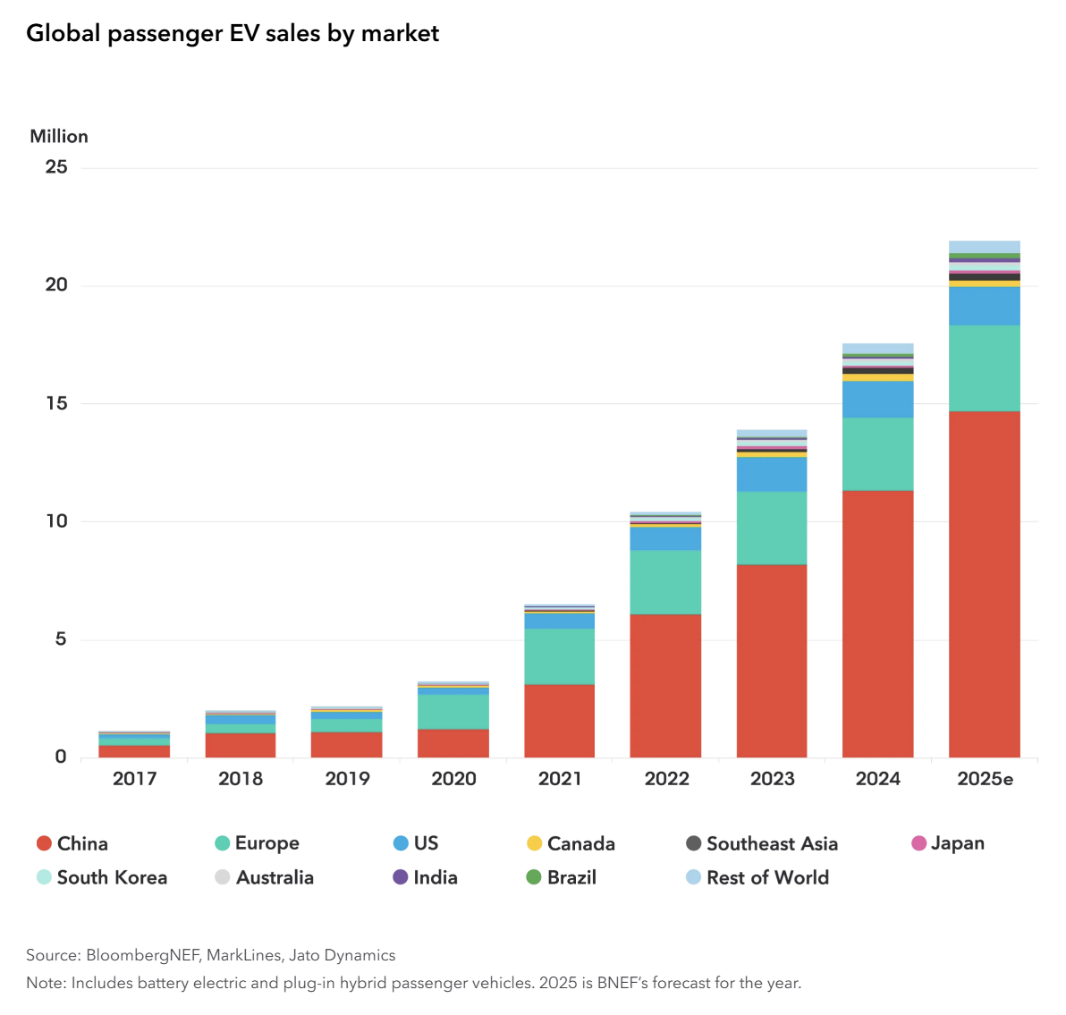
The EV industry in China has exploded over the past five years, as shown in the Bloomberg chart above. While Europe was an early adopter, China overtook it in 2021 and never looked back.
That matters because electric vehicles are the cutting edge of energy technology. The world moved towards electricity. All we have to do to prove that is to look in our garages. All the yard tools that were gas-powered a decade ago are now battery-powered.
Where I live, battery-powered bicycles are all the rage. Cities and college campuses all feature electric scooter rentals. This is the future of transportation. And we ceded it to China.
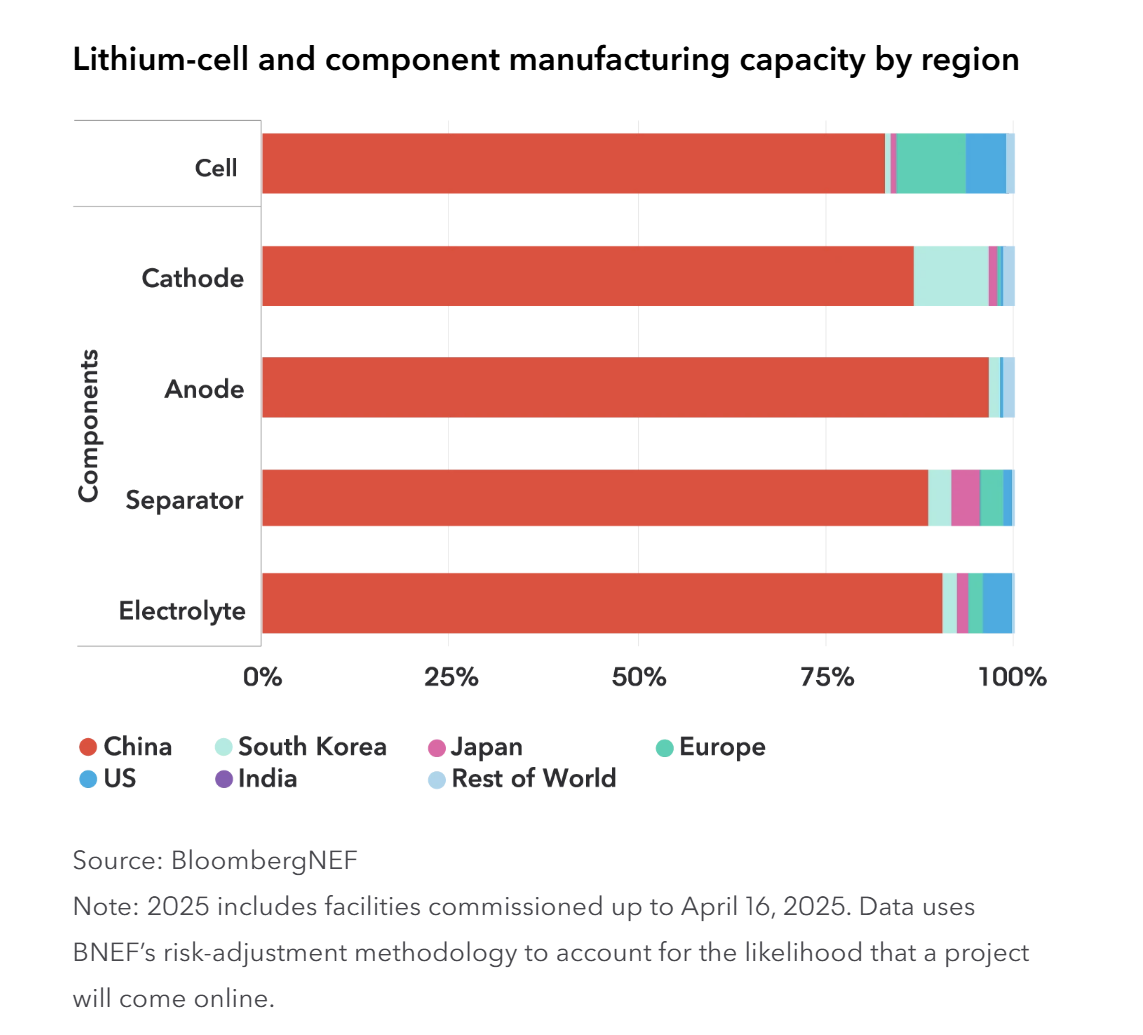
Without a structural demand driver in the domestic EV market, the U.S. won’t compete with China to develop new batteries. As you can see in the chart below, China dominates all sectors of lithium battery manufacturing:
BYD makes the Qin L, which gets 1,305 miles on a full charge and a full tank of fuel. It’s a hybrid that combines a 1.5-liter engine with a 25-kWh battery.
Now the U.S. is Behind
Killing this industry does several things to the U.S. It hurts our domestic automakers, who face billions in losses due to the lost sales. Honda and LG had planned to build a $4.4 billion battery plant in Ohio. That investment is dead now.
It’s important to understand that batteries aren’t just the future of vehicles… but the future of war as well. As we can watch live in Iran and Ukraine, drones are the future of war. And drones are battery-powered.
The war in Iran will do more for battery technology than any other geopolitical event in our lifetime. It highlighted the fragile nature of fuel supplies in many parts of the world, particularly in Europe.
Leaders now know that one simple waterway can hold their economies hostage. And that’s not sustainable. One fix is to adopt EVs for everything from trucking to mass transit. But if you want to do that, you’ll have to buy them from China.
One think tank called batteries the “bullets of the future.” That’s a scary thought when the U.S. leadership is anti-battery technology.

The Coming Shale Fail
Posted April 30, 2026
By Matt Badiali

Five Cent Bull
Posted April 29, 2026
By Sean Ring

America's Ticking Trucking Time Bomb
Posted April 28, 2026
By Sean Ring

Intel’s Resurrection
Posted April 27, 2026
By Sean Ring

Mushrooms Over Medicine
Posted April 24, 2026
By Ray Blanco
