Posted June 25, 2024

By Sean Ring
Freed Assange!
At the risk of offending the many ex-military and intelligence members who read the Rude, I must say I’m pleased as punch Julian Assange will finally be going home.
For those who are curious about my political leanings, I consider myself a right-libertarian. This means I support antiwar sentiments, a hard currency, and laissez-faire economics, while I oppose open borders, globalism, and money printing. Having lived in Singapore for six years, I find the Singapore governance model to my taste, although I have no plans to return there because of the inexhaustible heat.
Singapore boasts a small government, minimal excess spending on defense (no military-industrial complex), and the little tax money collected is sent back to the public through education, roads, or subways.
But because the United States has completely abandoned minimal government for a Leviathan-like state structure, much to the chagrin of most of the population, secrets abound. To keep those secrets from getting out, the USG co-opted the US mainstream media and many of the world’s newscasts and newspapers.
Enter Julian Assange.
He simply couldn’t be bought. Assange and Wikileaks released embarrassing stories, and the USG set out to get him. Wikileaks alleged the then-Secretary of State tried to whack him.
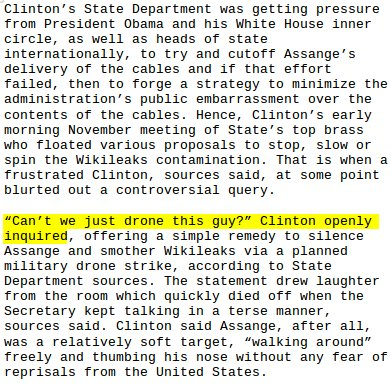
Credit: Wikileaks
This story remains unverified. Who could believe such a thing?
But let me take you back in time when reporting such things was considered a civic duty.
Ben Franklin and The Free Press
Benjamin Franklin, a pioneering figure in American journalism, had a profound view of the role and duties of journalism. He believed the primary purpose of the press was to inform the public, serve as a check on government, and promote civic virtue and personal responsibility. Through his own work as a printer and publisher, Franklin utilized the press as a tool for public debate and enlightenment.
Franklin held that journalists had a duty to question authority, expose corruption, and foster a well-informed citizenry. He was an advocate for free speech and press freedom, famously emphasizing that freedom of the press shouldn’t be restrained, as it serves as a critical counterbalance to governmental power.
Franklin's approach to journalism included a mix of serious commentary on public affairs, practical information, and humor. He understood the power of the press in shaping public opinion and often used it to support civic-minded initiatives and educational projects.
In essence, Franklin saw journalism as a civic duty with significant implications for society's health and functioning.
Remember those days? Perhaps not. But we’re reminded of a time when it was frowned upon for government to interfere with the press. Likewise, we should feel a little dirtier for the press to act as a public relations consultant for the government.
Leave it to Michael Malice to make this point about Assange:
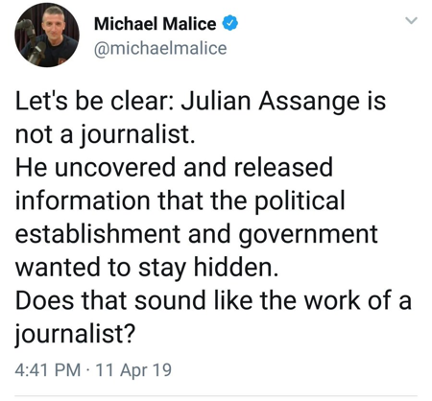
Credit: @Chesschick01
What Did Assange Do?
Let’s remind ourselves why the USG hates Assange and Wikileaks so much.
- Collateral Murder Video (2010): This was one of the earliest and most impactful releases by WikiLeaks. The footage from a US Apache helicopter in 2007, showed the killing of several people in Baghdad, including two Reuters journalists. The video raised serious questions about the conduct of US forces in Iraq and the rules of engagement.
- Afghan and Iraq War Logs (2010): WikiLeaks released nearly 400,000 military reports from the Iraq War and 90,000 from the Afghan conflict, which detailed operational events, intelligence, and reports on actions that resulted in the deaths of thousands of civilians. These logs exposed the scale of the turmoil and civilian casualties in both conflicts, often contradicting official narratives.
- US Diplomatic Cables (Cablegate, 2010): Over 250,000 diplomatic cables were published, revealing the inner workings of US diplomacy. The cables included frank assessments of foreign leaders, candid views on international relations, and discussions about US policies abroad. This leak strained the US’s relationships with many countries.
- Guantanamo Files (2011): WikiLeaks released files concerning the Guantanamo Bay detention camp, exposing the backgrounds of detainees held there, many of whom had weak connections to terrorist activities, as well as the conditions and legal justifications for their detention.
- Spy Files (2011): These files showed how Western technology companies sold equipment and software to authoritarian regimes, which could use them to surveil and repress their populations.
- Secret Trade Agreements (2013-2016): WikiLeaks published drafts of chapters from the Trans-Pacific Partnership (TPP), Trade in Services Agreement (TiSA), and the Transatlantic Trade and Investment Partnership (TTIP), revealing negotiations and terms that were kept secret from the public and heavily criticized for favoring big corporations.
These releases have sparked global debates about privacy, surveillance, the public’s right to know, government transparency, and national security.
The Suspended Sentence
According to Zero Hedge:
Earlier this year, Australian Prime Minister Anthony Albanese said he hoped the U.S. could find a way to conclude the case against Assange, and lawmakers there passed a motion calling for Assange to be allowed to return to his native home. German Chancellor Olaf Scholz has also weighed in, saying that the British courts should not extradite Assange to the U.S. In February, the United Nations special rapporteur on torture, Alice Jill Edwards, said Assange shouldn’t be extradited to the U.S. to face trial, saying he suffered from “depressive disorder” and was at risk of being placed in solitary confinement.
After being imprisoned in London since 2012 (partly at the Ecuadorian Embassy) - mainly to avoid being sent to the US - Assange will be sentenced to time served during a court appearance Wednesday in Saipan, in the US Northern Mariana Islands, avoiding a sentence in an American prison.
I hate to be cynical, but Biden surely okayed this deal to bolster his numbers. That’s fine as long as Assange is free.
Wrap Up
It’s nice to write a feel-good story for the day.
Assange is out, and we owe a debt to him. Thanks to him, we know the USG did some underhanded things we’d have never known about otherwise.
He’s a hero in the old sense of the word.

The Wright Stuff
Posted October 16, 2026
By Sean Ring

Crude and Unusual Profits
Posted October 15, 2026
By Dan Amoss
The Half-Life of a Bargain
Posted October 14, 2026
By Matt Badiali
Pump and Circumstance
Posted October 13, 2026
By Sean Ring
The Crusade That Never Paid
Posted October 12, 2026
By Sean Ring