Posted May 07, 2025

By Sean Ring
Fed’s “Stealth” QE Pushed Gold Above $3,400
Everyone’s tuned out the Fed lately.
The narrative is that Jerome Powell and crew are sidelined, with the hiking cycle essentially over and markets pricing in the next cut. The dot plot? Background noise. FOMC meetings? Yawns all around.
Today’s FOMC meeting at 2 p.m. will likely be a nothing burger, as the markets don’t think Jay Powell and his crew are ready to cut yet (especially if it will help out The Donald).
But if you think the Fed’s only job is fiddling with interest rates, you’re missing the real story.
Yesterday, gold soared by $100 an ounce, not because Powell spoke or inflation ran hot. But because of something that’s been happening quietly in the background:
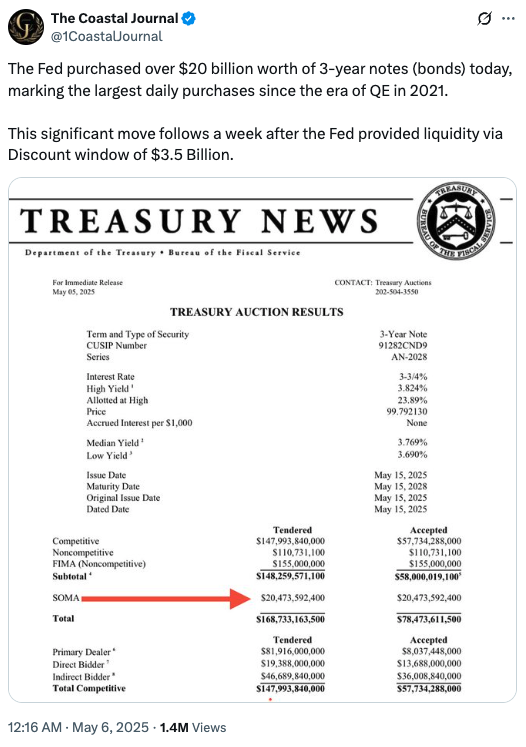
The Fed bought over $20 billion in bonds.
That’s right. Even with QT (quantitative tightening) supposedly underway, the Fed is still a net buyer of U.S. government debt.
 Credit: @1CoastalJournal
And that’s why gold rallied over $100.
If you’re wondering how this is connected, let me explain it simply.
The Fed printed over $20 billion out of thin air. Then they took those freshly cut dollars and bought U.S. Treasury bonds to help shore up the bond auction. Because the markets aren’t as dumb as Jay Powell thinks, they bought gold because they know this is a quantitative easing move, not tightening.
The Fed’s $20.4 billion purchase of these 3-year notes through the System Open Market Account (SOMA) is its largest daily bond acquisition since 2021. By doing this, the Fed signaled a shift toward liquidity support amid a $47 billion Treasury auction. In other words, if the U.S. Treasury can’t raise funds, the Fed will step in whenever needed. And that, my friend, is inflationary.
Following a $3.5 billion Discount Window injection the prior week, the Fed is quietly supporting the Treasury market, a tactic investors label as "stealth QE" (quantitative easing). This strategy is reminiscent of when the Fed balanced QT with unofficial liquidity boosts.
These bonds now sit on the Fed’s growing balance sheet. Investors will buy gold to counter the inflationary effects of the Fed’s bond buying.
Follow the Balance Sheet, Not the Presser
The mainstream media still treats rate policy as the only thing the Fed does. Jay Powell’s press conference today will almost certainly be an irrelevance. Why? Because the Fed’s balance sheet tells the real story.
Despite all the talk of unwinding, the Fed’s emergency lending facilities—BTFP, reverse repos, and assorted backdoor liquidity windows—remain active. And now, $20.4 billion in Treasury purchases shows they’re still papering over cracks in the system.
This isn’t easing by name. It’s easing by necessity.
Because who else is going to buy U.S. debt at scale right now? Foreign central banks are reducing exposure, de-dollarizing to avoid DC’s arbitrary belligerence. Domestic banks are still sitting on enormous unrealized losses from their Treasury holdings. (Bank of America is rumored to be sitting on $112 billion in unrealized losses.) Retail demand? Please.
That leaves the Fed, once again, as the buyer of last resort.
Gold Smells the Truth
Markets are smart. Smarter than Powell gives them credit for.
Gold didn’t spike because CPI missed by a basis point or two. It wasn’t PPI or any of the other economic indicators for inflation. It spiked because investors saw through the illusion of tightening.
When the Fed buys over $20 billion in Treasuries in one go, it's not neutral monetary policy. That’s stealth QE.
And when the central bank backstops the entire system like that, gold shines—because gold isn’t anyone’s liability. It’s not tied to the solvency of a system that constantly needs new tricks to stay afloat.
Why This Matters More Than Rates
Everyone’s obsessed with the Fed Funds Rate. But that’s just the price of money. The real issue is the quantity, and the Fed just showed us it's still injecting it when nobody else will.
This is the hidden game to keep rates high to signal discipline, quietly buy bonds to keep markets from breaking, and hope no one notices the contradiction!
Well, gold noticed, to the tune of $100/oz. And now, so should you.
Wrap Up
Expect more of this: more liquidity through backchannels, more market interventions with different labels, and more support for Treasuries... without calling it QE.
Every time the Fed steps in like this, hard assets—especially gold—get another boost. (And hopefully silver will join the party soon.)
Because the Fed isn’t out of the game.
It’s just playing under a different name.

All That Glitters Is Diesel
Posted October 22, 2026
By Sean Ring

Treason’s Greetings!
Posted October 21, 2026
By Sean Ring

Zach’s Second Opinion
Posted October 20, 2026
By Zach Scheidt

A COLA, But No Smile
Posted October 20, 2026
By Zach Scheidt

Give Me Liberty or Give Me Beige!
Posted October 19, 2026
By Matt Badiali
