Posted January 05, 2026

By Sean Ring
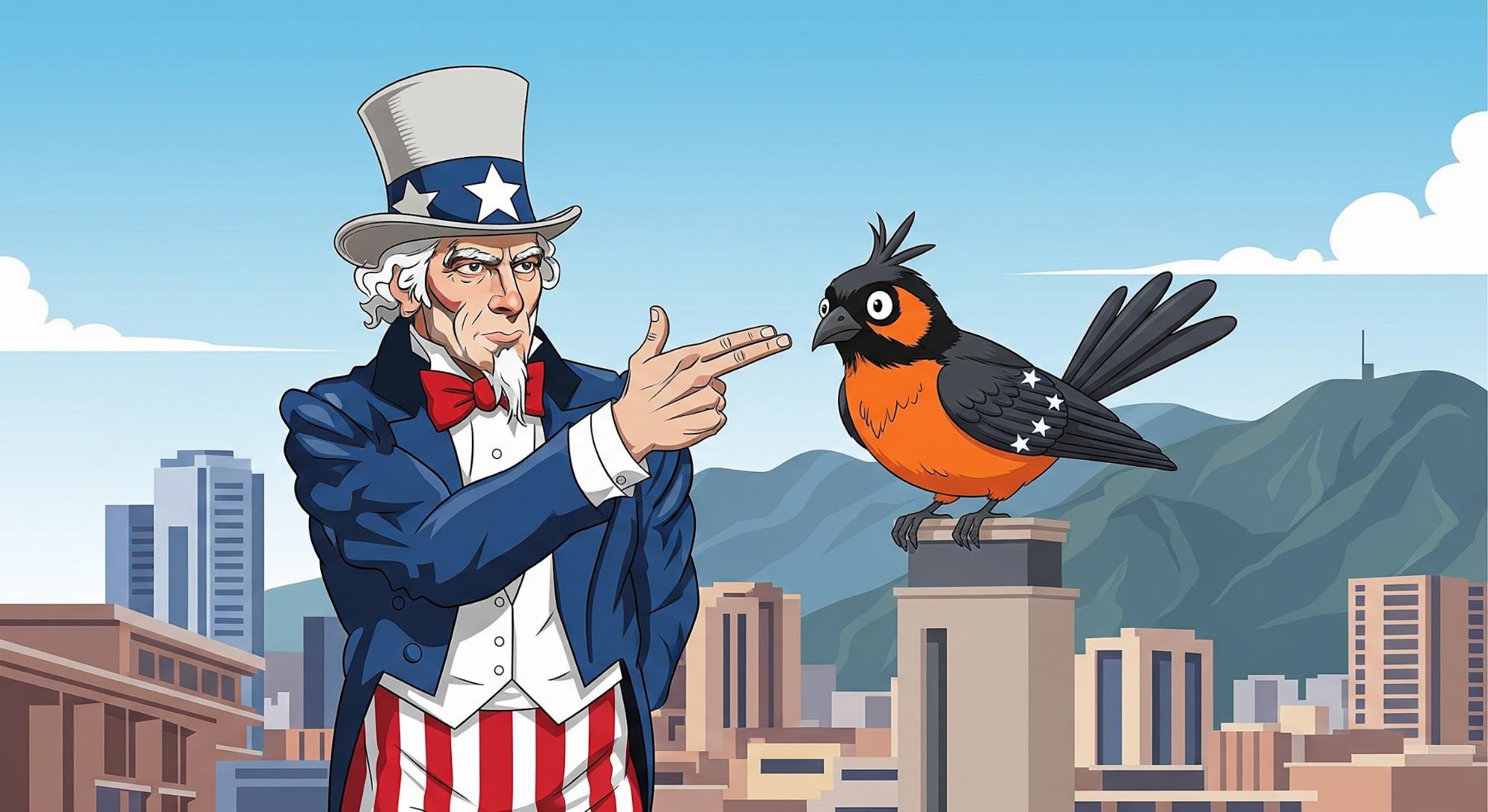
Empire At Gunpoint
You may not have been a Rude subscriber when I first started writing it in April 2021. But even back then, as we crept up to the Russia-Ukraine conflict, I was sounding the alarm. Dark U.S. and UK neocon forces were pushing Ukraine into a war it couldn’t win by poking the Russian bear.
Russia was provoked into invading its neighbor to protect its soft underbelly, something even NATO talking heads now admit. If anyone bothered to look at a map - a stretch for most Yanks, I know - they’d have come to the same conclusion.
That I defended Russia’s position then oddly puts me in a position to analyze the U.S. invasion of a sovereign nation, Venezuela, without being a complete hypocrite. Because a whole bunch of people who pilloried Russia for invading a sovereign nation are now applauding Trump’s move to capture Maduro. Heck, even UK Prime Minister Keir Starmer, the good toady (note the correct spelling, Bari Weiss) that he is, couldn’t bring himself to condemn Trump’s move.
Washington’s move to decapitate Venezuela’s leadership and grab control of its oil sector is the kind of maneuver late empires love: both impressive and corrosive, and dripping with a short-term swagger that masks long-term insecurity.
Yes, the United States can still move fast. It can still take capitals, kidnap leaders, and rewrite facts on the ground before anyone has time to draft a sternly worded, but ultimately useless UN memo.
But every time it does, the world learns something about American anxiety.
This was a display. And displays age badly.
Colonialism is So Back!
In the early hours of Saturday morning, U.S. forces launched Operation Absolute Resolve, a coordinated air and special operations strike across Caracas and surrounding military infrastructure.
Command-and-control nodes went dark. The U.S. hit key bases. By morning, Nicolás Maduro and his wife, Cilia Flores, were in U.S. custody, removed from their own country. Venezuelan officials described the capture as a chaotic, bloody night whose civilian toll is still being tallied.
Within hours, Donald Trump declared that the United States would “run” Venezuela until a “safe, proper, and judicious transition” could be arranged.
Trump didn’t ask Congress. He didn’t pretend there was an imminent attack on the U.S., and he didn’t bother wrapping the action in much legal language.
Legal scholars instantly noted this wasn’t self-defense. It was regime change, plain and simple, carried out against a sovereign state that had not attacked the United States.
DC’s Case
From inside the Beltway, the operation is being marketed as a strategic win. The pitch works domestically.
First, there’s oil. I won’t insult your intelligence by telling you this is about oil. I’ll let CBS News do that. But there’s a kernel of truth to the story that Washington is much happier that Venezuela’s oil will be repriced in dollars rather than sold directly to China in yuan or to Russia in rubles.
Second, there’s the drug war framing. I can’t get more honest with you than saying a few speedboats approaching the American coast getting blown up doesn’t concern me in the slightest. Heck, I wish the Italian Navy would do the same thing over here. But Venezuela is responsible for perhaps 1% of all drugs that enter the United States. So this wasn’t about drugs, really. But connecting fentanyl - and by association, China - to the story, it looks like the U.S. is smacking Emperor Pooh Bear in the mouth. Kind of like how Dick Cheney tied Saddam Hussein to 9/11 without a single shred of evidence.
Third, there’s energy chess. Kicking China and Russia out of Venezuela is a smart move. Kicking Canadian oil companies in the goolies is a bonus. And controlling Venezuela’s oil will help temper any price shocks for when Bibi orders The Donald to strike Iran. But the big thing is that cornering the oil market helps the USG mask the inflation that Trump’s other policies are creating. No increases at the gas pump, but everything else will probably get expensive.
On paper, it all sounds muscular.
In reality, it’s brittle.
The Costs
Start with the most basic problem: Venezuela did not attack the United States. There was no imminent threat. Once you strip away the rhetoric, what remains is an offensive war of choice.
Precedent matters. When a superpower normalizes abducting foreign leaders without UN backing, congressional authorization, or coalition support, it teaches everyone else that sovereignty is enforced only when convenient.
Again, I’m not shedding any tears over Maduro going. He was an absolute waste of space who destroyed the most resource-rich country in South America. Still, just because you toppled the leader doesn’t mean the rest of the population will just roll over.
And if I were Iran, I’d be racing to build the bomb. The only protection any nation has against the late-stage American empire is going nuclear.
Then there’s escalation. Trump officials have already said boots on the ground remain an option if “stability” doesn’t materialize quickly enough. Newsreaders dump Cuba into the same narrative soup of drugs, migration, and hostile influence.
“We need Greenland for national security,” said The Donald, much to the chagrin of Denmark and the EU.
This is how “limited actions” metastasize into quagmires.
And then there’s the part empires never like to talk about. The United States toppled and kidnapped a foreign head of state in broad daylight, without allies, without legal cover, and without much effort to pretend otherwise. To much of the world, it looks less like confidence and more like compulsion.
When a hegemon keeps insisting its dominance “will never be questioned again,” it means the questioning has already started.
The Excuse For Hemispheric Hegemony
Energy analysts highlight a critical reality: Venezuelan oil isn’t the immediate panacea for restoring American geopolitical strength. The United States is already a significant oil producer and exporter. Furthermore, reviving Venezuela's severely deteriorated oil infrastructure will take years, require immense capital investment, and demand a level of political stability that private companies will likely view as too high-risk for a significant commitment.
Oil, in this story, is less the prize than the pretext.
What Venezuela really offers is symbolism and position. By seizing control over the world’s largest proven reserves and prying them away from Chinese and Russian financing, Washington is sending a message that strategic assets in the U.S. near abroad aren’t up for negotiation.
That message may intimidate some actors in the short run. But it also accelerates the search for hedges, such as alternative payment systems, tighter regional blocs, and mechanisms explicitly designed to reduce exposure to American coercion.
Empires don’t collapse because they lack power, but because they teach others how badly that power can be used.
Late Stage Empire Behavior
The Venezuela operation shows the U.S. strategy paradox in the 2020s.
Militarily, America can still strike anywhere, anytime. Financially, it can still coerce, bribe, or exclude at scale. But legitimacy, the intangible asset that made U.S. primacy durable after 1945, erodes a little more with every unilateral strike dressed up as stability.
Washington may walk away from Caracas with oil contracts, improved drug policies, and a compliant government. On its own terms, it may even call that success.
But to the rest of the world, it looks like something else entirely: a great power acting out of the creeping awareness that its best days are behind it.
Wrap Up
Gold, silver, copper, and Bitcoin are all up on the news. (But Uncle Slammy will surely pay us an 8 am NY time visit.) Stay long, my friends (at least on the metals). BTC is now targeting $94,975 on my charts.
And yet, oil is as flat as a pancake, and traded as low as $56.31 this morning. It has four downside targets, the lowest of which is $50.31.

From The Shores of Tripoli to Caracas
Posted January 07, 2026
By Sean Ring

It's Been a Metals Year... and a Pick!
Posted January 02, 2026
By Sean Ring

The U.S. Equity Indices and What They Mean
Posted December 30, 2025
By Sean Ring

The Shape of Things to Come
Posted December 29, 2025
By Jim Rickards

A Copper Melt-Up in 2026, and “Tech” Meltdown
Posted December 26, 2025
By Byron King