Posted March 22, 2024

By Sean Ring
DEI: Didn’t Earn It
My goodness, how I wish I had come up with that myself!
Sometimes, the truth just smacks you in the face. And in this case, I’m glad it did.
Boeing’s doors coming off, Disney’s awful gender-swap live-action films, and BlackRock’s failed social investing initiatives all point to one thing: it’s time to call time on DEI. And those are just a few choice examples at the moment.
But as I was scrolling through X a few days ago, I saw this post:

I’m unsure if Cheong invented the term or passed it on, but I loved it immediately. And then, I took no further heed of it.
Until yesterday, when I saw this:
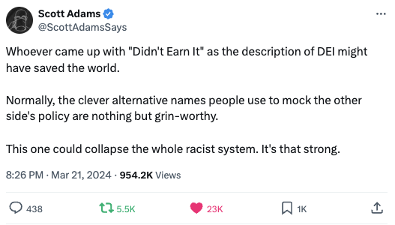
If you don’t recall, Scott Adams is the author of the Dilbert comic strip. He was canceled for not going along with The Narrative.
A Few Anecdotes
When I was in Hong Kong, I talked with a colleague from another bank. He, too, was a forty-something Vice President and married father-of-four who had no chance of promotion.
When I asked him why he thought that was, he said, “Well, in The West, diversity means ‘hiring non-white people’ into jobs. In Asia, it means ‘favoring the local talent.’”
He knew he’d never get promoted unless he left his current bank and joined another one at the next level up. And those jobs, of course, were going to the local talent, no matter their capability level compared to his. In essence, he was trapped.
Another friend of mine was looking for a job in London. Like me, he had a Master’s in Finance from London Business School, decades of experience, and was a chartered accountant.
Crickets.
I asked him why he thought he couldn’t get a job. He said, “Well, I’ve talked to some recruiters.”
They said, “We’re just waiting for a stock market crash.”
“Why?”
“Because we’ll be able to place white people again.”
The upshot was that banks were hiring younger, more diverse, and hence, cheaper talent into vice president roles rather than hiring properly experienced and more expensive directors and managing directors.
However, as banks are quasi-government entities that will always be bailed out, they don’t have to follow the usual business rules of getting the right talent for the right jobs. Momentum takes care of much when the US Treasury unconditionally backs you.
Why DEI Was Good
I’ll give this to DEI: it got good people out of their steel towers and into entrepreneurship.
Many high-IQ folks were shaken to their core and out of their slumber by being passed over one too many times. The relentless, inescapable conclusion was, “I’m never getting promoted, no matter how well I do.”
I can tell you, I’ll never again do a dance for a manager in a large corporation who’s several magnitudes beneath my intelligence level.
I’m sure there are millions—really—who think the same way. The explosion in entrepreneurship, solopreneurship, and small business ownership attests to the fact that it’s never been easier to start a business. Nor will you have any excuse not to… if you’ve got what it takes.
Quite frankly, the technology for running a business has become so intuitive that the “circle” of people who have what it takes has never been wider… and it keeps growing wider. The tricky part of running a business, what you get paid for, the organization, is almost completely taken care of by technology.
In this sense, we must be grateful for all the new ideas that would’ve died inside larger organizations had those smart folks been promoted and paid according to merit.
Why DEI Must DIE
But now, those vast corporations on whom we depend so much, are being hollowed out.
Their talent is leaving in droves. Why? Because they’re not getting what they deserve in terms of pay or respect.
When the right people don’t get into the right jobs because of HR’s manic mission to make everything equal, bad situations arise. For example:
Poorly implemented DEI backfires: If DEI becomes a box-ticking exercise or if quotas are seen as unfair, it breeds resentment among employees who feel qualified candidates are being overlooked.
Focusing on DEI distracts from the company’s core business. If DEI initiatives take up too much time and resources, they undermine the company's core mission.
Unintended consequences of inclusion efforts: Being inclusive is tricky. There are challenges in ensuring everyone feels valued without micromanaging interactions.
Lastly, as we now consider recent Harvard grads nothing special, DEI hires are found out quickly and tarred with a brush.
Wrap Up
No one and I mean no one, is against enforcing existing laws to ensure that the best people get the right jobs regardless of their race, color, or creed. But we’ve overstepped the bounds of propriety and implemented an oppressive corporate regime where the best get passed over because of their race, color, or creed.
What made America great were the limitless possibilities a talented individual had to make their way in the world.
What DEI has done is threaten America’s once unassailable corporate advantage.
So remember, DEI means “Didn’t earn it.”
Pass it around…
Have a wonderful weekend!
Brazilian Backfire
Posted October 26, 2026
By Sean Ring

A Crude Awakening
Posted October 23, 2026
By Sean Ring

All That Glitters Is Diesel
Posted October 22, 2026
By Sean Ring
Treason’s Greetings!
Posted October 21, 2026
By Sean Ring

Zach’s Second Opinion
Posted October 20, 2026
By Zach Scheidt