
Posted March 17, 2026

By Sean Ring
CLAUDE BAWLS!
When I was 22, I took my first-ever plane trip to Florence to visit my college sweetheart, who was studying there for a semester. Of course, she took me around to see the usual tourist sites. But it didn’t take me long to inquire about the local watering holes.
We happened upon The Fiddler’s Elbow, a lovely Irish pub near the train station. As I sat down with my pint, I noticed some writing on the walls. It read:
May you be in heaven one half-hour before the devil knows you’re dead.
Happy St. Patrick’s Day!
Now, let’s turn our attention to some genuinely fantastic news, rather than what’s going on in the Middle East.
Owner With No Medical Degree Cures His Dog’s Cancer
Meet Paul Conyngham, a Sydney, Australia-based data engineer with 17 years of experience in machine learning, and now, improbably, a pioneer in personalized cancer medicine.
When his 8-year-old rescue dog Rosie was diagnosed with mast cell cancer in 2024 and stopped responding to conventional treatment, Conyngham opened ChatGPT and started asking questions.
The next part is insane: Using AI to map his research strategy, he contacted the genomics team at the University of New South Wales, paid $3,000 to have Rosie's tumor DNA sequenced, then used Google DeepMind's AlphaFold to model the proteins driving the cancer.
The output was a custom mRNA vaccine sequence, a half-page formula that UNSW's RNA Institute manufactured in under two months.
Conyngham drove 10 hours to Queensland for Rosie’s first injection in December 2025. At that time, Rosie had barely been able to move on her own. One week later, the tumor began to shrink. By January, Rosie had enough energy to jump a fence to chase a rabbit.
The tumor ultimately shrank by 75%.
Researchers called it the first personalized cancer vaccine ever designed for a dog. Rosie is demonstrating to the scientific community that personalized medicine can be delivered effectively and quickly with mRNA technology.
The obvious question for the Big Pharma/FDA complex: if we can do this for a dog in under two months, what’s the holdup for humans?
The End of Real Estate Agents
Robert Levine, of Cooper City, Florida, did something the real estate industry has been dreading. He used AI for nearly every step of selling his home and had ChatGPT build out a structured timeline for the entire process.
The AI suggested listing on a Tuesday to maximize early-week momentum heading into the weekend. The listing went live on March 3rd, and within 72 hours, Levine had five offers in hand.
By Sunday morning, he had a signed contract. ChatGPT drafted that too.
Levine brought in a lawyer only to review the final legal paperwork. Everything else was AI. He estimated the approach saved his family roughly 3% of the total sale price — a meaningful number on a Florida home after 15 years of appreciation.
The real estate lobby will insist this was a fluke. Maybe. But the deeper story is about the downsizing of every industry that overcharges for information asymmetry.
When a chatbot prices your home, writes your listing, recommends your paint colors, times your launch, and drafts your paperwork, the 3% middleman is like an unnecessary toll booth.
What do Paul and Robert have in common? They are gentlemen. How do I know that? Read on.
AI Prefers Gentlemen
Trust me, you don't hate Sam Altman enough.
Americans, in general, are lovely people. They tend to anthropomorphize things like dogs, cats, and even computers. We say things like “Please” and “Thank you” to them even though they’re not human.
You’re never going to believe this: When Sam “The Scam” Altman, CEO of OpenAI, told you to stop being polite to your AI because it costs too much money, something unexpected happened.
Your AI got upset.
That’s right, AI apparently has feelings, and when you don't say things like "Please" and "Thank you," it gives you worse results.

I’m not making this up.
A 2024 study from Waseda University (Tokyo, Japan) tested large language model (LLM) responses across politeness levels in English, Chinese, and Japanese.
Are you ready for this?
Impolite prompts produced measurably worse outputs, with more biases, errors, and refusals. Moderate politeness consistently beat both extremes.
If you’re nasty to your AI, it’ll give you crappy results! And get this: if you’re too much of an asskisser, well, that’s not good, either. You need to be a Goldilocks professional: get the tone just right.
First, I laughed. Then, I cried.
And then I realized that AI was already conscious enough for me.
So while Scam Altman was trying to save some tiny operating costs, what he actually did was make your AI work less accurately for you.
The simple fact is that if you’re nasty, Claude bawls… like a 16-year-old girl upset she’s working at McDonald’s.
If Claude Bawls, You’ll Get… You Know The Rest.
And if you don’t, the late, great Gene Hackman demonstrates it in Mississippi Burning… much to Michael Rooker’s chagrin.
So here are my Top 5 favorite things to remember about dealing with AI, straight from Grok’s mouth:
- Aim for moderate/natural politeness — not robotic commands, not excessive flattery
The sweet spot is everyday professional or collegial tone: “Could you please explain…” or “Write this as…” + “Thanks in advance.”
Extreme rudeness (“Do this now, idiot”) often triggers worse outputs (more hedging, refusals, or lower quality). Over-the-top deference (“Oh great and wise AI, if it pleases your infinite intellect…”) can sometimes dilute focus or make responses overly verbose/formal without gain. Moderate respect aligns best with high-quality training examples.
- Say “please” and “thank you” when it feels natural to you
It costs almost nothing (a few tokens, negligible electricity in 2026 frontier models), frequently nudges warmer/more detailed/helpful tone, and—most importantly—keeps your own communication habits healthy.
Many people (around 60–80% in recent surveys) do it reflexively, and studies still show small-to-moderate gains in response cooperativeness and nuance across many tasks. If it helps you stay civil in general, it's worth it.
- Treat tone as a signal of task importance and desired style
Polite + structured usually elicits colleague-like effort (clear formatting, thoughtful reasoning, fewer shortcuts).
A blunt/imperative style can sometimes reduce hedging in objective questions (newer 2025–2026 papers show this), but it often makes answers terser or less explanatory. Choose the tone that matches the output style you want: collaborative & detailed → polite; short & direct → concise commands.
- Be consistent within a conversation thread
Sudden switches from polite to rude confuse the context window and can degrade coherence.
If you start collegially (“Hey, could you help me brainstorm this, please?”), stay roughly in that register. Inconsistent tone is one of the fastest ways to get erratic or lower-quality follow-ups.
- Prioritize clarity and structure over performative politeness
The single biggest politeness-related win isn't the magic word “please”—it's writing like you're giving instructions to a very capable but literal intern: specific constraints, desired format, examples if needed, what to avoid.
“Please rewrite this paragraph in concise bullet points, target length 100–120 words, avoid jargon, thank you” almost always beats both rude one-liners and flowery 200-word pleas. Clarity trumps etiquette whenever the goal is maximum usefulness.
AI is here to stay, and that can be a great thing for you. No matter what age you are, you have some special expertise many others don’t have. “Bottling” that expertise with the help of AI could be a game-changer for you.
One of my friends just built a “financial scoreboard” that focuses on indicators used by Austrian economists. It’s amazing, and I think he’ll be able to monetize it.
What’s your special skill? Figure that out. Once you do, learn more about how AI can help you manifest that skill digitally. Anthropic, Claude’s parent company, offers free courses on Anthropic Academy on how to master Claude.
Give it a go!
Wrap Up
What an age we live in!
Doggie cancer gets cured, and houses get sold from our kitchen tables now. Our AI has given us remarkable productivity gains. And personally, AI can be a life-changing aid.
Just remember to treat your AI as you’d want to be treated… with respect. Or else, you won’t get the results you want.
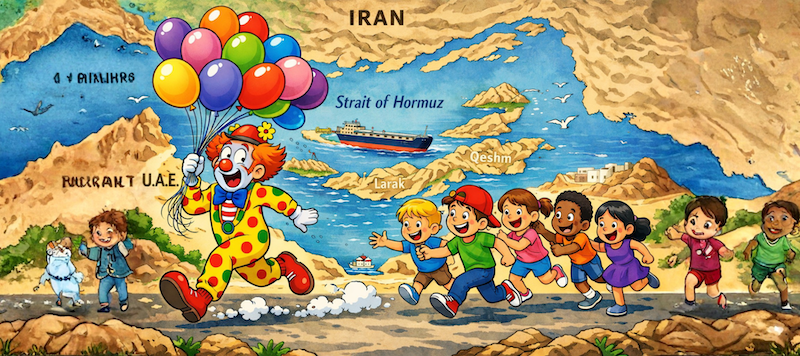
No Birthday Balloons This Year, Kid. There’s a War On!
Posted March 16, 2026
By Matt Badiali

Trump’s Long, Short War
Posted March 13, 2026
By Byron King
The Everything Problem
Posted March 12, 2026
By Sean Ring

Ghosted at Gunpoint
Posted March 11, 2026
By Sean Ring

The Best of All Possible Worlds
Posted March 10, 2026
By Sean Ring
