Posted August 25, 2026

By Sean Ring
Bessent's Last Stand
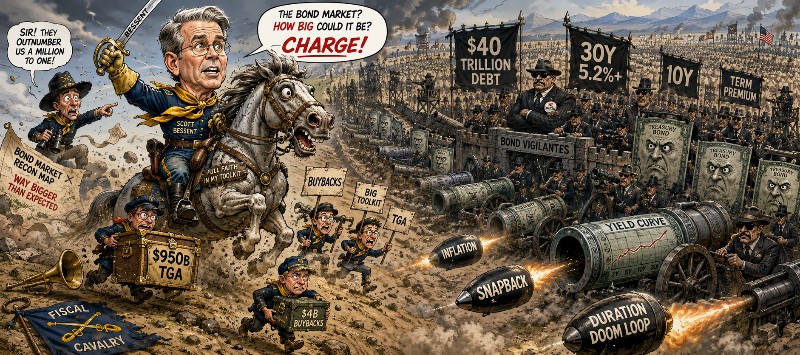
June 25, 1876. Little Bighorn.
George Armstrong Custer looked down at an encampment and saw a fight he could win. His scouts saw something else. The village below was bigger than any of them had ever counted. Custer split his command anyway and charged.
The reinforcements he counted on never arrived.
Last week, current, and maybe for-not-much-longer, Treasury Secretary Scott Bessent rode down his own hill, on live television.
The 30-year Treasury yield had just hit its highest level since 2007. The 10-year wasn't far behind. The national debt had crossed $40 trillion the same week. And the bond market, the last honest critic left in Washington, was demanding real compensation to keep funding it all.
So Bessent charged.
The Three Escalations
I was so happy we got a former hedge fund manager as a Treasury Secretary. Now, not only do I think my enthusiasm was misplaced, I think the man is flat-out certifiable.
On August 19, two weeks after the quarterly refunding, when changes like this are supposed to be announced, the Treasury said it would at least double its buybacks of 10- to 30-year debt. The cap went from $2 billion per operation to at least $4 billion, running September 9 through November 4. It’s like shooting an elephant with a Tic Tac. But, boy, did it excite the metals and miners.
Yields fell for exactly one day. Then they reversed. Of course, they did!
So Bessent went on CNBC and escalated. The buybacks could top $4 billion per issue. He'd - get this! - "make a market" in the long bond. In his words, he has “a big toolkit.”
Yesterday brought the third escalation. Two senior Treasury officials floated tapping the Treasury General Account (TGA), the government's $950 billion checking account at the Fed, to fund the buying.
That headline knocked the 10-year down to 4.7% and the 30-year to 5.23%... for a New York minute.
Here's my catalog of what can go wrong. Let me count the ways: 9. They come in 3 groups of 3: the inflation, the snapback, and the trap.
The Inflation 3
1. QE without the Fed.
The TGA sits at the Federal Reserve. When the Treasury spends it, cash flows out of that account and into the banking system as fresh reserves. Draining the TGA to buy bonds is a liquidity injection, run by a political appointee, timed ahead of an election, with inflation already above target. They can call it cash management. It's stealth QE during an inflation fight.
2. We fought this exact battle before, and lost.
From 1942 to 1951, the Fed pegged Treasury yields at the Treasury's request to fund the war. When price controls were removed, inflation rose to almost 20% in 1947. The Treasury-Fed Accord of 1951 exists because the whole country learned a hard lesson: a government that sets the price of its own debt pays for it in inflation. Bessent is unwinding 75 years of hard-earned knowledge by press release.
3. The dollar is already telling you.
Rising yields should attract capital and increase a currency’s spot (cash) value. Instead, yields rose while the dollar fell. That happens in emerging markets and banana republics, not in the home of the world’s reserve currency. And yet, it did.
It means capital is leaving, not repricing. If you suppress the yield on top of that, you take away the only compensation foreign T-bond holders were still getting. When they sell, the dollar drops further, and import prices climb. Of course, rising import prices are what The Donald wants. Fleeing capital is not.
The Snapback 3
4. Yield curve control always ends the same way.
Ask the Aussies. In November 2021, the Reserve Bank of Australia abandoned its bond yield target, and the market blew through the peg within days. Ask the Bank of Japan, whose exit from its own yield cap took years of hostage negotiation. The defending central bank always runs out of either ammunition or willpower. Then the yield gaps to where it should have been all along, plus a penalty for the panic.
5. He's shredding the one asset Treasury had: predictability.
For decades, the Treasury's mantra was "regular and predictable." It would announce its schedule and never surprise the market. That discipline is why the world lends to America cheaply. This off-cycle announcement broke it, and Wall Street desks said so in writing.
The result of this intervention is a higher term premium, because bondholders are paid more for lending over a longer period. That’s the very thing Bessent is fighting! The intervention manufactures the problem it claims to solve. This market needs Metamucil, not Pepto-Bismol.
6. The ammunition is finite.
The TGA holds $950 billion. The Treasury market rolls around $30 trillion, and the sellers reload at every auction, every week, forever. When the account runs dry and the buying stops, the curve doesn't drift back to its fair value. It snaps there and then overshoots, because the market will price in a Treasury Secretary who panics.
The Trap 3
7. The duration doom loop.
Even if Bessent buys back long bonds, he still has to finance the deficit, so he’ll have to issue short-term bills to do so.
Every buyback at the long end gets refinanced at the short end. The average maturity of the national debt shrinks. America is converting its long-term fixed rate mortgages to short-term floating rate ones on $40 trillion, at higher rates. Every future hike hits the budget almost immediately. Remember fiscal dominance? Here it is, made automatic.
8. The reinforcements aren't coming.
Fed Chair Kevin Warsh speaks Friday at Jackson Hole, and he's made his preference clear: markets should set rates, not The Swamp. That leaves two outcomes. The Fed accommodates Treasury, and its independence dies. Or the Fed fights back with tighter policy, and the two arms of the state pull the rope in opposite directions. Expansionary fiscal policy from Bessent will meet contractionary monetary policy from Warsh’s Fed.
9. The buffer disappears right when you'll need it.
The TGA was fattened up as a crisis cushion. If you piss it up a wall by suppressing yields, two bills will come due. First, there will be no dry powder for the next debt ceiling standoff, expected between winter and early spring. Second, the TGA will have to be rebuilt with a flood of bill issuance that drains liquidity from markets. That's an inevitable tightening shock on a delayed fuse.
Wrap Up
The 30-year yield is one of capitalism’s most important prices. It influences every pension, mortgage, and entrepreneurial decision. Heck, it’s the price of time.
It’s also the last alarm still ringing loud enough for The Swamp to hear. Bessent is buying its silence with the nation's checking account.
You can't stop him. But you don't have to ride in the column, either.
Own gold and hard assets, the things no Treasury official can buy back. Keep your duration short and your cash ready. Avoid anything whose value depends on the long end of the curve telling the truth.
Custer's men didn't get a choice about where they stood that afternoon.

A Crude Awakening
Posted October 23, 2026
By Sean Ring

All That Glitters Is Diesel
Posted October 22, 2026
By Sean Ring

Treason’s Greetings!
Posted October 21, 2026
By Sean Ring

Zach’s Second Opinion
Posted October 20, 2026
By Zach Scheidt

A COLA, But No Smile
Posted October 20, 2026
By Zach Scheidt