Posted November 09, 2026

By Sean Ring
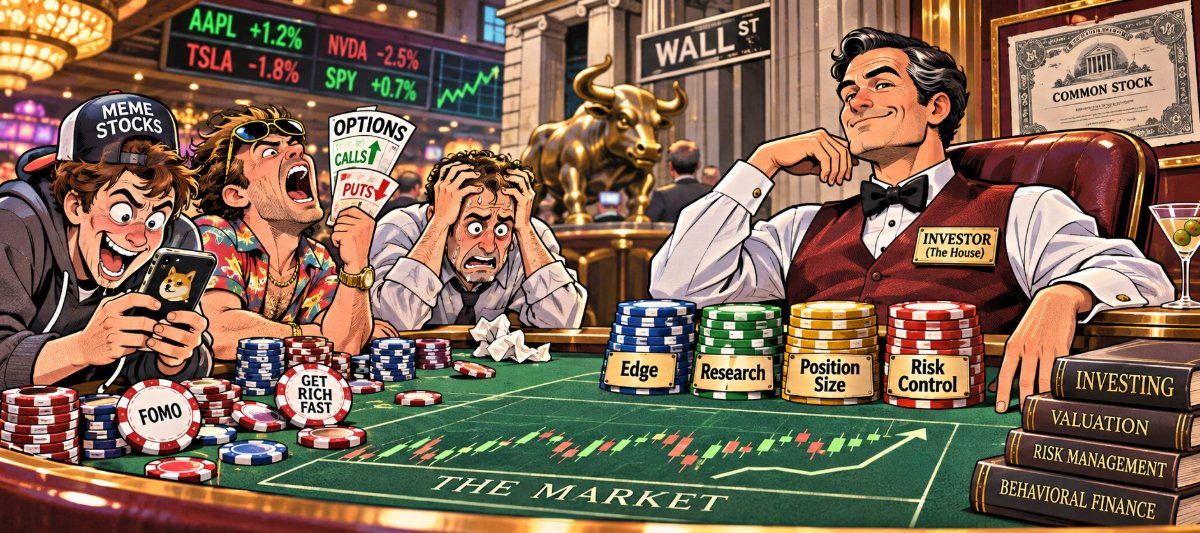
Be the House
Last week in Nashville, at our Whisky Bar roundtable, my friend and colleague James Altucher asserted that buying stocks is gambling.
Plenty of smart people believe the same thing, and I disagree with all of them.
Today, I’ll show you why. But to be fair, let’s start with what the claim gets right.
For far too many people, stocks are gambling. The man who buys a meme stock because a stranger on the internet told him to is gambling. So is the fellow who trades options on his phone at red lights. They’ve got no edge, no plan, and no idea what they own.
But that’s more about the players than the stocks.
Gambling isn’t something done only in a casino. It’s done everywhere you don’t have an edge.
Two Kinds of Not Knowing
In 1921, a University of Chicago economist named Frank Knight wrote a book called Risk, Uncertainty and Profit. It split the unknown into two kinds.
Risk is when you don’t know the outcome, but you know the odds. For instance, if you roll a die, you can’t say what’ll come up. But you know each face has a one-in-six chance of coming up.
Uncertainty is when you don’t even know the odds. Nobody can give you the true probability that a new drug works or that a mine finds the vein.
Now, let’s step into a casino.
An American roulette wheel has 38 pockets. If you bet on one number and it comes up, you get paid 35 to 1. The odds are fixed, printed, and known to the penny. Over time, the house keeps about 5.26% of every dollar wagered.
That’s pure risk, built for a single purpose: to take your money. The more you play, the more certain your loss becomes.
Conversely, the market runs on uncertainty. No one can print the odds on a business, because the future hasn’t been written yet.
Knight’s great insight was that profit comes from uncertainty, not from risk. If the odds are known, then someone will price them, and the edge will vanish. Real returns go to the people willing to carry the unknown. Early Bitcoin investors are a great example.
So the casino is the only place where your loss is mathematically certain. The reward for not knowing lives in the market.
And there’s one more difference. A roulette ball doesn’t make anything. A share of stock is a slice of a business that sells goods, earns profits, and pays you while you wait.
The Man Who Beat Both
If you want proof that gambling and investing aren’t about the venue, meet Ed Thorp.
Thorp was a math professor. In 1962, he published Beat the Dealer, which showed that a card counter could tilt blackjack odds in his favor. Casinos hated him and changed blackjack rules to stop people like him.
Realizing he could make more money with less risk to his kneecaps, Thorp applied the same mindset to the stock market. His fund, Princeton Newport Partners, compounded at about 19% a year before fees for nearly two decades. Thorp had 227 winning months out of 230, for an insane 98.695% win rate. And his worst loss was under 1%.
Let’s consider the implications. Even in the casino, Thorp wasn’t gambling. He had an edge, and he sized his bets to it. That’s investing, despite the tacky venue.
And the stock buyer with no edge, betting on a hot tip? He’s gambling, even though his venue is the prestigious stock market.
In short, your edge, not your venue, decides whether you’re a gambler or an investor.
Three Rules From Men Who Don’t Gamble
An edge is the first half. The second half is how you bet. Three of the best investors of the past century each said it in their own way.
I’ve written about Charlie Munger many times. One of my favorite things about him is that he didn’t try to be brilliant. He tried not to be stupid. He once said he and his old friend Warren Buffett got a remarkable long-term advantage by trying to be consistently not stupid, rather than very intelligent.
That might sound like a brilliant man feigning humility. But it’s also simple math. If you lose 50% on an investment, you need a 100% gain to break even. If you lose everything, no gain can save you. That’s the risk of ruin. The gambler swings for the fences. Munger stayed in the game until he finally died a few weeks short of his 100th birthday.
George Soros put it this way: It doesn’t matter whether you’re right or wrong, but how much you make when you’re right and how much you lose when you’re wrong.
In short, keep your winners big and your losers small.
His partner Stanley Druckenmiller said that was the most important thing Soros taught him.
The rule implies you can be wrong half the time and still get rich, if your losers are small and your winners are big. The gambler does the reverse. He cuts winners early to lock in a thrill, and he doubles down on losers to win it back.
Then there’s Druckenmiller himself. His favorite line comes from Mark Twain: put all your eggs in one basket, and watch that basket very carefully.
Most people only hear the first half. But Druckenmiller’s point is the second. He said that when you own a big position, it must have your full attention. Read every report. Notice when the facts change. And when they do, you sell.
By contrast, the gambler doesn’t watch his basket. He prays for it.
Wrap Up
You don’t need Thorp’s math skills or Soros’s cojones to stay on the right side of the table. You need to ask - and answer - three questions before taking any position.
- What’s my edge? What do I know or see that the price hasn’t caught up to? If the answer is “nothing,” buy the index or keep your money in cash.
- What do I do if I’m wrong? Size your position so a mistake hurts but doesn’t kill. As Ray Dalio says, “You can ding the car, but you can’t total it.”
- Will I keep a watchful eye? If you own it, read about it. If the story changes, you must change with it.
If you can answer those three questions, you won’t be the saddo in the casino pulling a slot lever.

The Yuan Trap
Posted November 06, 2026
By Sean Ring

The 16,000 Who Rule America
Posted November 05, 2026
By Sean Ring
The 87% Solution
Posted November 04, 2026
By Sean Ring

Warsaw Unpacked
Posted November 03, 2026
By Sean Ring
A Crude Tax
Posted November 02, 2026
By Sean Ring
