Posted July 16, 2026

By Byron King
America 250: Roll On, Big Boy… Roll On!
Trackside in Homestead
It began with a vibe. I felt it in my boots, energy conducted through the concrete where I stood and, of course, through the rails. I looked down along the track line, which faded into a long stretch of trees. And then I heard it… “Whooo… Whoooooo!”
I was in Homestead, Pennsylvania, last Saturday afternoon, an old steel mill town just south of Pittsburgh. My perch was the Amity Street crossing, next to a biker bar called Rogue BBQ (yes, great barbecue).
The weather was hot and muggy, with barely a breeze. And there I was, along with 8,000 close friends, spread out along the Norfolk Southern (NSC) right of way — the old Pennsylvania Railroad, to be thorough about it — with a growing crowd on a nearby bridge.
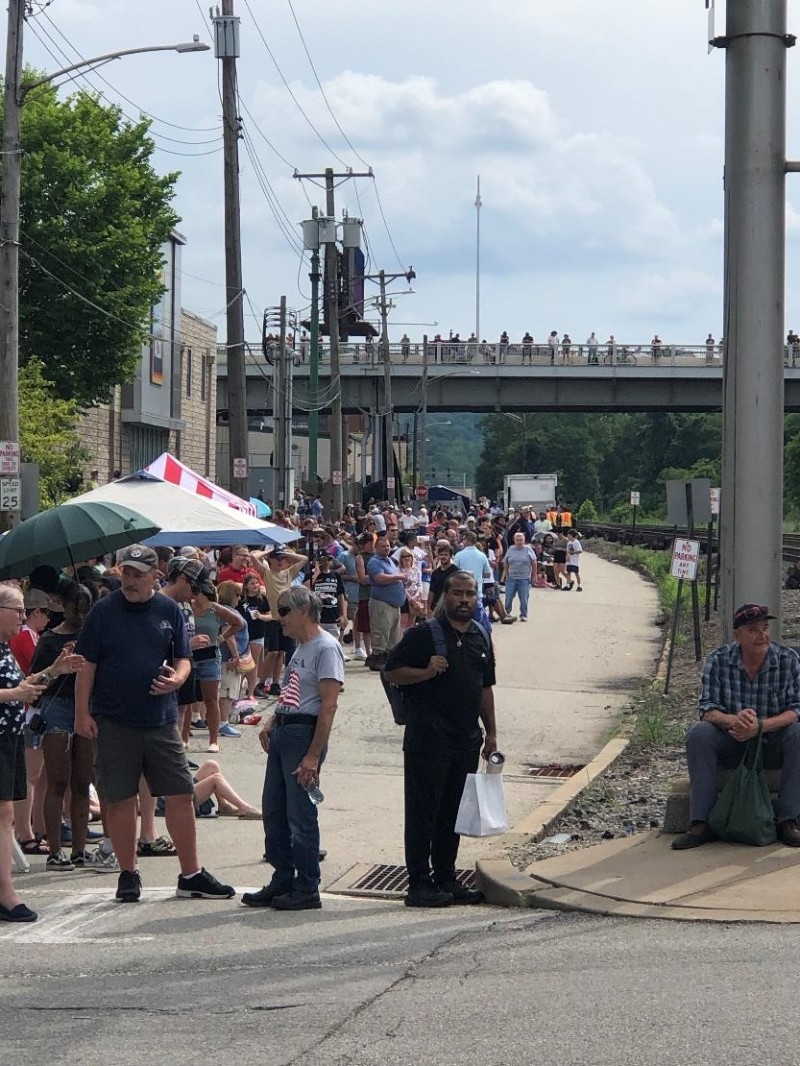 Crowds gather and await the train. Homestead, PA. BWK photo.
Here Comes Big Boy
Exciting? You betcha. We were there for Big Boy, aka engine No. 4014 of the Union Pacific Railroad Corporation (UNP), as he made his America 250 cross-country tour. And on July 11th, the iron giant rolled through town.
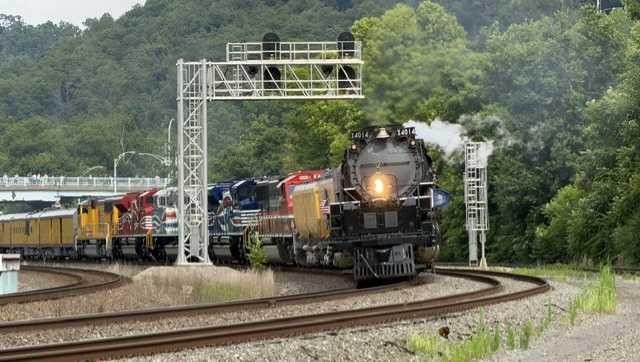 Big Boy in the industrial heartland of Western Pennsylvania. Credit WTAE.com.
A Whistle Like No Other
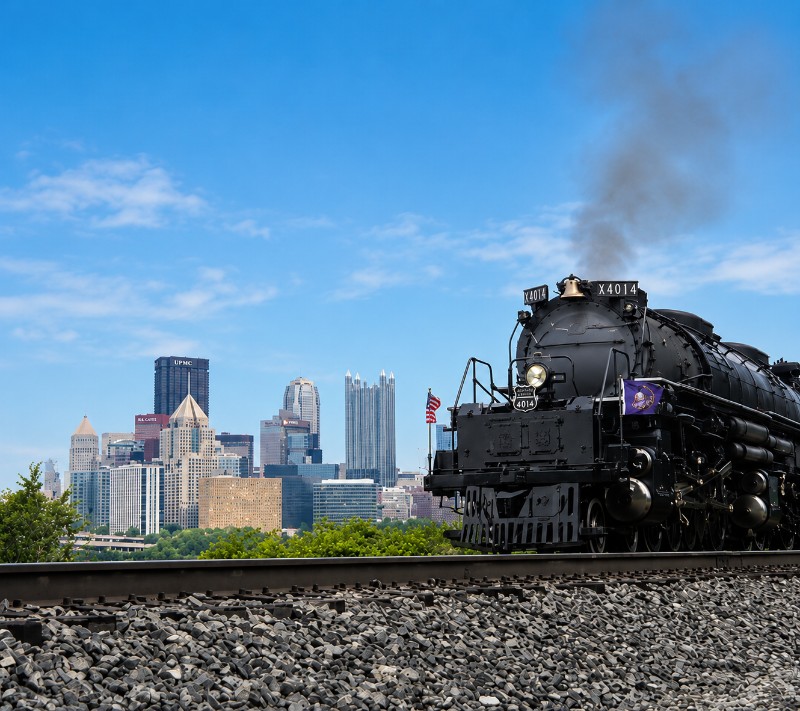
Big Boy is a smoke-belching steam locomotive (see above), one of the world’s largest. Assembled in 1941 in Schenectady, New York, he’s one of just 25 ever built. And his sound gives him away from afar.
That whistle! What a whistle! Oh man, what a sound!
It’s not an air horn, like what you hear from diesel locos. With a steam-train whistle, superheated water vapor blows through a valve into what’s called a “bell,” though not the kind that rings down at the church. No, it’s a cylindrical contraption in which steam expands and vibrates to create a resonant sound. Pitch and tone depend on the length of the bell and the amount of steam the operator releases. And most locomotive engineers develop their own distinctive style of whistling.
Big Boy? He’s distinctive. Very distinctive. “Whooo… Whoooooo!”
As train sets go — i.e., locomotive and tender — Big Boy tips the scales at nearly 1.2 million pounds. With 16 massive drive wheels and tremendous traction, this muscular machine and his 24 siblings hauled freight for UPac through the Rocky Mountains during World War II and beyond, until the entire class was retired in 1959.
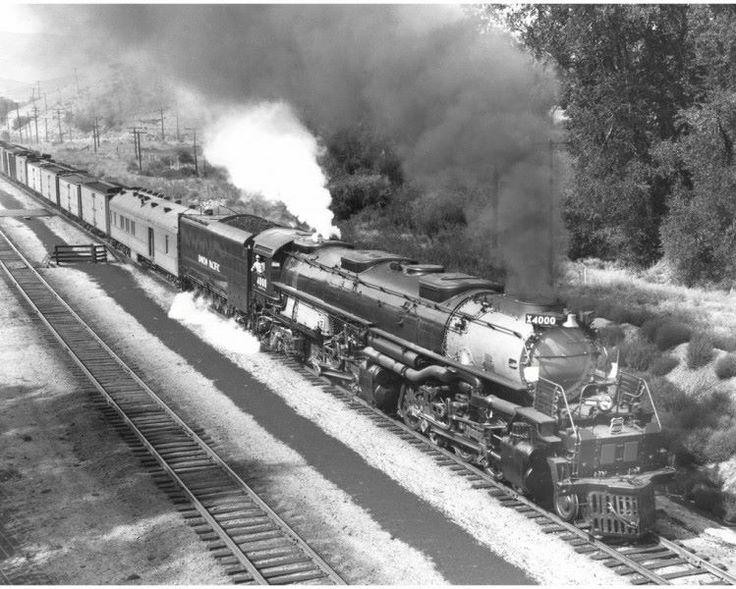
Big Boy sibling, locomotive No. 4000 in 1941. Credit Union Pacific RR.
The High-Water Mark of Steam
In many ways, Big Boy represents the pinnacle of railway engineering and technology for his era. As with ships, airplanes, electronics, munitions, and much else — right up to splitting the atom — the prewar environment and World War II created a time when necessity pushed scientists, engineers, and designers to their limits.
In this case, Big Boy marked the high-water mark of steam-locomotive technology after 130 years of development. Today, looking back at Big Boy and his ilk, these machines were ne plus ultra. No one, anywhere, has ever outdone the Big Boy series.
But as fate would have it, diesel-electric drive also improved dramatically during the war. For that main reason — and others, to be sure — Big Boy and his 24 siblings became the last of their mighty breed.
Today, only eight of these locomotive sets remain, and all were in museums until 2012, when UPac brought Big Boy out of a long respite in Pomona, California. The idea was to perform a mechanical restoration and bring the old steel knight of the rails back to life by 2019, for the 150th anniversary of completing the Transcontinental Railroad. That, and to use this iconic locomotive to promote the Union Pacific brand, which led to this year’s America 250 journey.
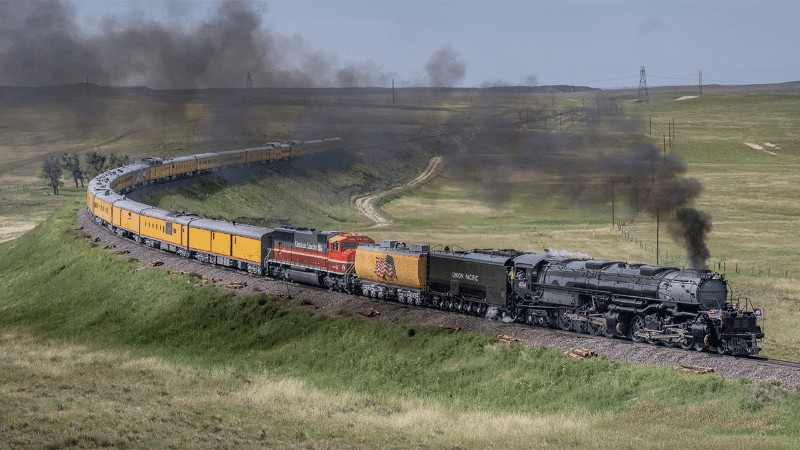 Union Pacific’s Big Boy locomotive. Credit RailwayAge.com.
Back from the Museum
Now home-based in Cheyenne, Wyoming, UPac rolls out Big Boy for special events and, on occasion, tasks the old guy with pulling freight as well.
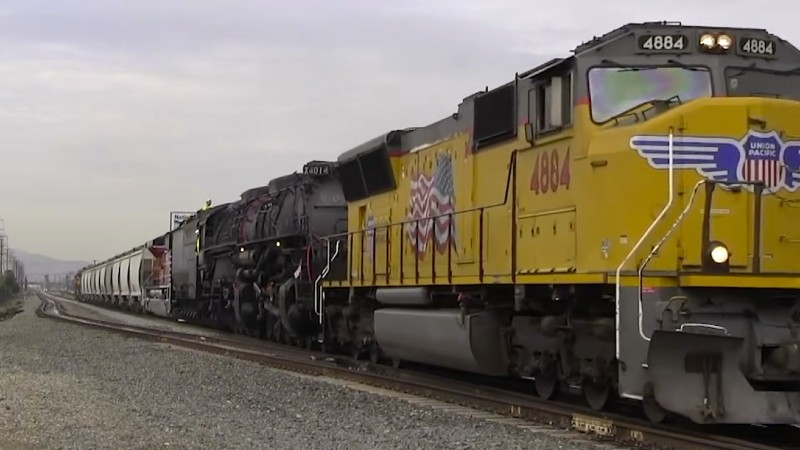 Big Boy teamed up with modern locomotive, hauling freight. Credit WanderRails.com.
The restoration was meticulous. UPac’s “Steam Team” tore Big Boy down to nuts, bolts, pipe, and plate. They recreated a digital twin of the machine, tested every inch for corrosion and material strength, remanufactured innumerable components — mostly by hand, like blacksmiths — and then conducted a faithful rebuild that strove for historical accuracy, except that Big Boy now burns oil-based fuel, not coal.
Pure Americana on the Rails
As you can — I hope — imagine, No. 4014 is eye candy for rail fans young and old. By the thousands, and tens of thousands in some places, people line the tracks to watch him roll past. UPac estimates that two million people have already seen Big Boy this year on the America 250 tour.
Why the turnout? What are people looking for? Perhaps it’s some sort of primal desire to see and smell smoke and steam, and to hear that glorious, deeply sonorous whistle. But whatever it is, Big Boy has a magnetic personality.
At Homestead last weekend, I saw old guys in wheelchairs and young moms with baby strollers; Cub Scouts and Boy Scouts; high school and college kids; doctors and nurses in scrubs; preachers in collars; people of all kinds and every race, even a guy dressed in Native American garb, waving a blessing upon the iron horse. And parked along the packed streets, I saw every sort of vehicle from across the region, from beat-up old pickup trucks to high-end Cadillacs and more.
Chalk it up to pure fascination and a desire for classic Americana: to watch that powerful train rumble by with U.S. and Pennsylvania state flags snapping up front in the breeze. That, and from numerous bystanders I heard the words, “It’s once in a lifetime,” when I asked what brought them out to watch Big Boy roll on.
A Route with a Sense of History
As 2026 has unfolded, UPac has had this beautiful train on a national tour to celebrate America 250. That, and perhaps to build goodwill for its proposed merger with Norfolk Southern Railroad to create a coast-to-coast system.
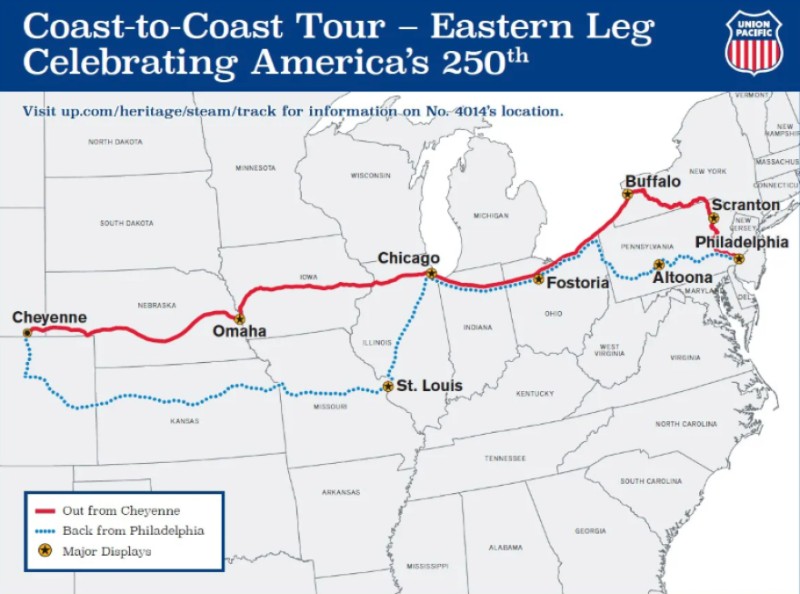 Big Boy route map. Credit Union Pacific Railroad.
I’ll leave the legal and economic merits of any merger to the Antitrust Division of the Justice Department. But I’ll say this about the UPac and Norfolk Southern routing for this train… Somebody was thinking. Someone has a sense of history. Someone at those railroads respects the nation’s past.
Because if ever there was a train trip that honors what made America wealthy and powerful – what “made America great,” to borrow a phrase – this is it.
I won’t retrace Big Boy’s whole trip, but in the beginning, per the map, he rolled across the Corn Belt Midwest, through Chicago, across Indiana and northern Ohio to Buffalo. He went through parts of America that became the Rust Belt over the past 50 years, and showed serious courtesy to the old rail lines and factory towns along the way.
To me, at least, Big Boy is like an old industrial ghost, back from the grave. With his sound and vibes, he tells Americans that the country can reboot, build up a new head of steam, and roll again.
After Buffalo, Big Boy traversed southern New York along old New York Central rights of way, past locales where companies like IBM, Kodak and Xerox got their start. He ground his wheels all the way back to his birthplace at the American Locomotive Works in Schenectady, a city and former manufacturing powerhouse not just for locomotives but much else; think of the long-lost General Electric Company of old.
And oh, along the way, what a sad tale of industrial decline one sees in that part of Upstate New York. But again, it’s as if Big Boy is blowing the whistle and saying, “Wake up! Let’s Roll Again!”
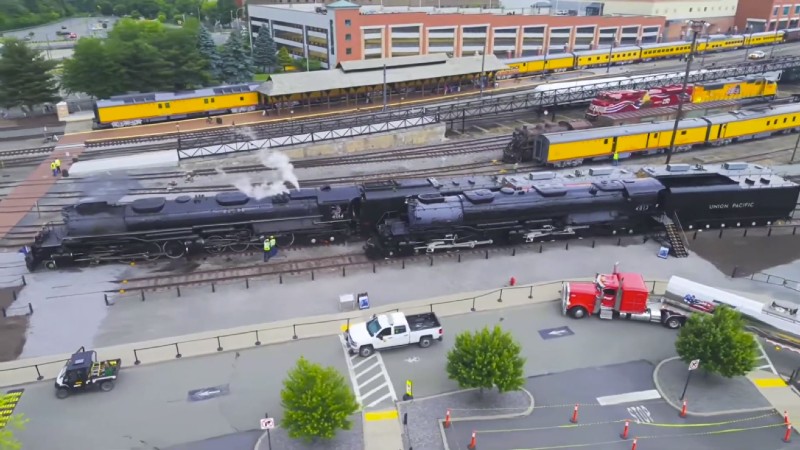 Big Boy No. 4014 alongside his brother, non-working engine No. 4012, at Steamtown National Historic Site. Credit Dept. of Interior.
Through the Old Industrial Heartland
Then Big Boy rolled south, down to Scranton and the National Park Service’s Steamtown National Historic Site, to spend time in maintenance and burn the calendar until he could huff and puff triumphantly into Philadelphia on the 4th of July.
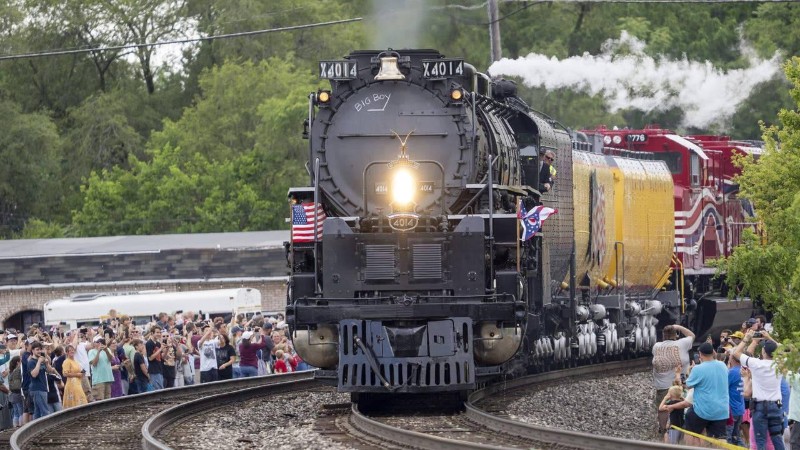 Big Boy rolls into Philadelphia for the 4th of July. Credit Philadelphia Inquirer.
After Philadelphia, it was off to Altoona, former workshop of the old Pennsylvania Railroad, nestled deep and high in the heart of the Alleghenies. And out of Altoona, Big Boy traversed the historic Horseshoe Curve, built 1851–54, then and even today an engineering marvel critical to the U.S. economy because it allows freight to move east-west through otherwise near-impassable terrain.
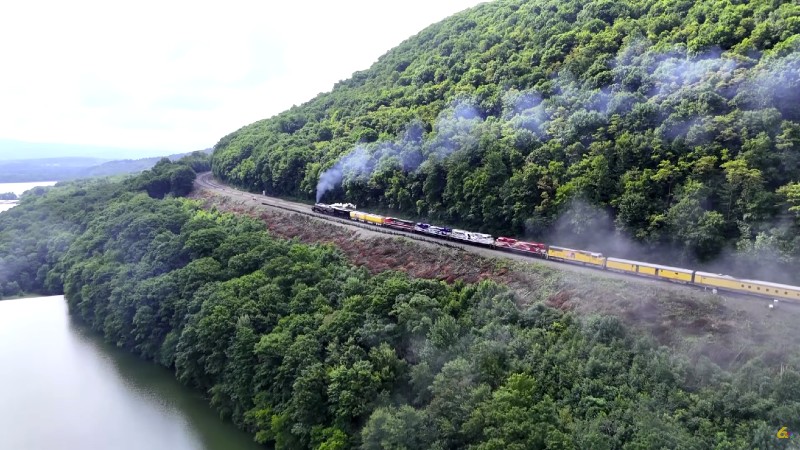 Big Boy ascends Horseshoe Curve, near Altoona, Pennsylvania. Credit WJACTV.
After the great Horseshoe, Big Boy rolled down and westward through Latrobe, not far from where a young George Washington skirmished with the French and, basically, began the Seven Years’ War.
Then Big Boy ground his way through Westmoreland County and the vast coal country that fired steel-mill furnaces for 150 years; through Greensburg and Jeannette, where natural gas and high-silica quartz sand gave America a glass industry; down toward Wilmerding (yes, a real name!), where George Westinghouse built air brakes and electrical equipment; then East McKeesport, former home of National Tube Company, which manufactured pipe, as well as artillery cannon and bomb casings.
Then Big Boy pulled northward along the Monongahela River, past Braddock, site of another George Washington skirmish, where in 1755 British General Braddock was killed while his young aide Washington gained an aura of eternal survival amid hails of bullets. And today, Braddock’s Field is the location of U.S. Steel’s Edgar Thomson Works.
After steaming past what locals call “E.T.,” Big Boy’s route followed the tracks into Homestead, site of Andrew Carnegie’s massive steel complex, where in 1892 strikers fought Pinkerton guards and laid a foundation for the country’s labor movement, which in its own way eventually brought prosperity to America’s working class for the next century.
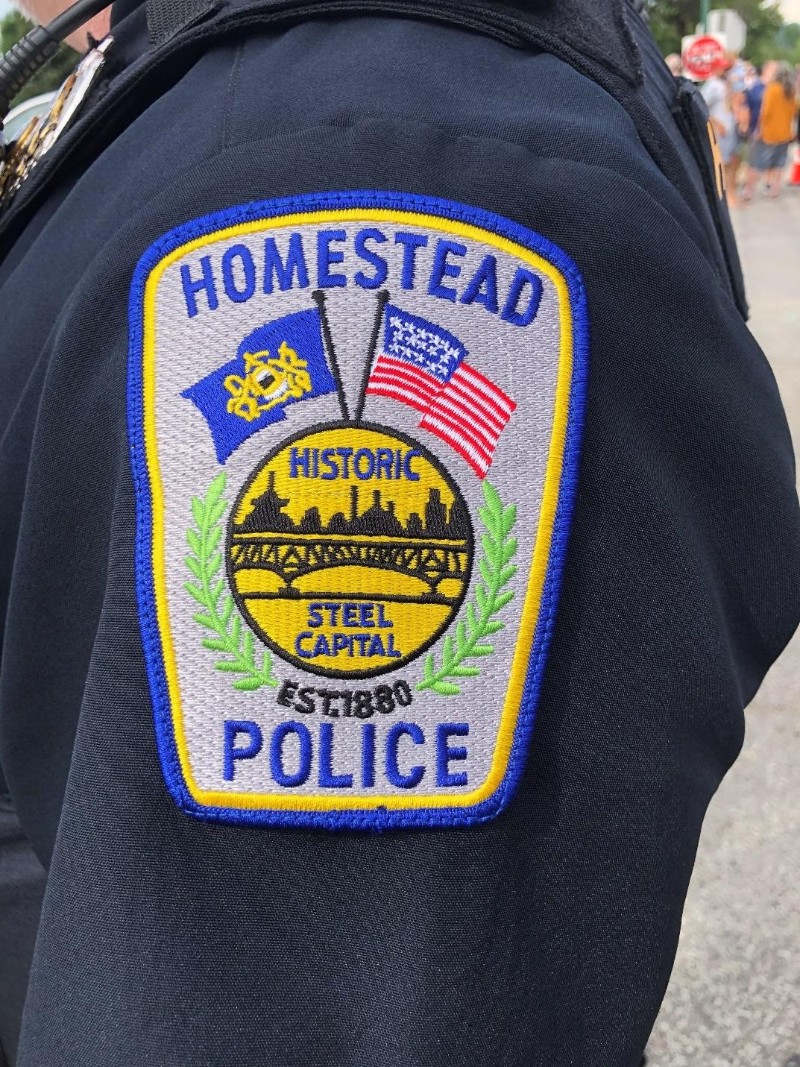 Homestead patch; police presence for rail safety and crowd control. BWK photo.
And onward rolled the train through Homestead, past the site of U.S. Steel’s former 48-inch armor-plate mill that, for many decades, supplied metal for Navy battleships and Army tanks; and through West Homestead, where my long-deceased father worked in the 1930s at Mesta Machine Company, cutting gears that went into battleship gun turrets.
Then north along the Monongahela, through Pittsburgh’s South Side Flats where, long ago, a company called Jones & Laughlin Steel had an immense steelmaking complex, and now we see apartment buildings and shopping malls.
Still north, past Station Square, formerly the headquarters and tracks of the old Pittsburgh & Lake Erie Railroad, which hauled Minnesota and Michigan iron ore from Erie down to the coal-fired mills of Western Pennsylvania.
Then Big Boy crossed the Ohio River, past Brunot’s Island, the first stop of Lewis and Clark as they headed downstream to explore the Louisiana Purchase of 1803.
Yes indeed… Plenty of American history adjacent to those train tracks.
The Whistling Tribute
And all along the route, Big Boy blew his whistle:
 Big Boy and Pittsburgh downtown. Credit Mayor Corey O’Connor.
I asked an acquaintance about that whistle. He’s a sound engineer, and he said that the frequency is about 1,100 Hertz, give or take.
But what a sound. What a feeling. Yes, it’s “only” a whistle, but there’s a certain elegance to it; a certain ineffable class.
And truly, that whistle is a tribute from Big Boy: a rich, resonant sound from a gorgeous old piece of America’s industrial past. That whistle recalls American history and power; not just for one particular region, but indeed the entire nation.
It may as well be Reinhold Glière’s Hymn to a Great City.
Thank you, Union Pacific. Thank you, Norfolk Southern. Thank you, Big Boy.
And… Roll on, Big Boy… Roll on.
There’s always more to say, but that’s it for now. Thank you all for subscribing and reading.
The Club You Ain’t In
Posted October 27, 2026
By Sean Ring

Brazilian Backfire
Posted October 26, 2026
By Sean Ring

A Crude Awakening
Posted October 23, 2026
By Sean Ring

All That Glitters Is Diesel
Posted October 22, 2026
By Sean Ring

Treason’s Greetings!
Posted October 21, 2026
By Sean Ring